
Pulp Fiction, 1916 · page 63 of 216
The Argosy, Vol. 81, No. 4 — page 63: what you’re looking at
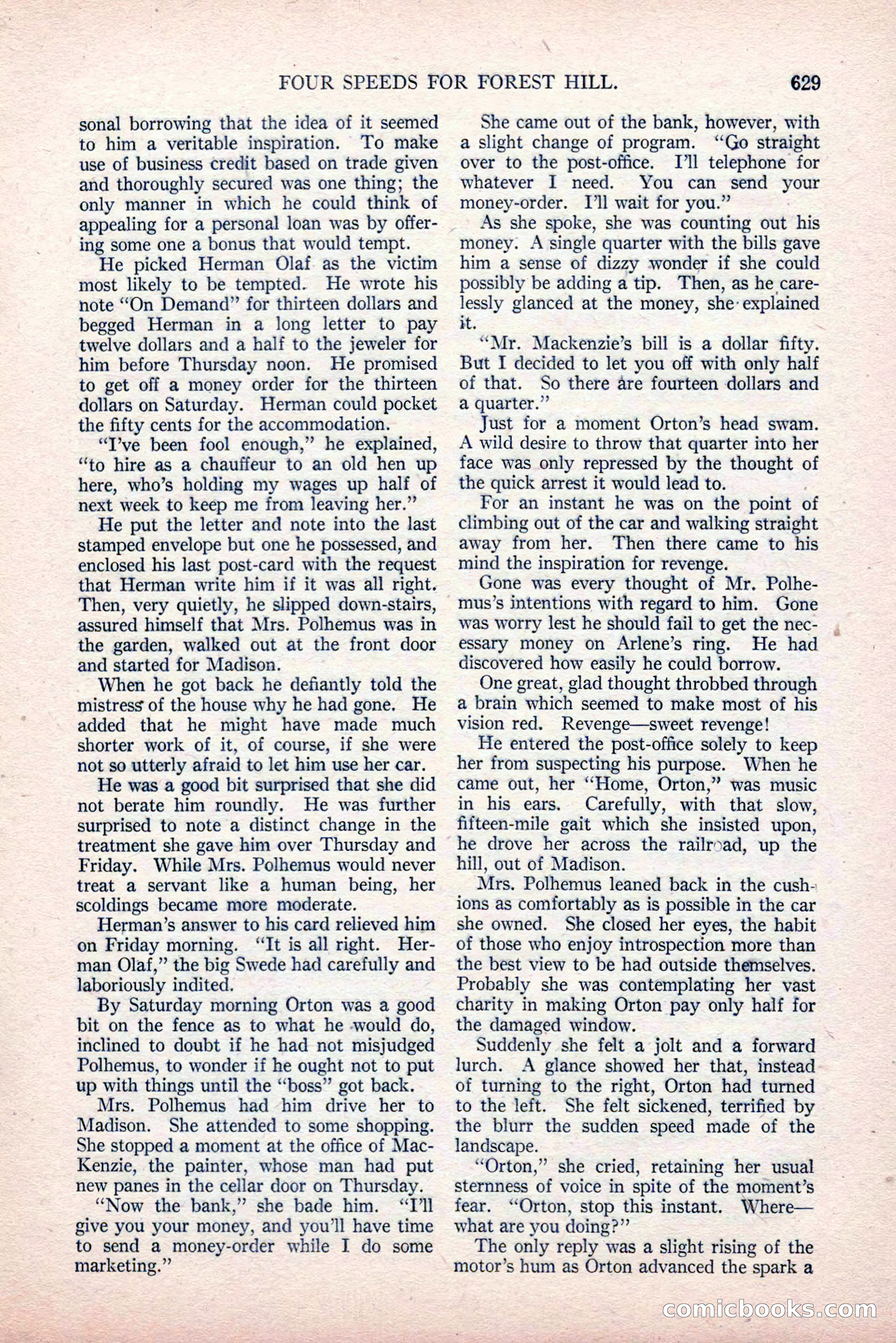
A restored page from Pulp Fiction, 1916. Page through the whole issue in the reader above.
📄 Transcribed text from this page (OCR, searchable)
Machine-transcribed from the original scan — historical spelling and the odd misread are preserved.
FOUR SPEEDS FOR FOREST HILL. sonal borrowing that the idea of it seemed to him a veritable inspiration. To make use of business credit based on trade given and thoroughly secured was one thing; the only manner in which he could think of appealing for a personal loan was by offer- ing some one a bonus that would tempt. He picked Herman Olaf as the victim most likely to be tempted. He wrote his note ‘On Demand” for thirteen dollars and begged Herman in a long letter to pay twelve dollars and a half to the jeweler for him before Thursday noon. He promised to get off a money order for the thirteen dollars on Saturday. Herman could pocket the fifty cents for the accommodation. “T’ve been fool enough,” he explained, “to hire as a chauffeur to an old hen up here, who’s holding my wages up half of next week to keep me from leaving her.” He put the letter and note into the last stamped envelope but one he possessed, and enclosed his last post-card with the request that Herman write him if it was all right. Then, very quietly, he slipped down-stairs, assured himself that Mrs. Polhemus was in the garden, walked out at the front door and started for Madison. When he got back he defiantly told the mistress of the house why he had gone. He added that he might have made much shorter work of it, of course, if she were not so utterly afraid to let him use her car. He was a good bit surprised that she did not berate him roundly. He was further surprised to note a distinct change in the treatment she gave him over Thursday and Friday. While Mrs. Polhemus would never treat a servant like a human being, her scoldings became more moderate. Herman’s answer to his card relieved him on Friday morning. “It is all right. Her- man Olaf,” the big Swede had carefully and laboriously indited. By Saturday morning Orton was a good bit on the fence as to what he -would do, inclined to doubt if he had not misjudged Polhemus, to wonder if he ought not to put up with things until the “boss” got back. Mrs. Polhemus had him drive her to Madison. She attended to some shopping. She stopped a moment at the office of Mac- Kenzie, the painter, whose man had put new panes in the cellar door on Thursday. “Now the bank,” she bade him. “I'll give you your money, and you'll have time to send a money-order while I do some marketing.” 629 She came out of the bank, however, with a slight change of program. ‘“‘Go straight over to the post-office. Ill telephone for whatever I need. You can send your money-order. I'll wait for you.” As she spoke, she was counting out his money. A single quarter with the bills gave him a sense of dizzy wonder if she could possibly be adding a tip. Then, as he care- lessly glanced at the money, she: explained it. “Mr. Mackenzie’s bill is a dollar fifty. But I decided to let you off with only half of that. So there are fourteen dollars and a quarter.” Just for a moment Orton’s head swam. A wild desire to throw that quarter into her face was only repressed by the thought of the quick arrest it would lead to. For an instant he was on the point of climbing out of the car and walking straight away from her. Then there came to his mind the inspiration for revenge. Gone was every thought of Mr. Polhe- mus’s intentions with regard to him. Gone was worry lest he should fail to get the nec- essary money on Arlene’s ring. He had discovered how easily he could borrow. One great, glad thought throbbed through a brain which seemed to make most of his vision red. Revenge—sweet revenge! He entered the post-office solely to keep her from suspecting his purpose. When he came out, her ““Home, Orton,” was music in his ears. Carefully, with that slow, fifteen-mile gait which she insisted upon, he drove her across the railroad, up the hill, out of Madison. Mrs. Polhemus leaned back in the cush- ions as comfortably as is possible in the car she owned. She closed her eyes, the habit of those who enjoy introspection more than the best view to be had outside themselves. Probably she was contemplating her vast charity in making Orton pay only half for the damaged window. Suddenly she felt a jolt and a forward lurch. A glance showed her that, instead of turning to the right, Orton had turned to the left. She felt sickened, terrified by the blurr the sudden speed made of the landscape. “Orton,” she cried, retaining her usual sternness of voice in spite of the moment’s fear. “Orton, stop this instant. Where— what are you doing?” The only reply was a slight rising of the motor’s hum as Orton advanced the spark a COMMEOOOKS (C@