
Pulp Fiction, 1916 · page 62 of 216
The Argosy, Vol. 81, No. 4 — page 62: what you’re looking at
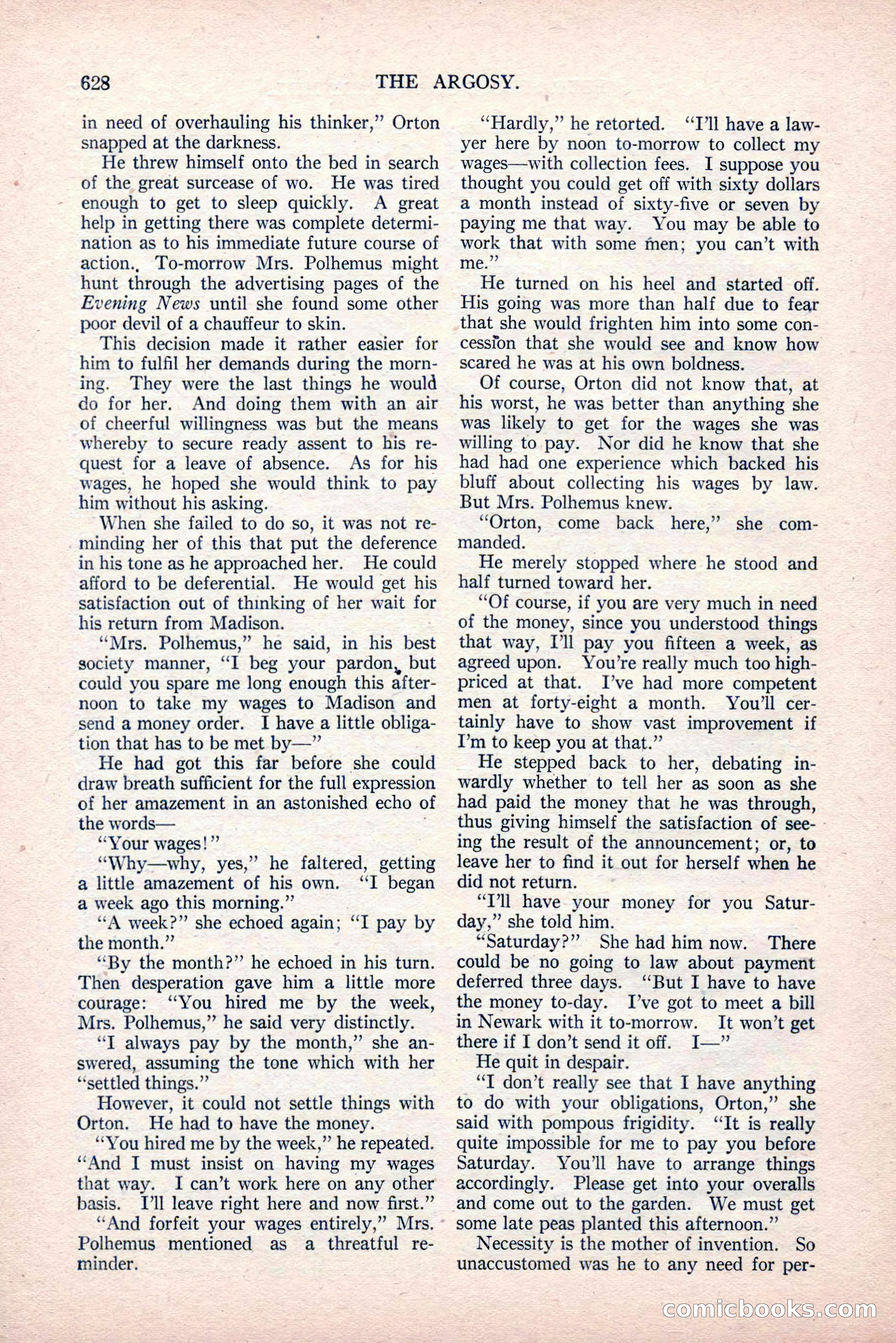
A restored page from Pulp Fiction, 1916. Page through the whole issue in the reader above.
📄 Transcribed text from this page (OCR, searchable)
Machine-transcribed from the original scan — historical spelling and the odd misread are preserved.
628 in need of overhauling his thinker,” Orton snapped at the darkness. He threw himself onto the bed in search of the great surcease of wo. He was tired enough to get to sleep quickly. A great help in getting there was complete determi- nation as to his immediate future course of action., To-morrow Mrs. Polhemus might hunt through the advertising pages of the Evening News until she found some other poor devil of a chauffeur to skin. This decision made it rather easier for him to fulfil her demands during the morn- ing. They were the last things he would do for her. And doing them with an air of cheerful willingness was but the means whereby to secure ready assent to his re- quest for a leave of absence. As for his wages, he hoped she would think to pay him without his asking. When she failed to do so, it was not re- minding her of this that put the deference in his tone as he approached her. He could afford to be deferential. He would get his satisfaction out of thinking of her wait for his return from Madison. “Mrs. Polhemus,” he said, in his best society manner, “I beg your pardon, but could you spare me long enough this after- noon to take my wages to Madison and send a money order. I have a little obliga- tion that has to be met by—”’ He had got this far before she could draw breath sufficient for the full expression of her amazement in an astonished echo of the words— | “Your wages!” “Why—why, yes,” he faltered, getting a little amazement of his own. “I began a week ago this morning.”’ ‘““A week?” she echoed again; “I pay by the month.” “By the month?” he echoed in his turn. Then desperation gave him a little more courage: ‘‘You hired me by the week, Mrs. Polhemus,” he said very distinctly. “T always pay by the month,” she an- swered, assuming the tone which with her “settled things.” However, it could not settle things with Orton. He had to have the money. “You hired me by the week,” he repeated. ‘“‘And I must insist on having my wages that way. I can’t work here on any other basis. Ill leave right here and now first.” “And forfeit your wages entirely,” Mrs. Polhemus mentioned as a threatful re- minder. THE ARGOSY. “Hardly,” he retorted. ‘‘TI’ll have a law- yer here by noon to-morrow to collect my wages—with collection fees. I suppose you thought you could get off with sixty dollars a month instead of sixty-five or seven by paying me that way. You may be able to work that with some men; you can’t with me.’ He turned on his heel and started off. His going was more than half due to fear that she would frighten him into some con- cession that she would see and know how scared he was at his own boldness. Of course, Orton did not know that, at his worst, he was better than anything she was likely to get for the wages she was willing to pay. Nor did he know that she had had one experience which backed his bluff about collecting his wages by law. But Mrs. Polhemus knew. “Orton, come back here,” she com- manded. He merely stopped where he stood and half turned toward her. “Of course, if you are very much in need of the money, since you understood things that way, I’ll pay you fifteen a week, as agreed upon. You’re really much too high- priced at that. I’ve had more competent men at forty-eight a month. You'll cer- tainly have to show vast improvement if I’m to keep you at that.” He stepped back to her, debating in- wardly whether to tell her as soon as she had paid the money that he was through, thus giving himself the satisfaction of see- ing the result of the announcement; or, to leave her to find it out for herself when he did not return. “T’ll have your money for you Satur- day,” she told him. “Saturday?” She had him now. There could be no going to law about payment deferred three days. ‘But I have to have the money to-day. I’ve got to meet a bill in Newark with it to-morrow. It won’t get there if I don’t send it off. I—” He quit in despair. “T don’t really see that I have anything to do with your obligations, Orton,” she said with pompous frigidity. “It is really quite impossible for me to pay you before Saturday. You'll have to arrange things accordingly. Please get into your overalls and come out to the garden. We must get some late peas planted this afternoon.” Necessity is the mother of invention. So unaccustomed was he to any need for per- CONNIE DOOKS (E@)