
Pulp Fiction, 1916 · page 64 of 216
The Argosy, Vol. 81, No. 4 — page 64: what you’re looking at
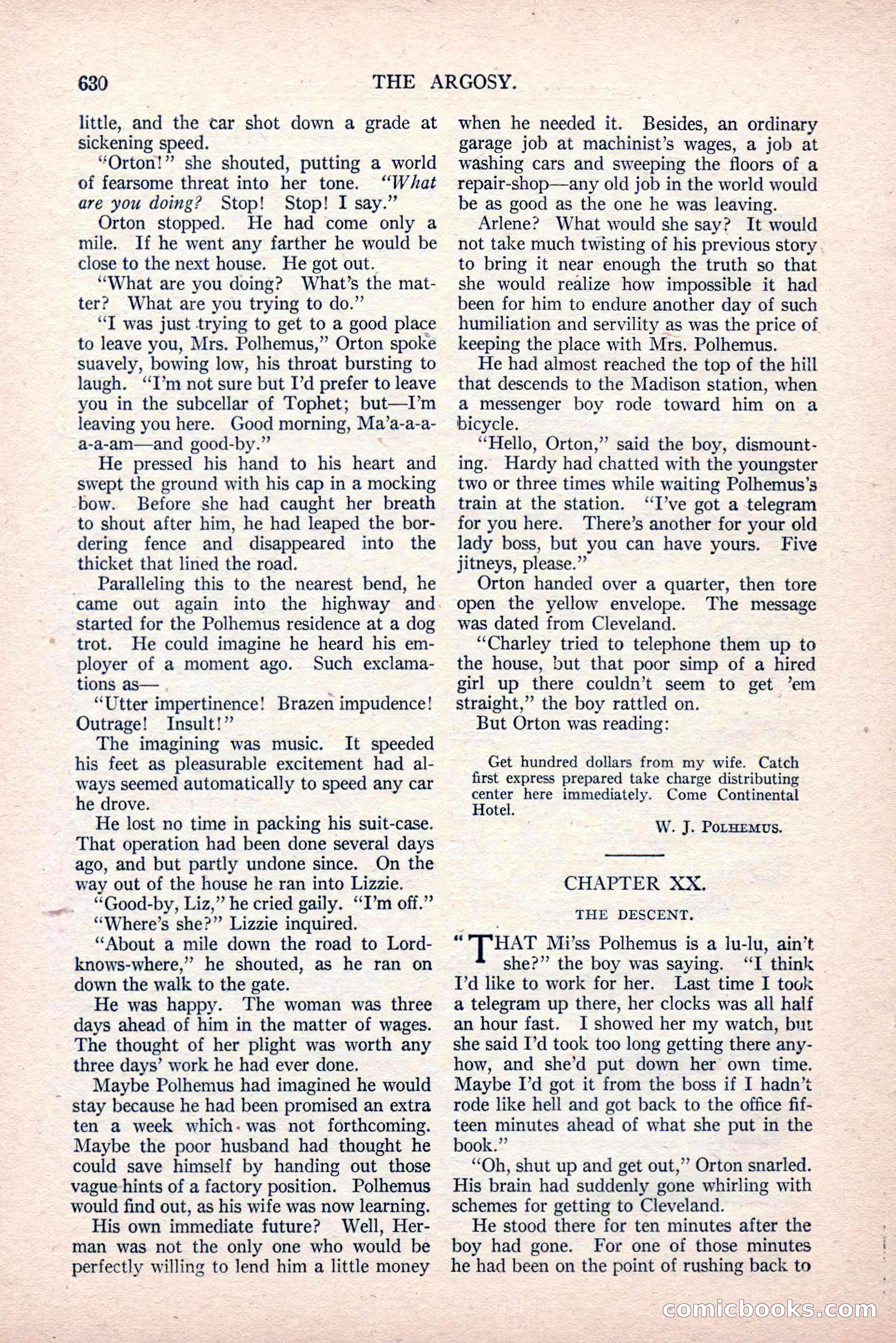
A restored page from Pulp Fiction, 1916. Page through the whole issue in the reader above.
📄 Transcribed text from this page (OCR, searchable)
Machine-transcribed from the original scan — historical spelling and the odd misread are preserved.
630 THE little, and the car shot down a grade at sickening speed. “Orton!” she shouted, putting a world of fearsome threat into her tone. ‘What are you doing? Stop! Stop! I say.” Orton stopped. He had come only a mile. If he went any farther he would be close to the next house. He got out. “What are you doing? What’s the mat- ter? What are you trying to do.” ‘“T was just trying to get to a good place to leave you, Mrs. Polhemus,” Orton spoke suavely, bowing low, his throat bursting to laugh. “I’m not sure but I’d prefer to leave you in the subcellar of Tophet; but—I’m leaving you here. Good morning, Ma’a-a-a- a-a-am—and good-by.” He pressed his hand to his heart and swept the ground with his cap in a mocking bow. Before she had caught her breath to shout after him, he had leaped the bor- dering fence and disappeared into the thicket that lined the road. Paralleling this to the nearest bend, he came out again into the highway and started for the Polhemus residence at a dog trot. He could imagine he heard his em- ployer of a moment ago. Such exclama- tions as— é “Utter impertinence! Brazen impudence! Outrage! Insult!” The imagining was music. It speeded his feet as pleasurable excitement had al- ways seemed automatically to speed any car he drove. He lost no time in packing his suit-case. That operation had been done several days ago, and but partly undone since. On the way out of the house he ran into Lizzie. “Good-by, Liz,” he cried gaily. “I’m off.” “Where’s she?” Lizzie inquired. “About a mile down the road to Lord- knows-where,” he shouted, as he ran on down the walk to the gate. He was happy. The woman was three days ahead of him in the matter of wages. The thought of her plight was worth any three days’ work he had ever done. _ Maybe Polhemus had imagined he would stay because he had been promised an extra ten a week which- was not forthcoming. Maybe the poor husband had thought he could save himself by handing out those vague hints of a factory position. Polhemus would find out, as his wife was now learning. His own immediate future? Well, Her- man was not the only one who would be perfectly willing to lend him a little money ARGOSY. when he needed it. Besides, an ordinary garage job at machinist’s wages, a job at washing cars and sweeping the floors of a repair-shop—any old job in the world would be as good as the one he was leaving. Arlene? What would she say? It would not take much twisting of his previous story to bring it near enough the truth so that she would realize how impossible it had been for him to endure another day of such humiliation and servility as was the price of keeping the place with Mrs. Polhemus. He had almost reached the top of the hill that descends to the Madison station, when a messenger boy rode toward him on a bicycle. “Hello, Orton,” said the boy, dismount- ing. Hardy had chatted with the youngster two or three times while waiting Polhemus’s train at the station. “I’ve got a telegram for you here. ‘There’s another for your old lady boss, but you can have yours. Five jitneys, please.” Orton handed over a quarter, then tore open the yellow envelope. The message was dated from Cleveland. “Charley tried to telephone them up to the house, but that poor simp of a hired girl up there couldn’t seem to get ’em straight,” the boy rattled on. But Orton was reading: Get hundred dollars from my wife. Catch first express prepared take charge distributing center here immediately. Come Continental Hotel. W. J. PoLHEMUs. CHAPTER XX. THE DESCENT. “"T'HAT Mi’ss Polhemus is a lu-lu, ain’t she?” the boy was saying. “I think I’d like to work for her. Last time I took a telegram up there, her clocks was all half an hour fast. I showed her my watch, but she said I’d took too long getting there any- how, and she’d put down her own time. Maybe I’d got it from the boss if I hadn’t rode like hell and got back to the office fif- teen minutes ahead of what she put in the book.” “Oh, shut up and get out,” Orton snarled. His brain had suddenly gone whirling with schemes for getting to Cleveland. He stood there for ten minutes after the boy had gone. For one of those minutes he had been on the point of rushing back to EOPMICLOOKS (E@)