
Pulp Fiction, 1916 · page 61 of 216
The Argosy, Vol. 81, No. 4 — page 61: what you’re looking at
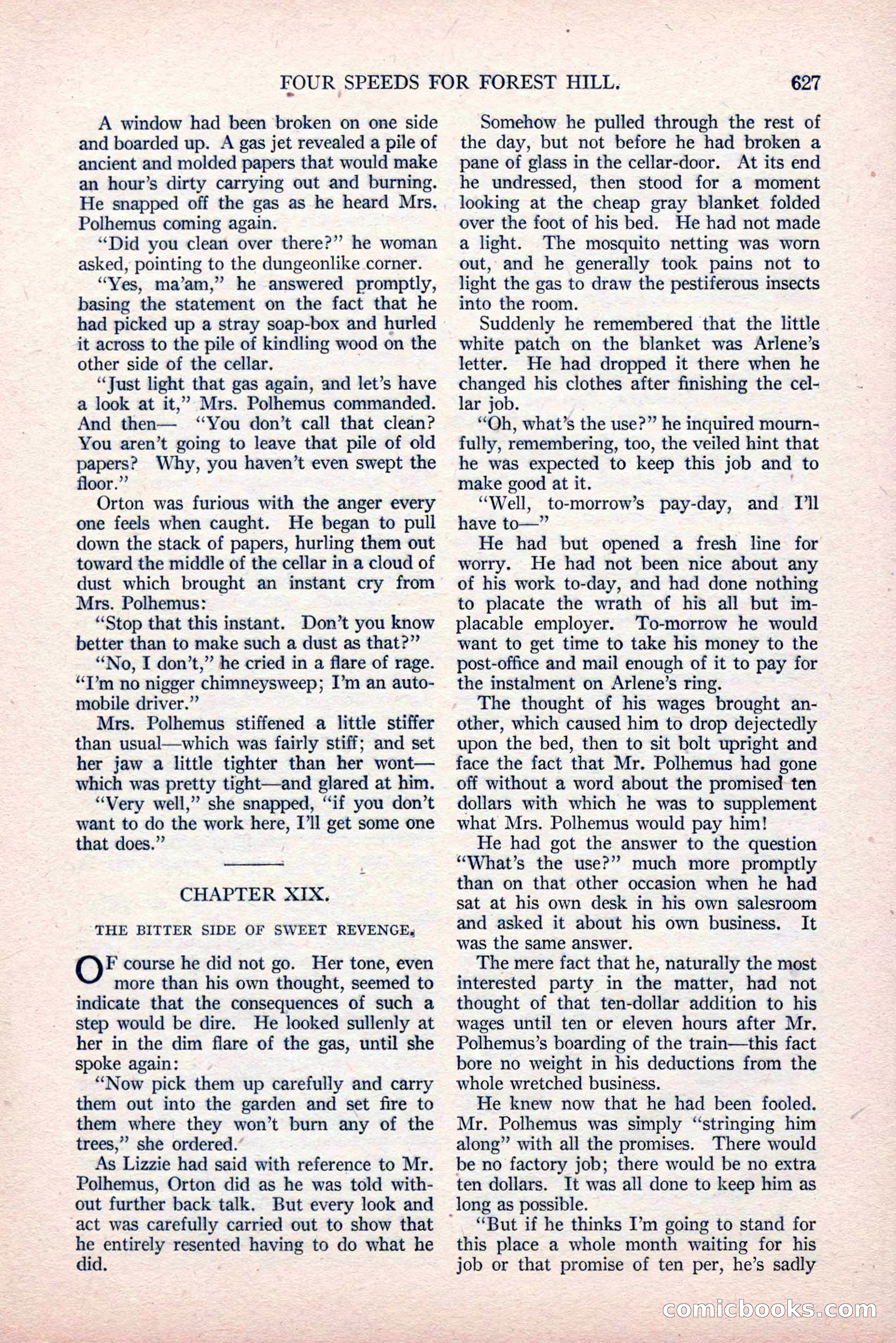
A restored page from Pulp Fiction, 1916. Page through the whole issue in the reader above.
📄 Transcribed text from this page (OCR, searchable)
Machine-transcribed from the original scan — historical spelling and the odd misread are preserved.
FOUR SPEEDS FOR FOREST HILL. A window had been broken on one side and boarded up. A gas jet revealed a pile of ancient and molded papers that would make an hour’s dirty carrying out and burning. He snapped off the gas as he heard Mrs. Polhemus coming again. “Did you clean over there?” he woman asked, pointing to the dungeonlike corner. “Yes, ma’am,” he answered promptly, basing the statement on the fact that he had picked up a stray soap-box and hurled it across to the pile of kindling wood on the other side of the cellar. “Just light that gas again, and let’s have a look at it,” Mrs. Polhemus commanded. And then— ‘You don’t call that clean? You aren’t going to leave that pile of old papers? Why, you haven’t even swept the floor.” Orton was furious with the anger every one feels when caught. He began to pull down the stack of papers, hurling them out toward the middle of the cellar in a cloud of dust which brought an instant cry from Mrs. Polhemus: “Stop that this instant. Don’t you know better than to make such a dust as that?” “No, I don’t,” he cried in a flare of rage. “T’m no nigger chimneysweep; I’m an auto- mobile driver.” Mrs. Polhemus stiffened a little stiffer than usual—which was fairly stiff; and set her jaw a little tighter than her wont— which was pretty tight—and glared at him. “Very well,” she snapped, “if you don’t want to do the work here, I’ll get some one that does.” CHAPTER XIX. THE BITTER SIDE OF SWEET REVENGE, OF course he did not go. Her tone, even more than his own thought, seemed to indicate that the consequences of such a step would be dire. He looked sullenly at her in the dim flare of the gas, until she spoke again: “Now pick them up carefully and carry them out into the garden and set fire to them where they won’t burn any of the trees,”’ she ordered. As Lizzie had said with reference to Mr. Polhemus, Orton did as he was told with- out further back talk. But every look and act was carefully carried out to show that he entirely resented having to do what he did. | 627 Somehow he pulled through the rest of the day, but not before he had broken a pane of glass in the cellar-door. At its end he undressed, then stood for a moment looking at the cheap gray blanket folded over the foot of his bed. He had not made a light. The mosquito netting was worn out, and he generally took pains not to light the gas to draw the pestiferous insects into the room. Suddenly he remembered that the little white patch on the blanket was Arlene’s letter. He had dropped it there when he changed his clothes after finishing the cel- lar job. “Qh, what’s the use?” he inquired mourn- fully, remembering, too, the veiled hint that he was expected to keep this job and to make good at it. | “Well, to-morrow’s pay-day, and [ll have to—” He had but opened a fresh line for worry. He had not been nice about any of his work to-day, and had done nothing to placate the wrath of his all but im- placable employer. ‘To-morrow he would want to get time to take his money to the post-office and mail enough of it to pay for the instalment on Arlene’s ring. The thought of his wages brought an- other, which caused him to drop dejectedly upon the bed, then to sit bolt upright and face the fact that Mr. Polhemus had gone off without a word about the promised ten dollars with which he was to supplement what Mrs. Polhemus would pay him! He had got the answer to the question “What’s the use?” much more promptly than on that other occasion when he had sat at his own desk in his own salesroom and asked it about his own business. It was the same answer. The mere fact that he, naturally the most interested party in the matter, had not thought of that ten-dollar addition to his wages until ten or eleven hours after Mr. Polhemus’s boarding of the train—this fact bore no weight in his deductions from the whole wretched business. He knew now that he had been fooled. Mr. Polhemus was simply “stringing him along” with all the promises. There would be no factory job; there would be no extra ten dollars. It was all done to keep him as long as possible. “But if he thinks I’m going to stand for this place a whole month waiting for his job or that promise of ten per, he’s sadly .DOOKS COLMUC (©)