
Pulp Fiction, 1916 · page 60 of 216
The Argosy, Vol. 81, No. 4 — page 60: what you’re looking at
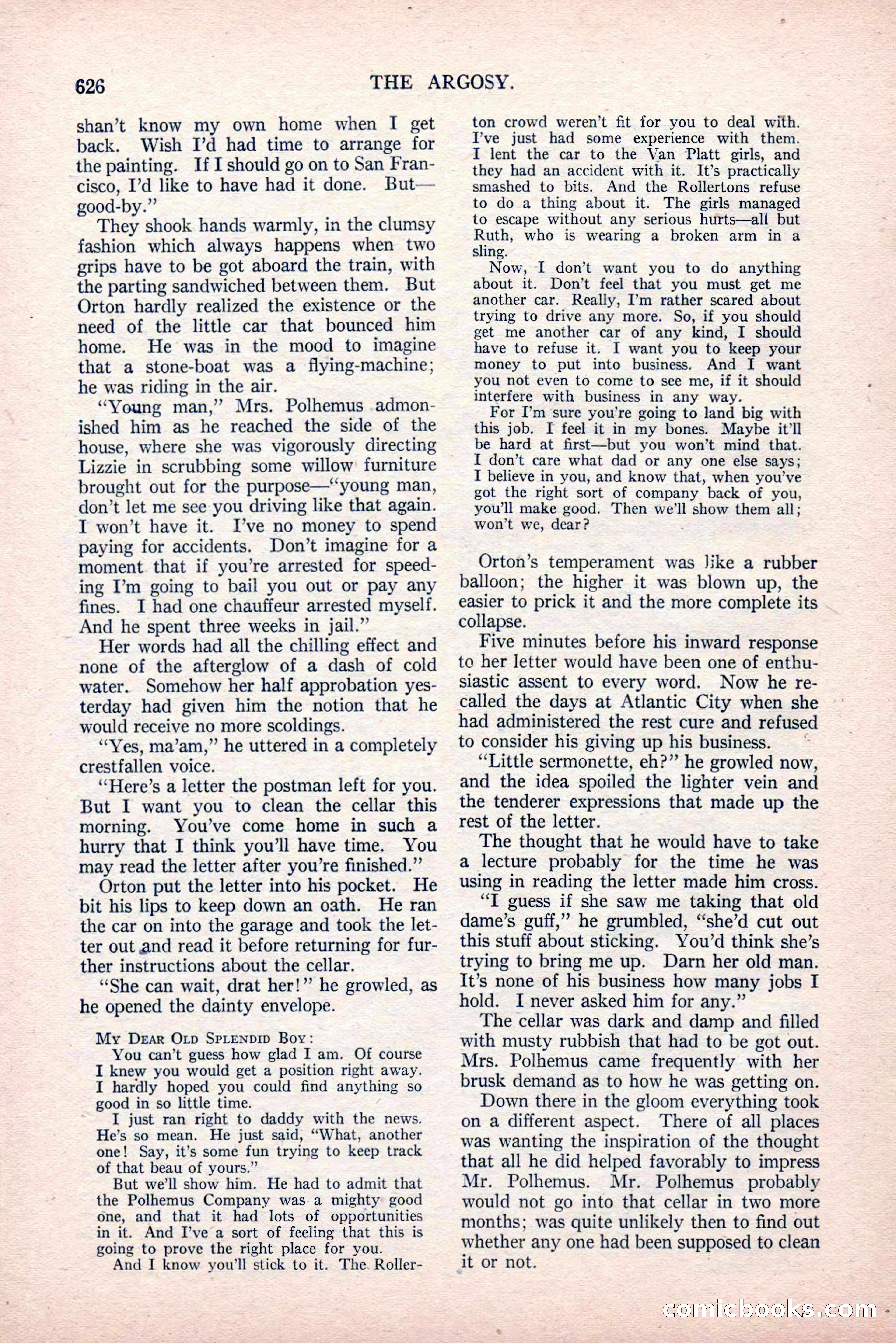
A restored page from Pulp Fiction, 1916. Page through the whole issue in the reader above.
📄 Transcribed text from this page (OCR, searchable)
Machine-transcribed from the original scan — historical spelling and the odd misread are preserved.
626 shan’t know my own home when I get back. Wish I’d had time to arrange for the painting. If I should go on to San Fran- cisco, I’d like to have had it done. But— good-by.”’ They shook hands warmly, in the clumsy fashion which always happens when two grips have to be got aboard the train, with the parting sandwiched between them. But Orton hardly realized the existence or the need of the little car that bounced him home. He was in the mood to imagine that a stone-boat was a flying-machine; he was riding in the air. “Young man,’ Mrs. Polhemus admon- ished him as he reached the side of the house, where she was vigorously directing Lizzie in scrubbing some willow furniture brought out for the purpose—“young man, don’t let me see you driving like that again. I won’t have it. I’ve no money to spend paying for accidents. Don’t imagine for a moment that if you’re arrested for speed- ing I’m going to bail you out or pay any fines. I had one chauffeur arrested myself. And he spent three weeks in jail.” Her words had all the chilling effect and none of the afterglow of a dash of cold water. Somehow her half approbation yes- terday had given him the notion that he would receive no more scoldings. “Ves, ma’am,” he uttered in a completely crestfallen voice. ‘“‘Here’s a letter the postman left for you. But I want you to clean the cellar this morning. You’ve come home in such a hurry that I think you'll have time. You may read the letter after you’re finished.” Orton put the letter into his pocket. He bit his lips to keep down an oath. He ran the car on into the garage and took the let- ter out and read it before returning for fur- ther instructions about the cellar. “She can wait, drat her!” he growled, as he opened the dainty envelope. My Dear Otp SpLenpip Boy: You can’t guess how glad I am. Of course I knew you would get a position right away. I hardly hoped you could find anything so good in so little time. I just ran right to daddy with the news. He’s so mean. He just said, “What, another one! Say, it’s some fun trying to keep track of that beau of yours.” But we'll show him. He had to admit that the Polhemus Company was.a mighty good one, and that it had lots of opportunities in it. And I’ve a sort of feeling that this is going to prove the right place for you. And I know you'll stick to it. The. Roller- THE ARGOSY. ton crowd weren’t fit for you to deal with. I’ve just had some experience with them. I lent the car to the Van Platt girls, and they had an accident with it. It’s practically smashed to bits. And the Rollertons refuse to do a thing about it. The girls managed to escape without any serious hurts—all but Ruth, who is wearing a broken arm in a sling. Now, I don’t want you to do anything about it. Don’t feel that you must get me another car. Really, I’m rather scared about trying to drive any more. So, if you should get me another car of any kind, I should have to refuse it. I want you to keep your money to put into business. And I want you not even to come to see me, if it should interfere with business in any way. For I’m sure you’re going to land big with this job. I feel it in my bones. Maybe it’ll be hard at first—but you won’t mind that. I don’t care what dad or any one else says; I believe in you, and know that, when you’ve got the right sort of company back of you, you'll make good. Then we’ll show them all; won’t we, dear? Orton’s temperament was like a rubber balloon; the higher it was blown up, the easier to prick it and the more complete its collapse. Five minutes before his inward response to her letter would have been one of enthu- siastic assent to every word. Now he re- called the days at Atlantic City when she had administered the rest cure and refused to consider his giving up his business. “Little sermonette, eh?” he growled now, and the idea spoiled the lighter vein and the tenderer expressions that made up the rest of the letter. The thought that he would have to take a lecture probably for the time he was using in reading the letter made him cross. “IT guess if she saw me taking that old dame’s guff,” he grumbled, “she’d cut out this stuff about sticking. You’d think she’s trying to bring me up. Darn her old man. It’s none of his business how many jobs I hold. I never asked him for any.” The cellar was dark and damp and filled with musty rubbish that had to be got out. Mrs. Polhemus came frequently with her brusk demand as to how he was getting on. Down there in the gloom everything took on a different aspect. There of all places was wanting the inspiration of the thought that all he did helped favorably to impress Mr. Polhemus. Mr. Polhemus probably would not go into that cellar in two more months; was quite unlikely then to find out whether any one had been supposed to clean it or not. : com .TOOKS (E@)