
Pulp Fiction, 1916 · page 56 of 216
The Argosy, Vol. 81, No. 4 — page 56: what you’re looking at
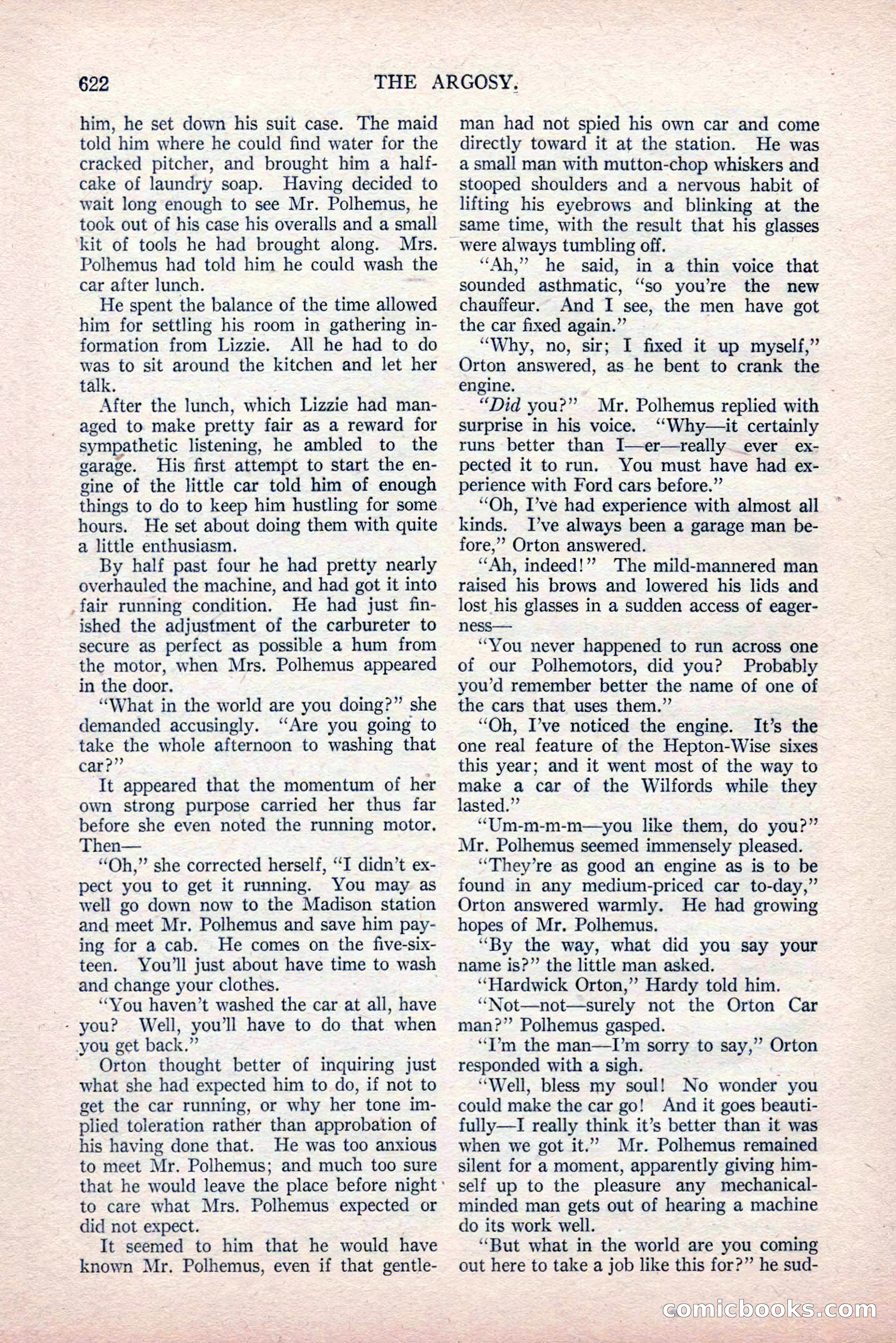
A restored page from Pulp Fiction, 1916. Page through the whole issue in the reader above.
📄 Transcribed text from this page (OCR, searchable)
Machine-transcribed from the original scan — historical spelling and the odd misread are preserved.
622 him, he set down his suit case. The maid told him where he could find water for the cracked pitcher, and brought him a half- cake of laundry soap. Having decided to wait long enough to see Mr. Polhemus, he took out of his case his overalls and a small kit of tools he had brought along. Mrs. Polhemus had told him he could wash the car after lunch. He spent the balance of the time allowed him for settling his room in gathering in- formation from Lizzie. All he had to do was to sit around the kitchen and let her talk. After the lunch, which Lizzie had man- aged to make pretty fair as a reward for sympathetic listening, he ambled to the garage. His first attempt to start the en- gine of the little car told him of enough things to do to keep him hustling for some hours. He set about doing them with quite a little enthusiasm. By half past four he had pretty nearly overhauled the machine, and had got it into fair running condition. He had just fin- ished the adjustment of the carbureter to secure as perfect as possible a hum from the motor, when Mrs. Polhemus appeared in the door. “What in the world are you doing?” she demanded accusingly. ‘Are you going to take the whole afternoon to washing that car?” It appeared that the momentum of her own strong purpose carried her thus far before she even noted the running motor, Then— “Oh,” she corrected herself, “I didn’t ex- pect you to get it running. You may as well go down now to the Madison station and meet Mr. Polhemus and save him pay- ing for a cab. He comes on the five-six- teen. You'll just about have time to wash and change your clothes. ‘Vou haven’t washed the car at all, have - you? Well, you'll have to do that when you get back.” Orton thought better of inquiring just what she had expected him to do, if not to get the car running, or why her tone im- plied toleration rather than approbation of his having done that. He was too anxious to meet Mr. Polhemus; and much too sure that he would leave the place before night ' to care what Mrs. Polhemus expected or did not expect. It seemed to him that he would have known Mr. Polhemus, even if that gentle- THE ARGOSY. man had not spied his own car and come directly toward it at the station. He was a small man with mutton-chop whiskers and stooped shoulders and a nervous habit of lifting his eyebrows and blinking at the same time, with the result that his glasses were always tumbling off. “Ah,” he said, in a thin voice that sounded asthmatic, “so you’re the new chauffeur. And I see, the men have got the car fixed again.” “Why, no, sir; I fixed it up myself,” Orton answered, as he bent to crank the engine. “Did you?” surprise in his voice. ‘‘Why—it certainly runs better than I—er—really ever ex- pected it to run. You must have had ex- perience with Ford cars before.” “Oh, I’ve had experience with almost all kinds. I’ve always been a garage man be- fore,’’ Orton answered. ‘““Ah, indeed!”” The mild-mannered man raised his brows and lowered his lids and lost his glasses in a sudden access of eager- ness— ‘You never happened to run across one of our Polhemotors, did you? Probably you’d remember better the name of one of the cars that uses them.” “Oh, I’ve noticed the engine. It’s the one real feature of the Hepton-Wise sixes this year; and it went most of the way to make a car of the Wilfords while they lasted.” ‘“‘Um-m-m-m—you like them, do you?” Mr. Polhemus seemed immensely pleased. ‘“They’re as good an engine as is to be found in any medium-priced car to-day,” Orton answered warmly. He had growing hopes of Mr. Polhemus. “By the way, what did you say your name is?”’ the little man asked. “Hardwick Orton,” Hardy told him. ‘“‘Not—not—surely not the Orton Car man?” Polhemus gasped. ‘“T’m the man—I’m sorry to say,” Orton responded with a sigh. . ‘Well, bless my soul! No wonder you could make the car go! And it goes beauti- fully—I really think it’s better than it was when we got it.” Mr. Polhemus remained silent for a moment, apparently giving him- self up to the pleasure any mechanical- minded man gets out of hearing a machine do its work well. “But what in the world are you coming out here to take a job like this for?” he sud- (EO) VOOKS AMUNG Mr. Polhemus replied with : (E@)