
Pulp Fiction, 1916 · page 55 of 216
The Argosy, Vol. 81, No. 4 — page 55: what you’re looking at
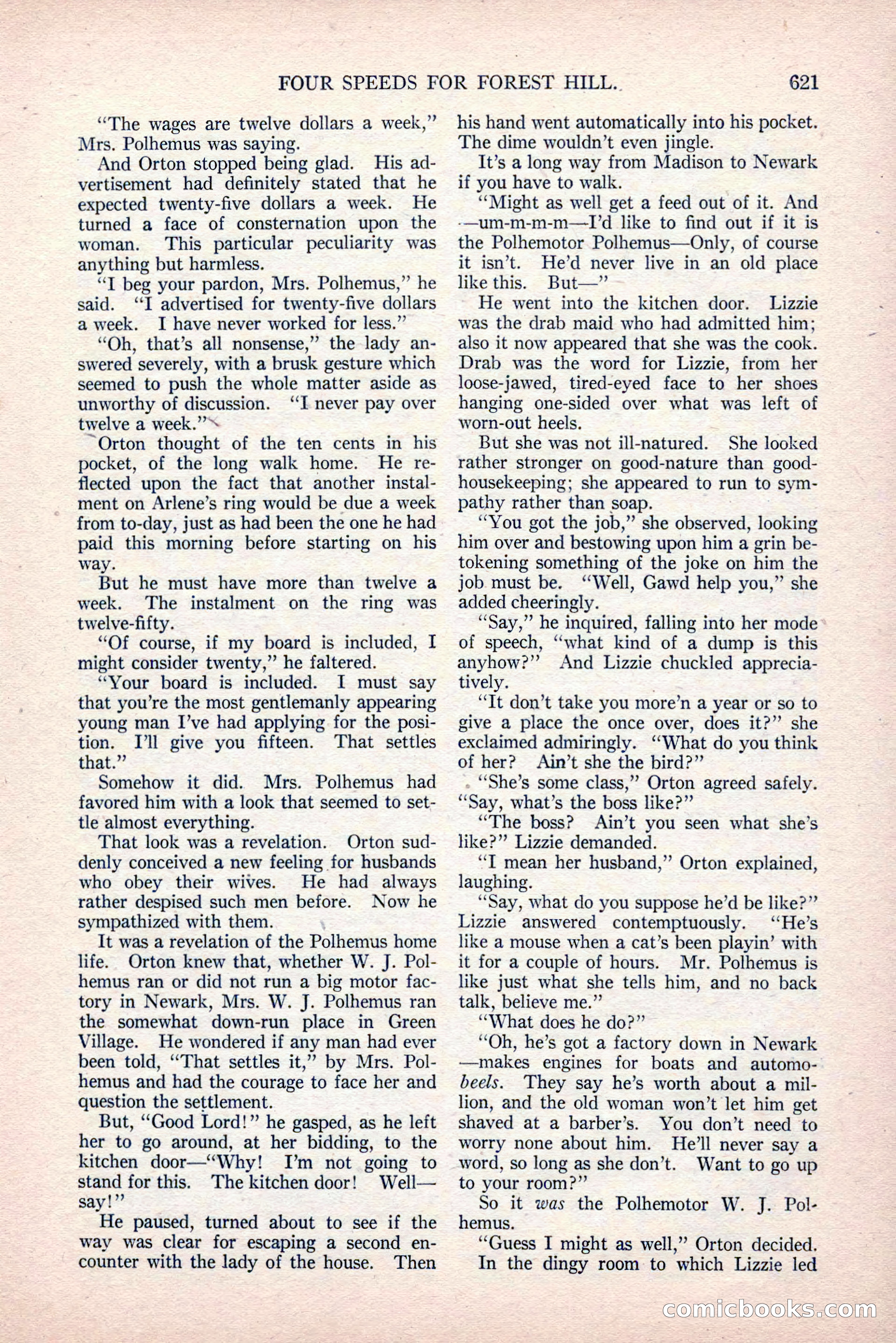
A restored page from Pulp Fiction, 1916. Page through the whole issue in the reader above.
📄 Transcribed text from this page (OCR, searchable)
Machine-transcribed from the original scan — historical spelling and the odd misread are preserved.
FOUR SPEEDS FOR FOREST HILL. “The wages are twelve dollars a week,” Mrs. Polhemus was saying. And Orton stopped being glad. His ad- vertisement had definitely stated that he expected twenty-five dollars a week. He turned a face of consternation upon the woman. This particular peculiarity was anything but harmless. “T beg your pardon, Mrs. Polhemus,” he said. ‘I advertised for twenty-five dollars a week. I have never worked for less.” “Oh, that’s all nonsense,” the lady an- swered severely, with a brusk gesture which seemed to push the whole matter aside as unworthy of discussion. “I never pay over twelve a week.’ ~Orton thought of the ten cents in his pocket, of the long walk home. He re- flected upon the fact that another instal- ment on Arlene’s ring would be due a week from to-day, just as had been the one he had paid this morning before starting on his way. But he must have more than twelve a week. The instalment on the ring was twelve-fifty. “Of course, if my board is included, I might consider twenty,” he faltered. “Your board is included. I must say that you’re the most gentlemanly appearing young man I’ve had applying for the posi- tion. I'll give you fifteen. That settles that.” Somehow it did. Mrs. Polhemus had favored him with a look that seemed to set- tle almost everything. That look was a revelation. Orton sud- denly conceived a new feeling for husbands who obey their wives. He had always rather despised such men before. Now he sympathized with them. It was a revelation of the Polhemus home life. Orton knew that, whether W. J. Pol- hemus ran or did not run a big motor fac- tory in Newark, Mrs. W. J. Polhemus ran the somewhat down-run place in Green Village. He wondered if any man had ever been told, ‘“‘That settles it,” by Mrs. Pol- hemus and had the courage to face her and question the settlement. But, “Good Lord!” he gasped, as he left her to go around, at her bidding, to the kitchen door—“Why! I’m not going to stand for this. The kitchen door! Well— say!” He paused, turned about to see if the way was clear for escaping a second en- counter with the lady of the house. Then 621 his hand went automatically into his pocket. The dime wouldn’t even jingle. It’s a long way from Madison to Newark if you have to walk. ‘Might as well get a feed out of it. And -—um-m-m-m—I’d like to find out if it is the Polhemotor Polhemus—Only, of course it isn’t. He’d never live in an old place like this. But—” He went into the kitchen door. Lizzie was the drab maid who had admitted him; also it now appeared that she was the cook. Drab was the word for Lizzie, from her loose-jawed, tired-eyed face to her shoes hanging one-sided over what was left of worn-out heels. But she was not ill-natured. She looked rather stronger on good-nature than good- housekeeping; she appeared to run to sym- pathy rather than soap. “You got the job,” she observed, looking him over rand bestowing upon him a grin be- tokening something of the joke on him the job must be. “Well, Gawd help you,” she added cheeringly. “Say,” he inquired, falling into her mode of speech, “what kind of a dump is this anyhow?” And Lizzie chuckled apprecia- tively. “Tt don’t take you more’n a year or so to give a place the once over, does it?” she exclaimed admiringly. “What do you think of her? Ain’t she the bird?” . ‘“She’s some class,”’ Orton agreed safely. “Say, what’s the boss like?” “The boss? Ain’t you seen what she’s like?” Lizzie demanded. ‘“‘T mean her husband,” Orton explained, laughing. ‘Say, what do you suppose he’d be like?” Lizzie answered contemptuously. ‘He’s like a mouse when a cat’s been playin’ with it for a couple of hours. Mr. Polhemus is like just what she tells him, and no back talk, believe me.” “What does he do?” “Oh, he’s got a factory down in Newark —makes engines for boats and automo- beels. They say he’s worth about a mil- lion, and the old woman won’t let him get shaved at a barber’s. You don’t need to worry none about him. He’ll never say a word, so long as she don’t. Want to go up to your room?” So it was the Polhemotor W. J. Pol- hemus. ‘Guess I might as well,” Orton decided. In the dingy room to which Lizzie led (EO) 0)(\) AAV <S (E@)