
Pulp Fiction, 1916 · page 57 of 216
The Argosy, Vol. 81, No. 4 — page 57: what you’re looking at
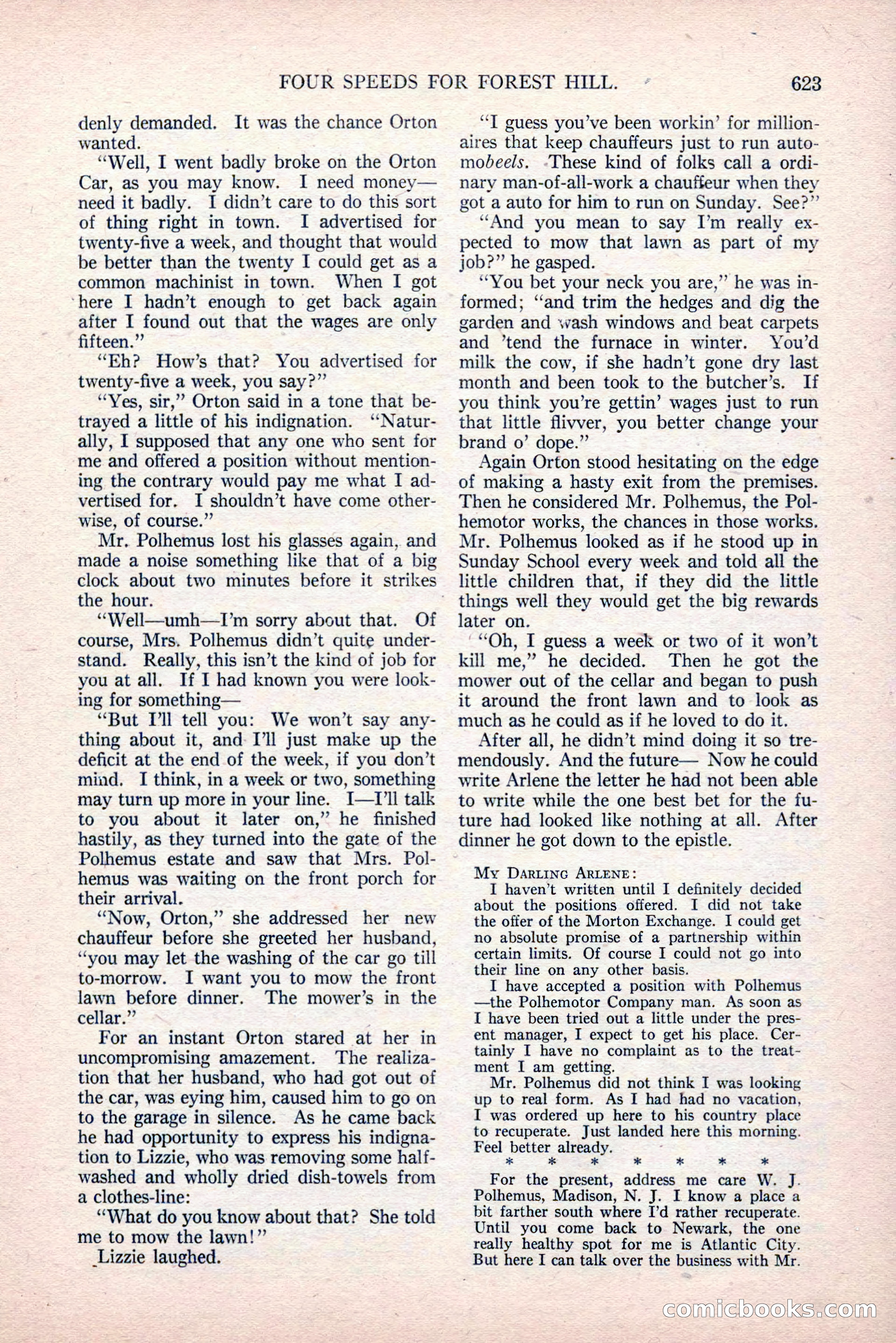
A restored page from Pulp Fiction, 1916. Page through the whole issue in the reader above.
📄 Transcribed text from this page (OCR, searchable)
Machine-transcribed from the original scan — historical spelling and the odd misread are preserved.
FOUR SPEEDS FOR FOREST HILL. denly demanded. It was the chance Orton wanted. “Well, I went badly broke on the Orton Car, as you may know. I need money— need it badly. I didn’t care to do this sort of thing right in town. I advertised for twenty-five a week, and thought that would be better than the twenty I could get as a common machinist in town. When I got ‘here I hadn’t enough to get back again after I found out that the wages are only fifteen.” “Eh? How’s that? You advertised for twenty-five a week, you say?”’ “Ves, sir,” Orton said in a tone that be- trayed a little of his indignation. ‘Natur- ally, I supposed that any one who sent for me and offered a position without mention- ing the contrary would pay me what I ad- vertised for. I shouldn’t have come other- wise, of course.” Mr. Polhemus lost his glasses again, and made a noise something like that of a big clock about two minutes before it strikes the hour. ‘“‘Well—umh—I’m sorry about that. Of course, Mrs. Polhemus didn’t quite under- stand. Really, this isn’t the kind of job for you at all. If I had known you were look- ing for something— “But Dll tell you: We won’t say any- thing about it, and I’ll just make up the deficit at the end of the week, if you don’t mind. I think, in a week or two, something may turn up more in your line. I—I’ll talk to you about it later on,” he finished hastily, as they turned into the gate of the Polhemus estate and saw that Mrs. Pol- hemus was waiting on the front porch for their arrival. “Now, Orton,” she addressed her new chauffeur before she greeted her husband, “vou may let the washing of the car go till to-morrow. I want you to mow the front lawn before dinner. The mower’s in the cellar.” For an instant Orton stared at her in uncompromising amazement. The realiza- tion that her husband, who had got out of the car, was eying him, caused him to go on to the garage in silence. As he came back he had opportunity to express his indigna- tion to Lizzie, who was removing some half- washed and wholly dried dish-towels from a clothes-line: “What do you know about that? She told me to mow the lawn!” Lizzie laughed. 623 ‘“T guess you’ve been workin’ for million- aires that keep chauffeurs just to run auto- mobeels. -These kind of folks call a ordi- nary man-of-all-work a chauffeur when they got a auto for him to run on Sunday. See?” “And you mean to say I’m really ex- pected to mow that lawn as part of my job?” he gasped. ‘You bet your neck you are,” he was in- formed; ‘‘and trim the hedges and dig the garden and wash windows and beat carpets and ’tend the furnace in winter. You’d milk the cow, if she hadn’t gone dry last month and been took to the butcher’s. If you think you’re gettin’ wages just to run that little flivver, you better change your brand o’ dope.” Again Orton stood hesitating on the edge of making a hasty exit from the premises. Then he considered Mr. Polhemus, the Pol- hemotor works, the chances in those works, Mr. Polhemus looked as if he stood up in Sunday School every week and told all the little children that, if they did the little things well they would get the big rewards later on. “Oh, I guess a week or two of it won’t kill me,” he decided. Then he got the mower out of the cellar and began to push it around the front lawn and to look as much as he could as if he loved to do it. After all, he didn’t mind doing it so tre- mendously. And the future— Now he could write Arlene the letter he had not been able to write while the one best bet for the fu- ture had looked like nothing at all. After dinner he got down to the epistle. My Dariinc ARLENE: I haven’t written until I definitely decided about the positions offered. I did not take the offer of the Morton Exchange. I could get no absolute promise of a partnership within certain limits. Of course I could not go into their line on any other basis. I have accepted a position with Polhemus —the Polhemotor Company man. As soon as I have been tried out a little under the pres- ent manager, I expect to get his place. Cer- tainly I have no complaint as to the treat- ment I am getting. Mr. Polhemus did not think I was looking up to real form. As I had had no vacation, I was ordered up here to his country place to recuperate. Just landed here this morning. Feel better already. : % x 2 y * 7 * For the present, address me care W. J. Polhemus, Madison, N. J. I know a place a bit farther south where I’d rather recuperate. Until you come back to Newark, the one really healthy spot for me is Atlantic City. But here I can talk over the business with Mr. COMIGOOOKS (E@