
Pulp Fiction, 1916 · page 54 of 216
The Argosy, Vol. 81, No. 4 — page 54: what you’re looking at
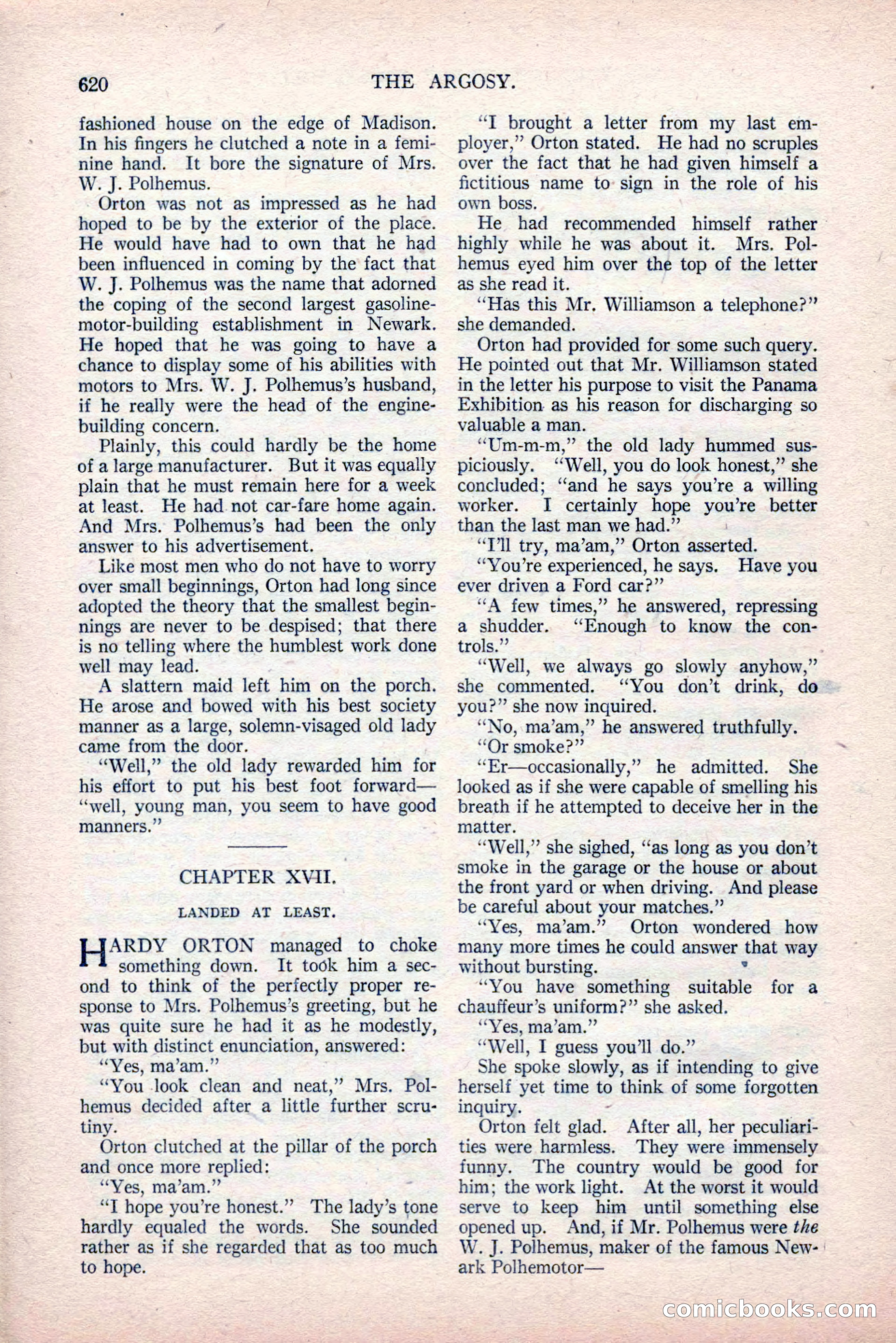
A restored page from Pulp Fiction, 1916. Page through the whole issue in the reader above.
📄 Transcribed text from this page (OCR, searchable)
Machine-transcribed from the original scan — historical spelling and the odd misread are preserved.
620 THE fashioned house on the edge of Madison. In his fingers he clutched a note in a femi- nine hand. It bore the signature of Mrs. W. J. Polhemus. Orton was not as impressed as he had hoped to be by the exterior of the place. He would have had to own that he had been influenced in coming by the fact that W. J. Polhemus was the name that adorned the coping of the second largest gasoline- motor-building establishment in Newark. He hoped that he was going to have a chance to display some of his abilities with motors to Mrs. W. J. Polhemus’s husband, if he really were the head of the engine- building concern. Plainly, this could hardly be the home of alarge manufacturer. But it was equally plain that he must remain here for a week at least. He had not car-fare home again. And Mrs. Polhemus’s had been the only answer to his advertisement. Like most men who do not have to worry over small beginnings, Orton had long since adopted the theory that the smallest begin- nings are never to be despised; that there is no telling where the humblest work done well may lead. A slattern maid left him on the porch. He arose and bowed with his best society manner as a large, solemn-visaged old lady came from the door. “Well,” the old lady rewarded him for his effort to put his best foot forward— “well, young man, you seem to have good manners.” CHAPTER XVII, LANDED AT LEAST. HARDY ORTON managed to choke something down. It took him a sec- ond to think of the periectly proper re- sponse to Mrs. Polhemus’s greeting, but he was quite sure he had it as he modestly, but with distinct enunciation, answered: “Yes, ma’am.”’ “Vou look clean and neat,” Mrs. Pol- hemus decided after a little further scru- tiny. Orton clutched at the pillar of the porch and once more replied: “Ves, ma’am.’ “T hope you're honest.” The lady’s tone hardly equaled the words. She sounded rather as if she regarded that as too much to hope. ARGOSY. “T brought a letter from my last em- ployer,’’ Orton stated. He had no scruples over the fact that he had given himself a fictitious name to: sign in the role of his own boss. He had recommended himself rather highly while he was about it. Mrs. Pol- hemus eyed him over the top of the letter as she read it. “Has this Mr. Williamson a telephone?” she demanded. Orton had provided for some such query. He pointed out that Mr. Williamson stated in the letter his purpose to visit the Panama Exhibition as his reason for discharging so valuable a man. “Um-m-m,” the old lady hummed sus- piciously. ‘Well, you do look honest,” she concluded; ‘‘and he says you’re a willing worker. I certainly hope you ’re_ better than the last man we had. “Tl try, ma’am,”’ Orton asserted. ‘““You’re experienced, he says. Have you ever driven a Ford car?” ‘““A few times,” he answered, repressing a shudder. ‘Enough to know the con- trols.” “Well, we always go slowly anyhow,” she commented. “You don’t drink, do you?” she now inquired. “No, ma’am,” he answered truthfully. “Or smoke?” ““Er—occasionally,” he admitted. She looked as if she were capable of smelling his breath if he attempted to deceive her in the matter. ‘Well,’ she sighed, ‘‘as long as you don’t smoke in the garage or the house or about the front yard or when driving. And please be careful about your matches.” “Yes, ma’am.” Orton wondered how many more times he could answer that way without bursting. “You have something Sone for a chauffeur’s uniform?” she asked. “Yes, ma’am.” “Well, I guess you'll do.” She spoke slowly, as if intending to give herself yet time © think of some forgotten inquiry. Orton felt glad. After all, her peculiari- ties were harmless. They were immensely funny. The country would be good for him; the work light. At the worst it would serve to keep him until something else opened up. And, if Mr. Polhemus were the W. J. Polhemus, maker of the famous New- ' ark Polhemotor— (e(6) NOOLKS AAI (E@)