
Pulp Fiction, 1916 · page 53 of 216
The Argosy, Vol. 81, No. 4 — page 53: what you’re looking at
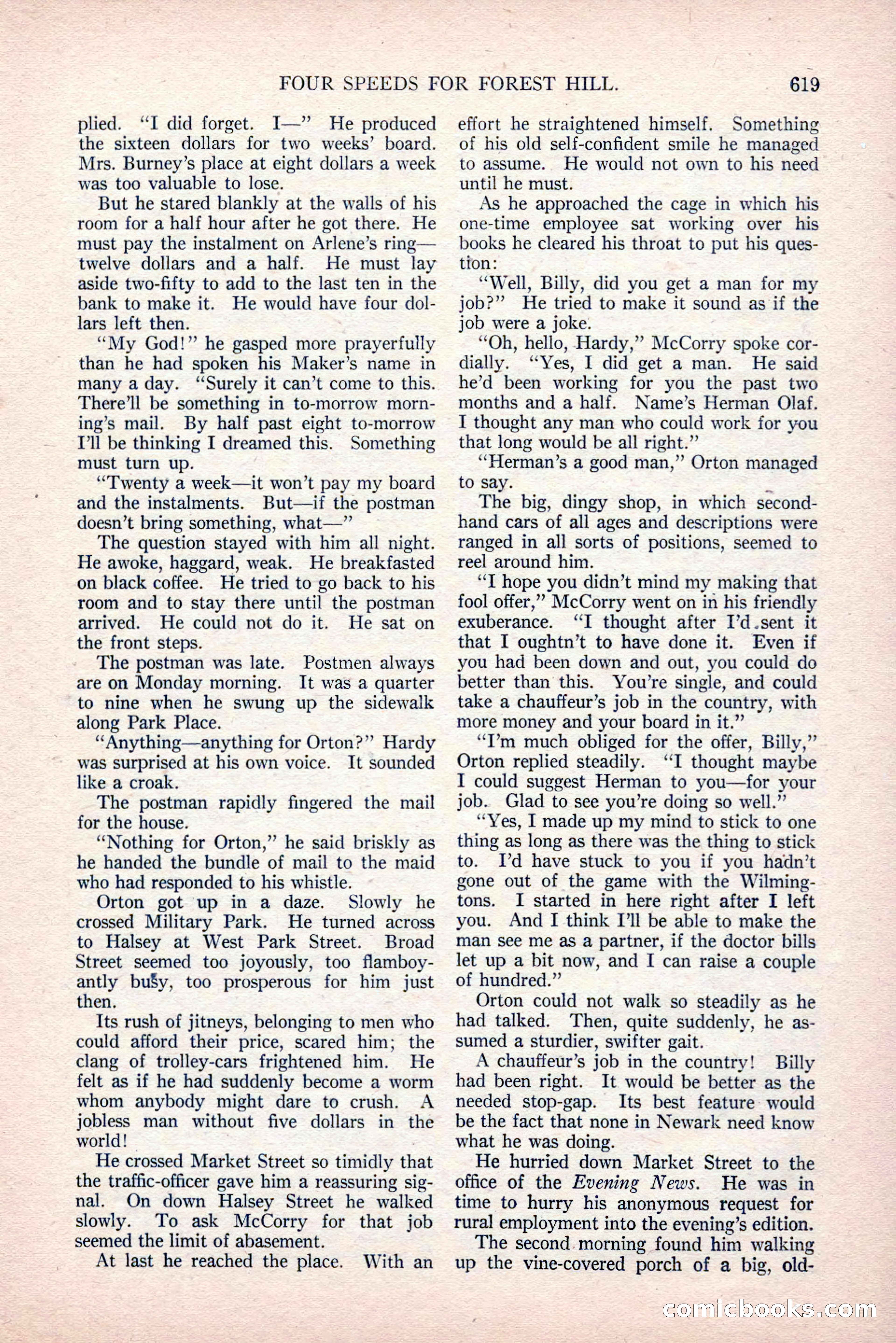
A restored page from Pulp Fiction, 1916. Page through the whole issue in the reader above.
📄 Transcribed text from this page (OCR, searchable)
Machine-transcribed from the original scan — historical spelling and the odd misread are preserved.
FOUR SPEEDS FOR FOREST HILL. plied. “I did forget. I—” He produced the sixteen dollars for two weeks’ board. Mrs. Burney’s place at eight dollars a week was too valuable to lose. But he stared blankly at the walls of his room for a half hour after he got there. He must pay the instalment on Arlene’s ring— twelve dollars and a half. He must lay aside two-fifty to add to the last ten in the bank to make it. He would have four dol- lars left then. “My God!” he gasped more prayerfully than he had spoken his Maker’s name in many a day. “Surely it can’t come to this. There'll be something in to-morrow morn- ing’s mail. By half past eight to-morrow I'll be thinking I dreamed this. Something must turn up. “Twenty a week—it won’t pay my board and the instalments. But—if the postman doesn’t bring something, what—” The question stayed with him all night. He awoke, haggard, weak. He breakfasted on black coffee. He tried to go back to his room and to stay there until the postman arrived. He could not do it. He sat on the front steps. The postman was late. Postmen always are on Monday morning. It was a quarter to nine when he swung up the sidewalk along Park Place. ‘““Anything—anything for Orton?” Hardy was surprised at his own voice. It sounded like a croak. The postman rapidly fingered the mail for the house. ‘Nothing for Orton,” he said briskly as he handed the bundle of mail to the maid who had responded to his whistle. Orton got up in a daze. Slowly he crossed Military Park. He turned across to Halsey at West Park Street. Broad Street seemed too joyously, too flamboy- antly bu$y, too prosperous for him just then. Its rush of jitneys, belonging to men who could afford their price, scared him; the clang of trolley-cars frightened him. He felt as if he had suddenly become a worm whom anybody might dare to crush. A jobless man without five dollars in the world! | He crossed Market Street so timidly that the traffic-officer gave him a reassuring sig- nal. On down Halsey Street he walked slowly. To ask McCorry for that job seemed the limit of abasement. At last he reached the place. With an 619 effort he straightened himself. Something of his old self-confident smile he managed to assume. He would not own to his need until he must. As he approached the cage in which his one-time employee sat working over his books he cleared his throat to put his ques- tion: “Well, Billy, did you get a man for my job?” He tried to make it sound as if the job were a joke. “Oh, hello, Hardy,” McCorry spoke cor- dially. “Yes, I did get a man. He said he’d been working for you the past two months and a half. Name’s Herman Olaf. I thought any man who could work for you that long would be all right.” ‘“‘Herman’s a good man,” Orton managed to say. ~ The big, dingy shop, in which second- hand cars of all ages and descriptions were ranged in all sorts of positions, seemed to reel around him. “T hope you didn’t mind my making that fool offer,”? McCorry went on in his friendly exuberance. “I thought after I’d.sent it that I oughtn’t to have done it. Even if you had been down and out, you could do better than this. You're single, and could take a chauffeur’s job in the country, with more money and your board in it.” ‘“T’m much obliged for the offer, Billy,” Orton replied steadily. “I thought maybe I could suggest Herman to you—for your job. Glad to see you’re doing so well.” “Yes, I made up my mind to stick to one thing as long as there was the thing to stick to. I’d have stuck to you if you hadn’t gone out of the game with the Wilming- tons. I started in here right after I left you. And I think I'll be able to make the man see me as a partner, if the doctor bills let up a bit now, and I can raise a couple of hundred.” Orton could not walk so steadily as he had talked. Then, quite suddenly, he as- sumed a sturdier, swifter gait. A chauffeur’s job in the country! had been right. It would be better as the needed stop-gap. Its best feature would be the fact that none in Newark need know what he was doing. He hurried down Market Street to the office of the Evening News. He was in time to hurry his anonymous request for rural employment into the evening’s edition. The second. morning found him walking up the vine-covered porch of a big, old- Billy ECOPMICLOOOKS (E@