
Pulp Fiction, 1916 · page 48 of 216
The Argosy, Vol. 81, No. 4 — page 48: what you’re looking at
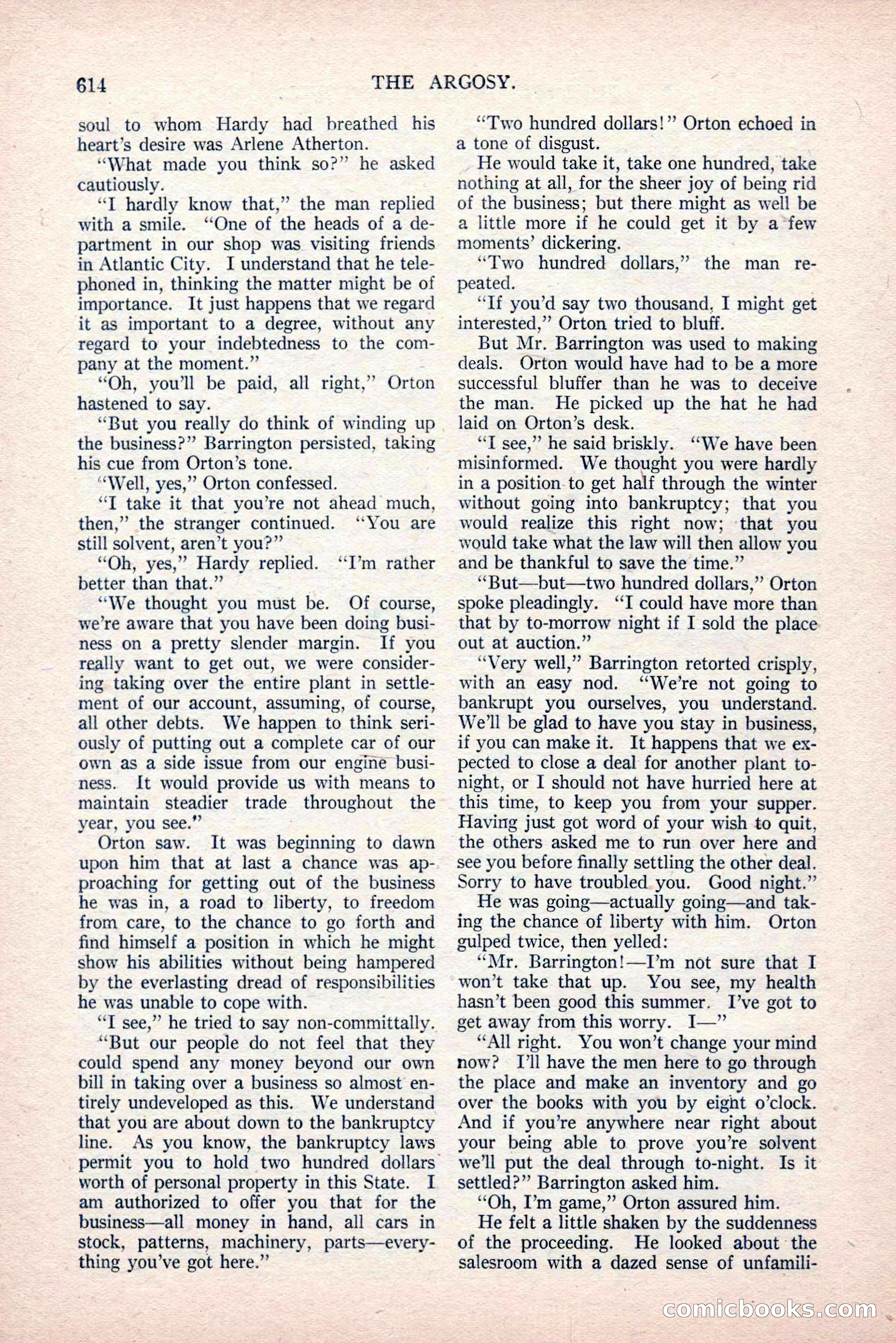
A restored page from Pulp Fiction, 1916. Page through the whole issue in the reader above.
📄 Transcribed text from this page (OCR, searchable)
Machine-transcribed from the original scan — historical spelling and the odd misread are preserved.
614 soul to whom Hardy had breathed his heart’s desire was Arlene Atherton. ‘What made you think so?” he asked cautiously. “T hardly know that,” the man replied with a smile. ‘One of the heads of a de- partment in our shop was visiting friends in Atlantic City. I understand that he tele- phoned in, thinking the matter might be of importance. It just happens that we regard it as important to a degree, without any regard to your indebtedness to the com- pany at the moment.”’ “Oh, you'll be paid, all right,’ Orton hastened to say. “But you really do think of winding up the business?” Barrington persisted, taking his cue from Orton’s tone. ‘Well, yes,” Orton confessed. “T take it that you’re not ahead much, then,” the stranger continued. ‘You are still solvent, aren’t you?” “Oh, yes,” Hardy replied. better than that.” “We thought you must be. Of course, we're aware that you have been doing busi- ness On a pretty slender margin. If you really want to get out, we were consider- ing taking over the entire plant in settle- ment of our account, assuming, of course, all other debts. We happen to think seri- ously of putting out a complete car of our own as a side issue from our engine busi- ness. It would provide us with means to maintain steadier trade throughout the year, you see.” Orton saw. It was beginning to dawn upon him that at last a chance was ap- proaching for getting out of the business he was in, a road to liberty, to freedom from care, to the chance to go forth and find himself a position in which he might show his abilities without being hampered by the everlasting dread of responsibilities he was unable to cope with. “T see,” he tried to say non-committally. “But our people do not feel that they could spend any money beyond our own bill in taking over a business so almost en- tirely undeveloped as this. We understand that you are about down to the bankruptcy line. As you know, the bankruptcy laws ‘“‘T’m rather permit you to hold two hundred dollars worth of personal property in this State. I am authorized to offer you that for the business—all money in hand, all cars in stock, patterns, machinery, parts—every- thing you’ve got here.” THE ARGOSY. “Two hundred dollars!’”’ Orton echoed ia a tone of disgust. He would take it, take one hundred, take nothing at all, for the sheer joy of being rid of the business; but there might as well be a little more if he could get it by afew moments’ dickering. “Two hundred dollars,” aie: man re- peated. “If you’d say two thousand. I might get interested,” Orton tried to bluff. But Mr. Barrington was used to making deals. Orton would have had to be a more successful bluffer than he was to deceive the man. He picked up the hat he had laid on Orton’s desk. “T see,” he said briskly. ‘‘We have been misinformed. We thought you were hardly in a position. to get half through the winter without going into bankruptcy; that you would realize this right now; that you would take what the law will then allow you and be thankful to save the time.” ‘““But—but—two hundred dollars,” Orton spoke pleadingly. “I could have more than that by to-morrow night if I sold the place out at auction.” “Very well,” Barrington retorted crisply, with an easy nod. “We're not going to bankrupt you ourselves, you understand. We'll be glad to have you stay in business, if you can make it. It happens that we ex- pected to close a deal for another plant to- night, or I should not have hurried here at this time, to keep you from your supper. Having just got word of your wish to quit, the others asked me to run over here and see you before finally settling the other deal. Sorry to have troubled you. Good night.” He was going—actually going—and tak- ing the chance of liberty with him. Orton gulped twice, then yelled: “Mr. Barrington!—I’m not sure that I won’t take that up. You see, my health hasn’t been good this summer. I’ve got to get away from this worry. I—” “All right. You won’t change your mind now? I'll have the men here to go through the place and make an inventory and go over the books with you by eight o’clock. And if you’re anywhere near right about your being able to prove you’re solvent we'll put the deal through to-night. Is it settled?” Barrington asked him. “Oh, I’m game,” Orton assured him. He felt a little shaken by the suddenness of the proceeding. He looked about the salesroom with a dazed sense of unfamili- ECOPMICLOOOKS (E@)