
Pulp Fiction, 1916 · page 47 of 216
The Argosy, Vol. 81, No. 4 — page 47: what you’re looking at
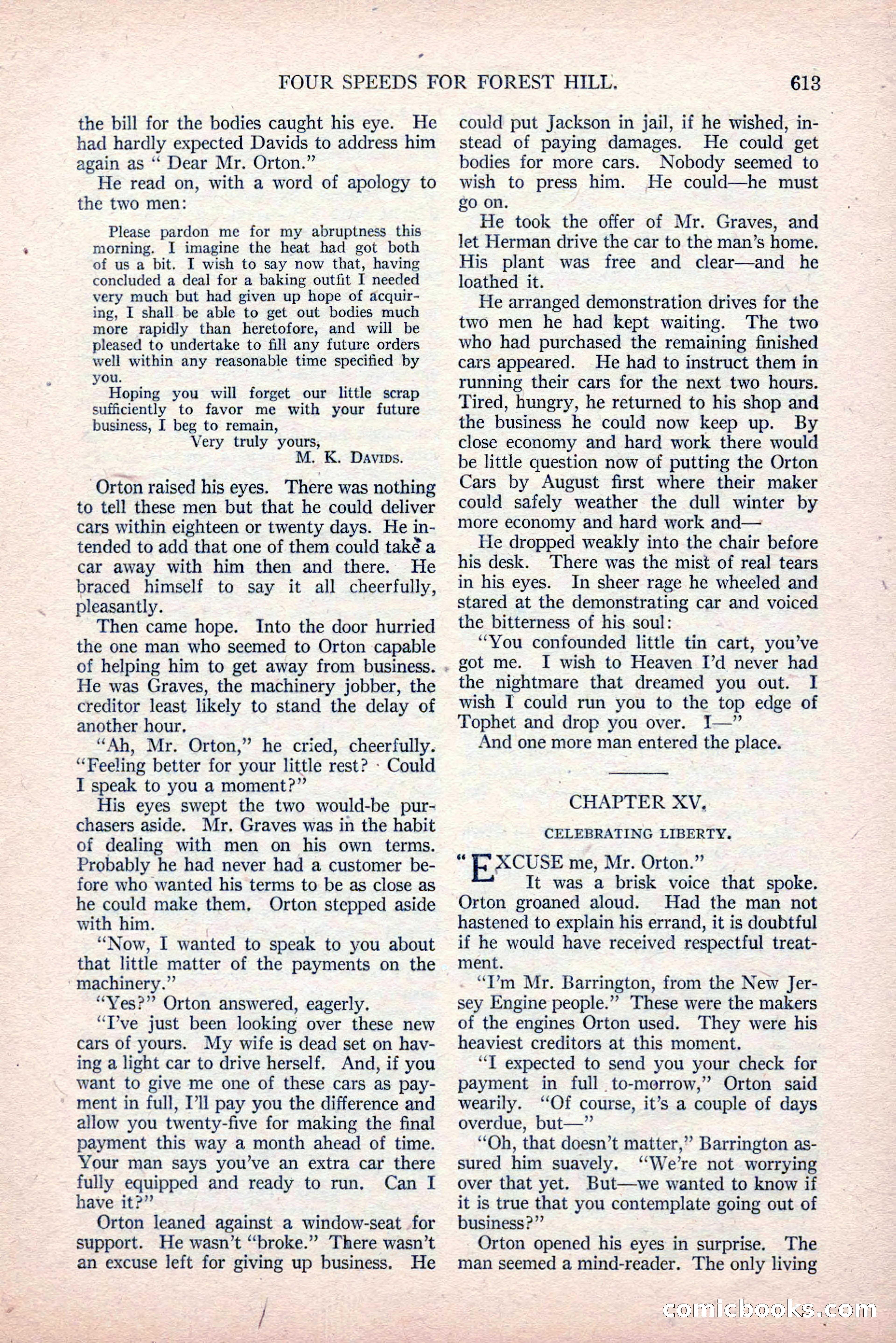
A restored page from Pulp Fiction, 1916. Page through the whole issue in the reader above.
📄 Transcribed text from this page (OCR, searchable)
Machine-transcribed from the original scan — historical spelling and the odd misread are preserved.
- FOUR SPEEDS FOR FOREST HILL, the bill for the bodies caught his eye. He had hardly expected Davids to address him again as “‘ Dear Mr. Orton.” He read on, with a word of apology to the two men: Please pardon me for my abruptness this morning. I imagine the heat had got both of us a bit. I wish to say now that, having concluded a deal for a baking outfit I needed very much but had given up hope of acquir- ing, I shall be able to get out bodies much more rapidly than heretofore, and will be pleased to undertake to fill any future orders well within any reasonable time specified by you. Hoping you will forget our little scrap sufficiently to favor me with your future business, I beg to remain, Very truly yours, M. K. Davips. Orton raised his eyes. There was nothing to tell these men but that he could deliver cars within eighteen or twenty days. He in- tended to add that one of them could také a car away with him then and there. He braced himself to say it all cheerfully, pleasantly. Then came hope. Into the door hurried the one man who seemed to Orton capable of helping him to get away from business. . He was Graves, the machinery jobber, the creditor least likely to stand the delay of another hour. “Ah, Mr. Orton,” he cried, cheerfully. “Feeling better for your little rest? - Could I speak to you a moment?” His eyes swept the two would-be pur- chasers aside. Mr. Graves was in the habit of dealing with men on his own terms. Probably he had never had a customer be- fore who wanted his terms to be as close as he could make them, Orton stepped aside with him. “Now, I wanted to speak to you about that little matter of the payments on the ‘machinery.”’ “Yes?” Orton answered, eagerly. “T’ve just been looking over these new cars of yours. My wife is dead set on hav- ing a light car to drive herself. And, if you want to give me one of these cars as pay- ment in full, I’ll pay you the difference and allow you twenty-five for making the final payment this way a month ahead of time. Your man says you’ve an extra car there fully equipped and ready to run. Can I have it?” Orton leaned against a window-seat for support. He wasn’t “broke.” There wasn’t an excuse left for giving up business. He / 613 could put Jackson in jail, if he wished, in- — stead of paying damages. He could get bodies for more cars. Nobody seemed to wish to press him. He could—he must go on. He took the offer of Mr. Graves, and let Herman drive the car to the man’s home. His plant was free and clear—and he loathed it. He arranged demonstration drives for the two men he had kept waiting. The two who had purchased the remaining finished cars appeared. He had to instruct them in running their cars for the next two hours. Tired, hungry, he returned to his shop and the business he could now keep up. By close economy and hard work there would be little question now of putting the Orton Cars by August first where their maker could safely weather the dull winter by more economy and hard work and— He dropped weakly into the chair before his desk. There was the mist of real tears in his eyes. In sheer rage he wheeled and stared at the demonstrating car and voiced the bitterness of his soul: “You confounded little tin cart, you’ve got me. I wish to Heaven I’d never had the nightmare that dreamed you out. I wish I could run you to the top edge of Tophet and drop you over. I—” And one more man entered the place. CHAPTER XV, CELEBRATING LIBERTY. . fXCUSE me, Mr. Orton.” It was a brisk voice that spoke. Orton groaned aloud. Had the man not hastened to explain his errand, it is doubtful if he would have received respectful treat- ment. “Y’m Mr. Barrington, from the New Jer- sey Engine people.” These were the makers of the engines Orton used. They were his heaviest creditors at this moment. ‘“T expected to send you your check for payment in full to-merrow,” Orton said wearily. ‘Of course, it’s a couple of days overdue, but—” ‘Oh, that doesn’t matter,” Barrington as- sured him suavely. ‘We’re not worrying over that yet. But—we wanted to know if it is true that you contemplate going out of business?” Orton opened his eyes in surprise. The man seemed a mind-reader. The only living COPMICGLOOOKS (E@)