
Pulp Fiction, 1916 · page 49 of 216
The Argosy, Vol. 81, No. 4 — page 49: what you’re looking at
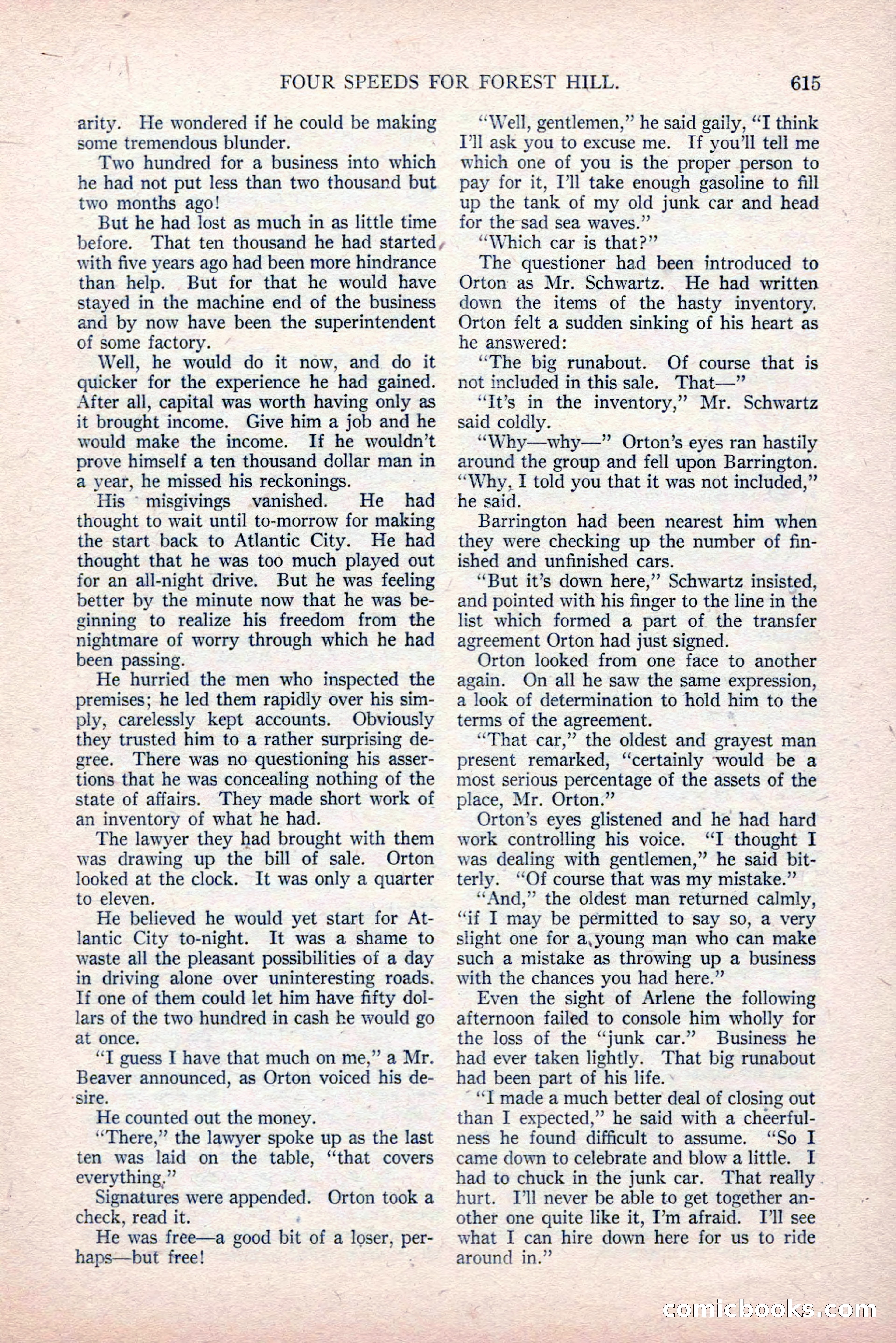
A restored page from Pulp Fiction, 1916. Page through the whole issue in the reader above.
📄 Transcribed text from this page (OCR, searchable)
Machine-transcribed from the original scan — historical spelling and the odd misread are preserved.
FOUR SPEEDS FOR FOREST HILL. arity. He wondered if he could be making some tremendous blunder. Two hundred for a business into which he had not put less than two thousand but two months ago! But he had lost as much in as little time before. That ten thousand he had started, with five years ago had been more hindrance than help. But for that he would have stayed in the machine end of the business and by now have been the superintendent of some factory. Well, he would do it now, and do it quicker for the experience he had gained. After all, capital was worth having only as it brought income. Give him a job and he would make the income. If he wouldn’t prove himself a ten thousand dollar man in a year, he missed his reckonings. His ~ misgivings vanished. He had thought to wait until to-morrow for making the start back to Atlantic City. He had thought that he was too much played out for an all-night drive. But he was feeling better by the minute now that he was be- ginning to realize his freedom from the nightmare of worry through which he had been passing. He hurried the men who inspected the premises; he led them rapidly over his sim- ply, carelessly kept accounts. Obviously they trusted him to a rather surprising de- gree. There was no questioning his asser- tions that he was concealing nothing of the state of affairs. ‘They made short work of an inventory of what he had. The lawyer they had brought with them was drawing up the bill of sale. Orton looked at the clock. It was only a quarter to eleven. He believed he would yet start for At- lantic City to-night. It was a shame to waste all the pleasant possibilities of a day in driving alone over uninteresting roads. If one of them could let him have fifty dol- lars of the two hundred in cash ke would go at once. “T guess I have that much on me,” a Mr. Beaver announced, as Orton voiced his de- ‘sire. He counted out the money. “There,” the lawyer spoke up as the last ten was laid on the table, ‘‘that covers everything.” Signatures were appended. Orton took a check, read it. He was free—a good bit of a loser, pS haps—but free! | 615 “Well, gentlemen,” he said gaily, “I think I'll ask you to excuse me. If you'll tell me which one of you is the proper person to pay for it, I'll take enough gasoline to fill up the tank of my old junk car and head for the sad sea waves.” “Which car is that?” The questioner had been introduced to Orton as Mr. Schwartz. He had written down the items of the hasty inventory. Orton felt a sudden sinking of his heart as he answered: “The big runabout. Of course that is not included in this sale. That—” “{t’s in the inventory,” Mr. Schwartz said coldly. ‘“Why—why—” Orton’s eyes ran hastily around the group and fell upon Barrington. “Why, I told you that it was not included,” he said. Barrington had been nearest him when they were checking up the number of fin- ished and unfinished cars. “But it’s down here,” Schwartz insisted, and pointed with his finger to the line in the list which formed a part of the transfer agreement Orton had just signed. Orton looked from one face to another again. On all he saw the same expression, a look of determination to hold him to the terms of the agreement. “That car,” the oldest and erayest man present remarked, “certainly would be a most serious percentage of the assets of the place, Mr. Orton.” Orton’s eyes glistened and he had hard work controlling his voice. “I thought I was dealing with gentlemen,” he said bit- terly. “Of course that was my mistake.” “And,” the oldest man returned calmly, ‘if I may be permitted to say so, a very slight one for a,young man who can make such a mistake as throwing up a business with the chances you had here.” Even the sight of Arlene the following afternoon failed to console him wholly for the loss of the “junk car.” Business he had ever taken lightly. That big runabout had been part of his life. “TI made a much better deal of closing out than I expected,” he said with a cheerful- ness he found difficult to assume. “So I came down to celebrate and blow a little. I had to chuck in the junk car. hurt. Ill never be able to get together an- other one quite like it, I’m afraid. Ill see what I can hire down here for us to ride around in.” (EO) _DOOK That really . (C@)