
Pulp Fiction, 1916 · page 32 of 216
The Argosy, Vol. 81, No. 4 — page 32: what you’re looking at
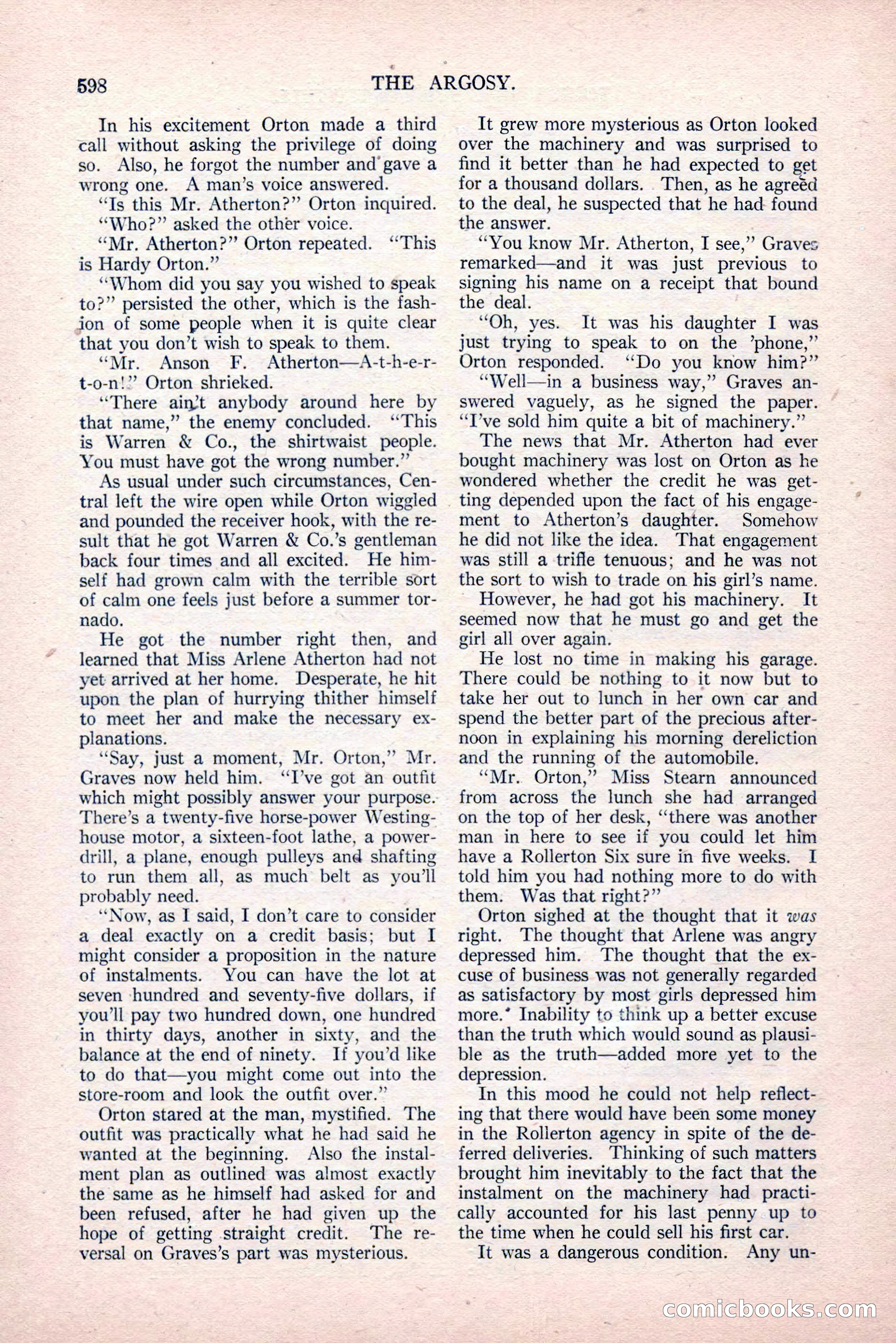
A restored page from Pulp Fiction, 1916. Page through the whole issue in the reader above.
📄 Transcribed text from this page (OCR, searchable)
Machine-transcribed from the original scan — historical spelling and the odd misread are preserved.
598 In his excitement Orton made a third call without asking the privilege of doing so. Also, he forgot the number and gave a wrong one. A man’s voice answered. “Ts this Mr. Atherton?” Orton inquired. “Whor” asked the other voice. “Mr. Atherton?” Orton repeated. is Hardy Orton.” “Whom did you say you wished to speak to?” persisted the other, which is the fash- jon of some people when it is quite clear that you don’t wish to speak to them. “Mr. Anson F. Atherton—A-t-h-e-r- t-o-n!”’ Orton shrieked. “There aint anybody around here by that name,” the enemy concluded. ‘This is Warren & Co., the shirtwaist people. You must have got the wrong number.”’ As usual under such circumstances, Cen- tral left the wire open while Orton wiggled and pounded the receiver hook, with the re- sult that he got Warren & Co.’s gentleman back four times and all excited. He him- self had grown calm with the terrible sort of calm one feels just before a summer tor- nado. He got the number right then, and learned that Miss Arlene Atherton had not yet arrived at her home. Desperate, he hit upon the plan of hurrying thither himself to meet her and make the necessary ex- planations. “Say, just a moment, Mr. Orton,” Mr. Graves now held him. “I’ve got an outfit which might possibly answer your purpose. There’s a twenty-five horse-power Westing- house motor, a sixteen-foot lathe, a power- drill, a plane, enough pulleys and shafting to run them all, as much belt as you'll probably need. “Now, as I said, I don’t care to consider a deal exactly on a credit basis; but I might consider a proposition in the nature of instalments. You can have the lot at seven hundred and seventy-five dollars, if you'll pay two hundred down, one hundred in thirty days, another in sixty, and the balance at the end of ninety. If you’d like to do that—you might come out into the store-room and look the outfit over.” Orton stared at the man, mystified. The outfit was practically what he had said he wanted at the beginning. Also fhe instal- ment plan as outlined was almost exactly the same as he himself had asked for and been refused, after he had given up the hope of getting straight credit. The re- versal on Graves’s part was mysterious. “This THE ARGOSY. It grew more mysterious as Orton looked over the machinery and was surprised to find it better than he had expected to get for a thousand dollars. Then, as he agreéd to the deal, he suspected that he had found the answer. “You know Mr. Atherton, I see,’’ Graves remarked—and it was just previous to signing his name on a receipt that bound the deal. “Oh, yes. It was his daughter I was just trying to speak to on the ’phone,”’ Orton responded. ‘Do you know him?” ‘““Well—in a business way,” Graves an- swered vaguely, as he signed the paper. “T’ve sold him quite a bit of machinery.” The news that Mr. Atherton had ever bought machinery was lost on Orton as he wondered whether the credit he was get- ting depended upon the fact of his engage- ment to Atherton’s daughter. Somehow he did not like the idea. That engagement was still a trifle tenuous; and he was not the sort to wish to trade on his girl’s name. However, he had got his machinery. It seemed now that he must go and get the girl all over again. He lost no time in making his garage. There could be nothing to it now but to take her out to lunch in her own car and spend the better part of the precious after- noon in explaining his morning dereliction and the running of the automobile. “Mr. Orton,” Miss Stearn announced from across the lunch she had arranged on the top of her desk, “‘there was another man in here to see if you could let him have a Rollerton Six sure in five weeks. I told him you had nothing more to do with them. Was that right?” Orton sighed at the thought that it was right. The thought that Arlene was angry depressed him. The thought that the ex- cuse of business was not generally regarded as satisfactory by most girls depressed him more.” Inability to think up a better excuse than the truth which would sound as plausi- ble as the truth—added more yet to the depression. In this mood he could not help reflect- ing that there would have been some money in the Rolierton agency in spite of the de- ferred deliveries. Thinking of such matters brought him inevitably to the fact that the instalment on the machinery had _ practi- cally accounted for his last penny up to the time when he could sell his first car. It was a dangerous condition. Any un- COPMICOOOKS (E@)