
Pulp Fiction, 1916 · page 31 of 216
The Argosy, Vol. 81, No. 4 — page 31: what you’re looking at
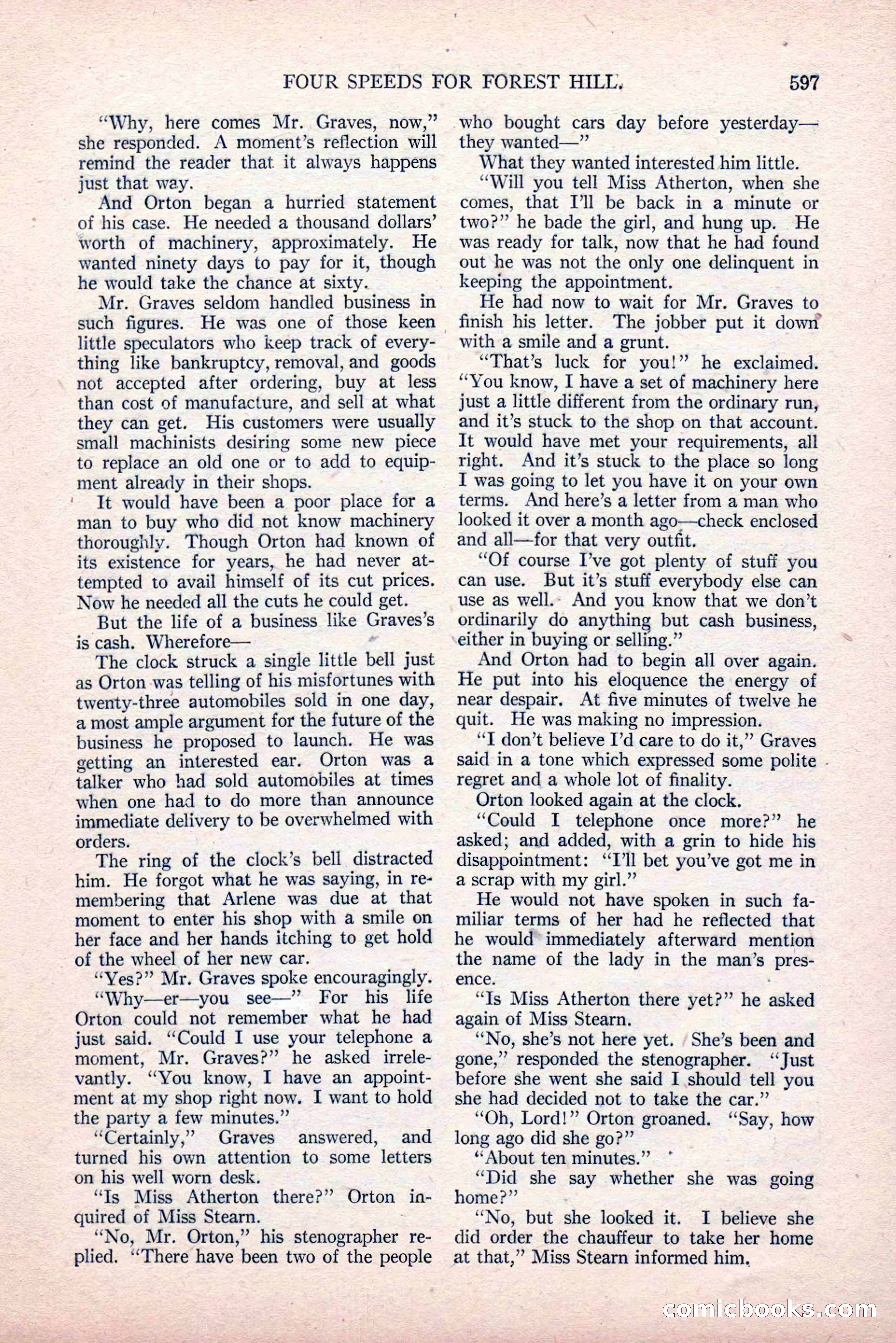
A restored page from Pulp Fiction, 1916. Page through the whole issue in the reader above.
📄 Transcribed text from this page (OCR, searchable)
Machine-transcribed from the original scan — historical spelling and the odd misread are preserved.
‘ FOUR SPEEDS FOR FOREST HILL. “Why, here comes Mr. Graves, now,” she responded. A moment’s reflection will remind the reader that it always happens just that way. And Orton began a hurried statement of his case. He needed a thousand dollars’ worth of machinery, approximately. He wanted ninety days to pay for it, though he would take the chance at sixty. Mr. Graves seldom handled business in such figures. He was one of those keen little speculators who keep track of every- thing like bankruptcy, removal, and goods not accepted after ordering, buy at less than cost of manufacture, and sell at what they can get. His customers were usually small machinists desiring some new piece to replace an old one or to add to equip- ment already in their shops. It would have been a poor place for a man to buy who did not know machinery thoroughly. Though Orton had known of its existence for years, he had never at- tempted to avail himself of its cut prices. Now he needed all the cuts he could get. But the life of a business like Graves’s is cash. Wherefore— The clock struck a single little bell just as Orton was telling of his misfortunes with twenty-three automobiles sold in one day, a most ample argument for the future of the business he proposed to launch. He was getting an interested ear. Orton was a talker who had sold automobiles at times when one had to do more than announce immediate delivery to be overwhelmed with orders. The ring of the clock’s bell distracted him. He forgot what he was saying, in re- membering that Arlene was due at that moment to enter his shop with a smile on her face and her hands itching to get hold of the wheel of her new car. “Yes?” Mr. Graves spoke encouragingly. “Why—er—you see—” For his life Orton could not remember what he had just said. “Could I use your telephone a moment, Mr. Graves?” he asked irrele- vantly. “You know, I have an appoint- ment at my shop right now. I want to hold the party a few minutes.” “Certainly,” Graves answered, and turned his own attention to some letters on his well worn desk. “Is Miss Atherton there?” Orton quired of Miss Stearn. “No, Mr. Orton,” his stenographer re- plied. ‘‘There have been two of the people in- 597 who bought cars day before yesterday— they wanted—”’ What they wanted interested him little. “Will you tell Miss Atherton, when she comes, that I'll be back in a minute or two?” he bade the girl, and hung up. He was ready for talk, now that he had found out he was not the only one delinquent in keeping the appointment. He had now to wait for Mr. Graves to finish his letter. The jobber put it down with a smile and a grunt. “That’s luck for you!” he exclaimed. “You know, I have a set of machinery here just a little different from the ordinary run, and it’s stuck to the shop on that account. It would have met your requirements, all right. And it’s stuck to the place so long I was going to let you have it on your own terms. And here’s a letter from a man who looked it over a month ago—check enclosed and all—for that very outfit. “Of course I’ve got plenty of stuff you can use. But it’s stuff everybody else can use as well.- And you know that we don’t ordinarily do anything but cash business, either in buying or selling.” And Orton had to begin all over again. He put into his eloquence the energy of near despair, At five minutes of twelve he quit. He was making no impression. “T don’t believe I’d care to do it,”’ Graves said in a tone which expressed some polite - regret and a whole lot of finality. Orton looked again at the clock. “Could I telephone once more?” he asked; and added, with a grin to hide his disappointment: “‘I’ll bet you’ve got me in a scrap with my girl.” He would not have spoken in such fa- miliar terms of her had he reflected that he would immediately afterward mention the name of the lady in the man’s pres- ence. “Is Miss Atherton there yet?” he again of Miss Stearn. ‘““No, she’s not here yet. _She’s been and gone,” responded the stenographer. ‘Just before she went she said I should tell you she had decided not to take the car.” “Oh, Lord!” Orton groaned. “Say, how long ago did she go?” “About ten minutes.” “Did she say whether she was going home?” ‘‘No, but she looked it. I believe she did order the chauffeur to take her home at that,” Miss Stearn informed him. asked EOPMICLOOOLX< (E@)