
Pulp Fiction, 1916 · page 30 of 216
The Argosy, Vol. 81, No. 4 — page 30: what you’re looking at
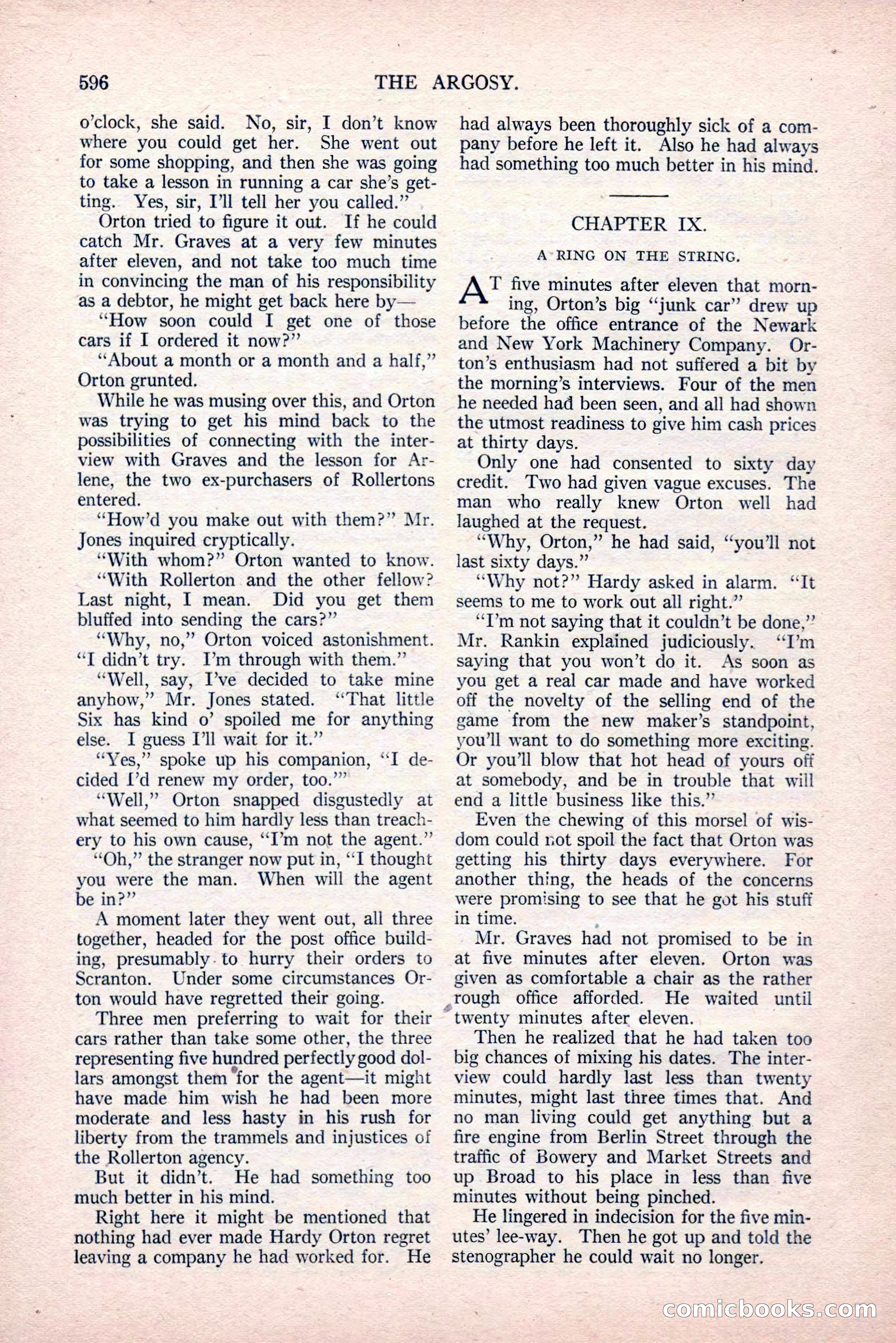
A restored page from Pulp Fiction, 1916. Page through the whole issue in the reader above.
📄 Transcribed text from this page (OCR, searchable)
Machine-transcribed from the original scan — historical spelling and the odd misread are preserved.
596 o'clock, she said. No, sir, I don’t know where you could get her. She went out for some shopping, and then she was going to take a lesson in running a car she’s get- ting. Yes, sir, I’ll tell her you called.” Orton tried to figure it out. If he could catch Mr. Graves at a very few minutes after eleven, and not take too much time in convincing the man of his responsibility as a debtor, he might get back here by— ‘How soon could I get one of those cars if I ordered it now?” “About a month or a month and a half,” Orton grunted. While he was musing over this, and Orton was trying to get his mind back to the possibilities of connecting with the inter- view with Graves and the lesson for Ar- lene, the two ex-purchasers of Rollertons entered. ‘“How’d you make out with them?” Mr. Jones inquired cryptically. “With whom?” Orton wanted to know. “With Rollerton and the other fellow? Last night, I mean. Did you get them bluffed into sending the cars?” “Why, no,” Orton voiced astonishment. “T didn’t try. U’m through with them.” “Well, say, I’ve decided to take mine anyhow,” Mr. Jones stated. ‘That little Six has kind o’ spoiled me for anything else. I guess [ll wait for it.” “Yes,” spoke up his companion, “I de- cided [’d renew my order, too.”” “Well,” Orton snapped disgustedly at what seemed to him hardly less than treach- ery to his own cause, “I’m not the agent.”’ “Oh,” the stranger now put in, “I thought you were the man. When will the agent be in?” A moment later they went out, all three together, headed for the post office build- ing, presumably. to hurry their orders to Scranton. Under some circumstances Or- ton would have regretted their going. Three men preferring to wait for their cars rather than take some other, the three representing five hundred perfectly good dol- lars amongst them for the agent—it might have made him wish he had been more moderate and less hasty in his rush for liberty from the trammels and injustices of the Rollerton agency. But it didn’t. He had something too much better in his mind. Right here it might be mentioned that nothing had ever made Hardy Orton regret leaving a company he had worked for. He THE ARGOSY. had always been thoroughly sick of a com- pany before he left it. Also he had always had something too much better in his mind. CHAPTER IX. A-RING ON THE STRING. AF five minutes after eleven that morn- ing, Orton’s big ‘junk car’ drew up before the office entrance of the Newark and New York Machinery Company. Or- ton’s enthusiasm had not suffered a bit by the morning’s interviews. Four of the men he needed had been seen, and all had shown the utmost readiness to give him cash prices at thirty days. Only one had consented to sixty day credit. Two had given vague excuses. The man who really knew Orton well had laughed at the request. “Why, Orton,” he had said, “you'll not last sixty days.” ‘Why not?” Hardy asked in alarm. “It seems to me to work out all right.” “Tm not saying that it couldn’t be done,” Mr. Rankin explained judiciously. ‘I’m saying that you won’t do it. As soon as you get a real car made and have worked off the novelty of the selling end of the game from the new maker’s standpoint, you'll want to do something more exciting. Or you'll blow that hot head of yours off at somebody, and be in trouble that will end a little business like this.” Even the chewing of this morsel of wis- dom could not spoil the fact that Orton was getting his thirty days everywhere. For another thing, the heads of the concerns were promising to see that he got his stuff in time. i Mr. Graves had not promised to be in at five minutes after eleven. Orton was given as comfortable a chair as the rather Tough office afforded. He waited until “twenty minutes after eleven. Then he realized that he had taken too big chances of mixing his dates. The inter- view could hardly last less than twenty minutes, might last three times that. And no man living could get anything but a fire engine from Berlin Street through the traffic of Bowery and Market Streets and up Broad to his place in less than five minutes without being pinched. He lingered in indecision for the five min- utes’ lee-way. Then he got up and told the stenographer he could wait no longer. Gcomichook (E©)