
Pulp Fiction, 1916 · page 27 of 216
The Argosy, Vol. 81, No. 4 — page 27: what you’re looking at
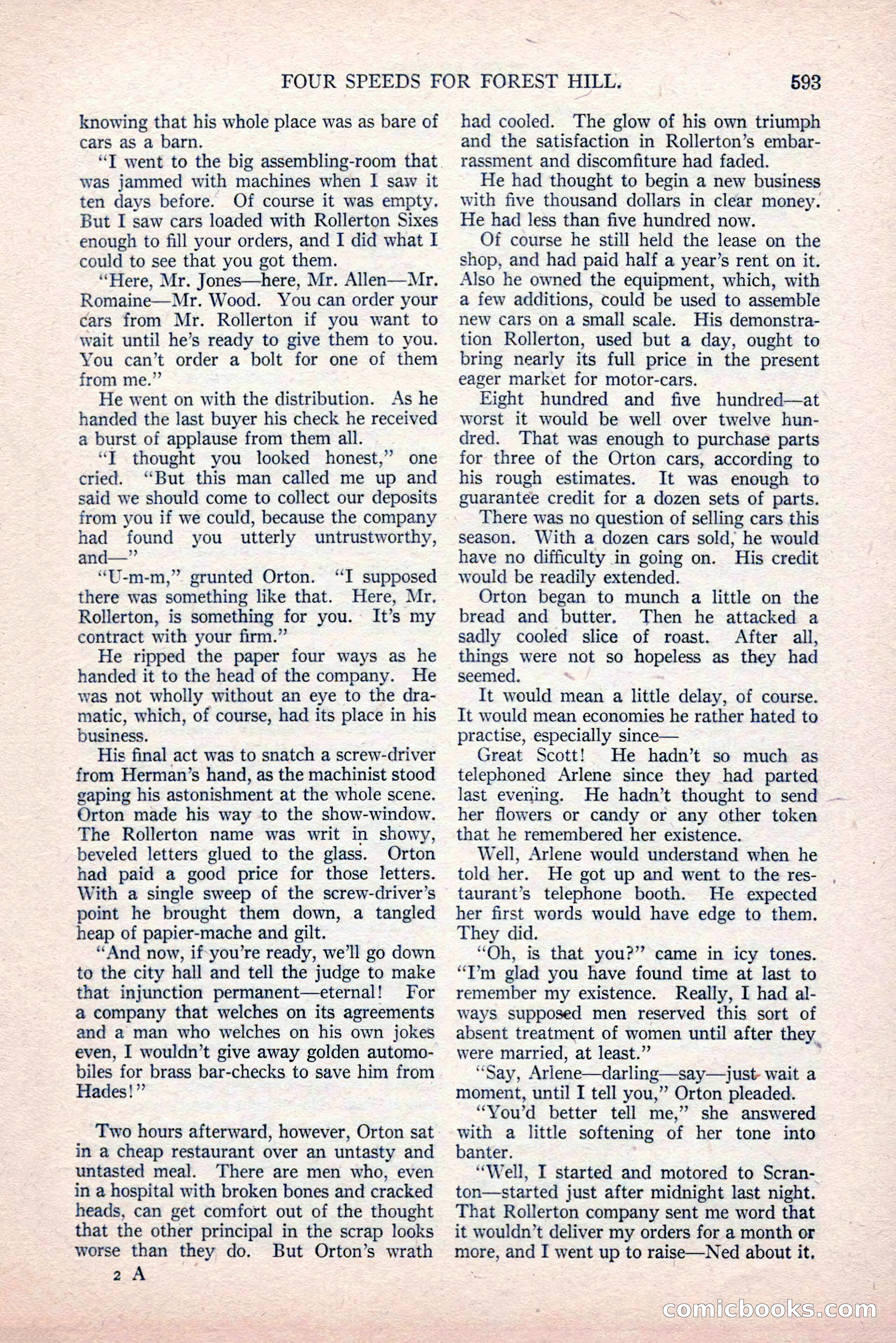
A restored page from Pulp Fiction, 1916. Page through the whole issue in the reader above.
📄 Transcribed text from this page (OCR, searchable)
Machine-transcribed from the original scan — historical spelling and the odd misread are preserved.
FOUR SPEEDS FOR FOREST HILL. knowing that his whole place was as bare of cars as a barn. “T went to the big assembling-room that was jammed with machines when I saw it ten days before. Of course it was empty. But I saw cars loaded with Rollerton Sixes enough to fill your orders, and I did what I could to see that you got them. “Here, Mr. Jones—here, Mr. Allen—Mr. Romaine—Mr. Wood. You can order your cars from Mr. Rollerton if you want to wait until he’s ready to give them to you. You can’t order a bolt for one of them from me.” He went on with the distribution. As he handed the last buyer his check he received a burst of applause from them all. “J thought you looked honest,” one cried. “But this man called me up and said we should come to collect our deposits from you if we could, because the company had found you utterly untrustworthy, and—”’ “U-m-m,” grunted Orton. there was something like that. Rollerton, is something for you. contract with your firm.” He ripped the paper four ways as he handed it to the head of the company. He was not wholly without an eye to the dra- matic, which, of course, had its place in his business. His final act was to snatch a screw-driver from Herman’s hand, as the machinist stood gaping his astonishment at the whole scene. Orton made his way to the show-window. The Rollerton name was writ in showy, beveled letters glued to the glass. Orton had paid a good price for those letters. With a single sweep of the screw-driver’s point he brought them down, a tangled heap of papier-mache and gilt. “And now, if-you’re ready, we’ll go down to the city hall and tell the judge to make that injunction permanent—eternal! For a company that welches on its agreements and a man who welches on his own jokes even, I wouldn’t give away golden automo- biles for brass bar-checks to save him from Hades!” “T supposed Here, Mr. It’s my Two hours afterward, however, Orton sat in a cheap restaurant over an untasty and untasted meal. ‘There are men who, even in a hospital with broken bones and cracked heads, can get comfort out of the thought that the other principal in the scrap looks worse than they do. But Orton’s wrath 2A 593 had cooled. The glow of his own triumph and the satisfaction in Rollerton’s embar- rassment and discomfiture had faded. He had thought to begin a new business with five thousand dollars in clear money. He had less than five hundred now. Of course he still held the lease on the shop, and had paid half a year’s rent on it. Also he owned the equipment, which, with a few additions, could be used to assemble new cars on a small scale. His demonstra- tion Rollerton, used but a day, ought to bring nearly its full price in the present eager market for motor-cars. Eight hundred and five hundred—at worst it would be well over twelve hun- dred. That was enough to purchase parts for three of the Orton cars, according to his rough estimates. It was enough to guarantee credit for a dozen sets of parts. There was no question of selling cars this season. With a dozen cars sold; he would have no difficulty in going on. His credit would be readily extended. Orton began to munch a little on the bread and butter. Then he attacked a sadly cooled slice of roast. After all, things were not so hopeless as they had seemed. It would mean a little delay, of course. It would mean economies he rather hated to practise, especially since— Great Scott! He hadn’t so much as telephoned Arlene since they had parted last evening. He hadn’t thought to send her flowers or candy or any other token that he remembered her existence. Well, Arlene would understand when he told her. He got up and went to the res- taurant’s telephone booth. He expected her first words would have edge to them. They did. “Oh, is that you?” came in icy tones. “I’m glad you have found time at last to remember my existence. Really, I had al- ways supposed men reserved this sort of absent treatment of women until after they were married, at least.” ; “Say, Arlene—darling—say—just wait a moment, until I tell you,” Orton pleaded. ‘“You’d better tell me,” she answered with a little softening of her tone into banter. ‘Well, I started and motored to Scran- ton—started just after midnight last night. That Rollerton company sent me word that it wouldn’t deliver my orders for a month or more, and I went up to raise—Ned about it. COMIC LOOOKS (©)