
Pulp Fiction, 1916 · page 26 of 216
The Argosy, Vol. 81, No. 4 — page 26: what you’re looking at
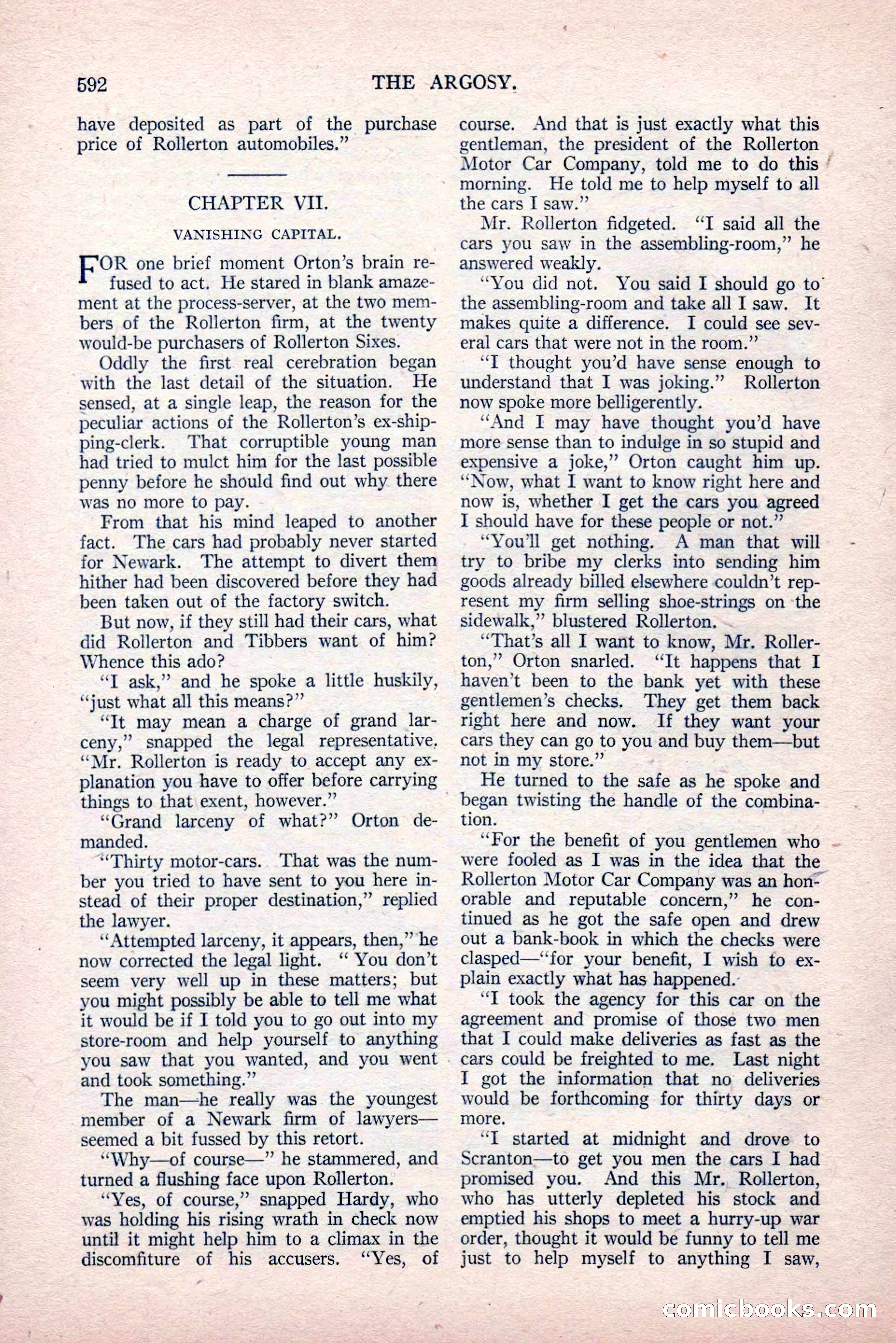
A restored page from Pulp Fiction, 1916. Page through the whole issue in the reader above.
📄 Transcribed text from this page (OCR, searchable)
Machine-transcribed from the original scan — historical spelling and the odd misread are preserved.
592 have deposited as part of the purchase price of Rollerton automobiles.” CHAPTER VII. VANISHING CAPITAL, FoR one brief moment Orton’s brain re- fused to act. He stared in blank amaze- ment at the process-server, at the two mem- bers of the Rollerton firm, at the twenty would-be purchasers of Rollerton Sixes. Oddly the first real cerebration began with the last detail of the situation. He sensed, at a single leap, the reason for the peculiar actions of the Rollerton’s ex-ship- ping-clerk. That corruptible young man had tried to mulct him for the last possible penny before he should find out why there was no more to pay. From that his mind leaped to another fact. The cars had probably never started for Newark. The attempt to divert them hither had been discovered before they had been taken out of the factory switch. But now, if they still had their cars, what did Rollerton and Tibbers want of him? Whence this ado? “T ask,” and he spoke a little huskily, “Just what all this means?” “Tt may mean a charge of grand lar- ceny,” snapped the legal representative. “Mr. Rollerton is ready to accept any ex- planation you have to offer before carrying things to that exent, however.” “Grand larceny of what?” Orton de- manded. “Thirty motor-cars. That was the num- ber you tried to have sent to you here in- stead of their proper destination,” replied the lawyer. ‘Attempted larceny, it appears, then,” he now corrected the legal light. ‘‘ You don’t seem very well up in these matters; but you might possibly be able to tell me what it would be if I told you to go out into my store-room and help yourself to anything you saw that you wanted, and you went . and took something.” The man—he really was the youngest member of a Newark firm of lawyers— seemed a bit fussed by this retort. ‘‘Why—of course—” he stammered, and turned a flushing face upon Rollerton. “Ves, of course,” snapped Hardy, who was holding his rising wrath in check now until it might help him to a climax in the discomfiture of his accusers. ‘Yes, of THE ARGOSY. course. And that is just exactly what this gentleman, the president of the Rollerton Motor Car Company, told me to do this * morning. He told me to help myself to all the cars I saw.” Mr. Rollerton fidgeted. ‘‘I said all the cars you saw in the assembling-room,” he answered weakly. “You did not. the assembling-room and take all I saw. It makes quite a difference. I could see sev- eral cars that were not in the room.” ‘“T thought you’d have sense enough to understand that I was joking.” Rollerton now spoke more belligerently. ‘And I may have thought you’d have more sense than to indulge in so stupid and expensive a joke,” Orton caught him up. ‘‘Now, what I want to know right here and now is, whether I get the cars you agreed I should have for these people or not.” “You'll get nothing. A man that will try to bribe my clerks into sending him goods already billed elsewhere couldn’t rep- resent my firm selling shoe-strings on ‘the sidewalk,” blustered Rollerton. ~ ‘“That’s all I want to know, Mr. Roller- ton,” Orton snarled. “It happens that I haven’t been to the bank yet with these gentlemen’s checks. They get them back right here and now. If they want your cars they can go to you and buy them—but not in my store.” He turned to the safe as he spoke and began twisting the handle of the combina- tion. You said I should go to’ “For the benefit of you gentlemen who -~ were fooled as I was in the idea that the Rollerton Motor Car Company was an hon- orable and reputable concern,” he con- tinued as he got the safe open and drew out a bank-book in which the checks were clasped—“‘for your benefit, I wish to ex- plain exactly what has happened. “IT took the agency for this car on the agreement and promise of those two men that I could make deliveries as fast as the cars could be freighted to me. Last night I got the information that no deliveries would be forthcoming for thirty days or more. ‘“T started at midnight and drove to Scranton—to get you men the cars I had promised you. And this Mr. Rollerton, who has utterly depleted his stock and emptied his shops to meet a hurry-up war order, thought it would be funny to tell me just to help myself to anything I saw, Gomichoo (C S (E@)