
Pulp Fiction, 1916 · page 28 of 216
The Argosy, Vol. 81, No. 4 — page 28: what you’re looking at
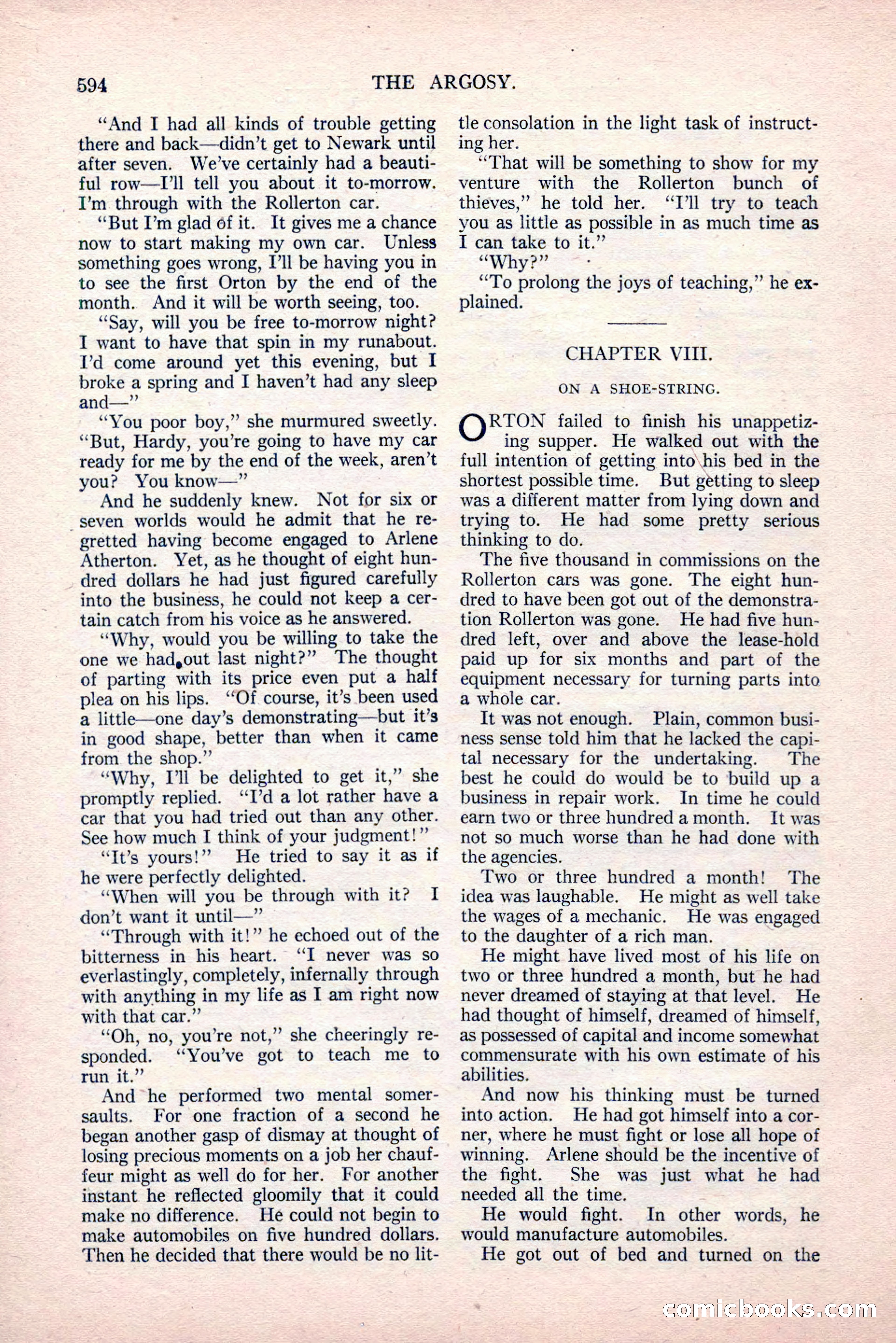
A restored page from Pulp Fiction, 1916. Page through the whole issue in the reader above.
📄 Transcribed text from this page (OCR, searchable)
Machine-transcribed from the original scan — historical spelling and the odd misread are preserved.
594 THE “And I had all kinds of trouble getting there and back—didn’t get to Newark until after seven. We've certainly had a beauti- ful row—I’ll tell you about it to-morrow. _ I’m through with the Rollerton car. “But I’m glad of it. It gives me a chance now to start making my own car. Unless something goes wrong, Ill be having you in to see the first Orton by the end of the month. And it will be worth seeing, too. “Say, will you be free to-morrow night? I want to have that spin in my runabout. I’d come around yet this evening, but I broke a spring and I haven’t had any sleep and—”’ “You poor boy,” she murmured sweetly. “But, Hardy, you’re going to have my car ready for me by the end of the week, aren’t your You know—” And he suddenly knew. Not for six or seven worlds would he admit that he re- gretted having become engaged to Arlene Atherton. Yet, as he thought of eight hun- dred dollars he had just figured carefully into the business, he could not keep a cer- tain catch from his voice as he answered. “Why, would you be willing to take the one we had,out last night?” The thought of parting with its price even put a half plea on his lips. “Of course, it’s been used a little—one day’s demonstrating—but it’s in good shape, better than when it came from the shop.” “Why, I'll be delighted to get it,” she promptly replied. “I’d a lot rather have a car that you had tried out than any other. See how much I think of your judgment!”’ “It’s yours!” He tried to say it as if he were perfectly delighted. “When will you be through with it? I don’t want it until—”’ “Through with it!” he echoed out of the bitterness in his heart. “I never was so everlastingly, completely, infernally through with anything in my life as I am right now with that car.” “Oh, no, you’re not,” she cheeringly re- sponded. ‘“You’ve got to teach me to run it.” And he performed two mental somer- saults. For one fraction of a second he began another gasp of dismay at thought of losing precious moments on a job her chauf- feur might as well do for her. For another instant he reflected gloomily that it could make no difference. He could not begin to make automobiles on five hundred dollars. Then he decided that there would be no lit- ARGOSY. tle consolation in the light task of instruct- ing her. ‘That will be something to show for my venture with the Rollerton bunch of thieves,” he told her. “I’ll try to teach you as little as possible in as much time as I can take to it.” “Why?” “To prolong the joys of teaching,” he ex- plained. CHAPTER VIII. ON A SHOE-STRING. RTON failed to finish his unappetiz- ing supper. He walked out with the full intention of getting into\his bed in the shortest possible time. But getting to sleep was a different matter from lying down and trying to. He had some pretty serious thinking to do. The five thousand in commissions on the Rollerton cars was gone. The eight hun- dred to have been got out of the demonstra- tion Rollerton was gone. He had five hun- dred left, over and above the lease-hold paid up for six months and part of the equipment necessary for turning parts into a whole car. It was not enough. Plain, common busi- ness sense told him that he lacked the capi- tal necessary for the undertaking. The best he could do would be to build up a business in repair work. In time he could earn two or three hundred a month. It was not so much worse than he had done with the agencies. Two or three hundred a month! The idea was laughable. He might as well take the wages of a mechanic. He was engaged to the daughter of a rich man. He might have lived most of his life on two or three hundred a month, but he had never dreamed of staying at that level. He had thought of himself, dreamed of himself, as possessed of capital and income somewhat commensurate with his own estimate of his abilities. And now his thinking must be turned into action. He had got himself into a cor- ner, where he must fight or lose all hope of winning. Arlene should be the incentive of the fight. She was just what he had needed all the time. He would fight. In other words, he would manufacture automobiles. He got out of bed and turned on the (E60) 0)(0\6) AAU S (©)