
Pulp Fiction, 1916 · page 177 of 216
The Argosy, Vol. 81, No. 4 — page 177: what you’re looking at
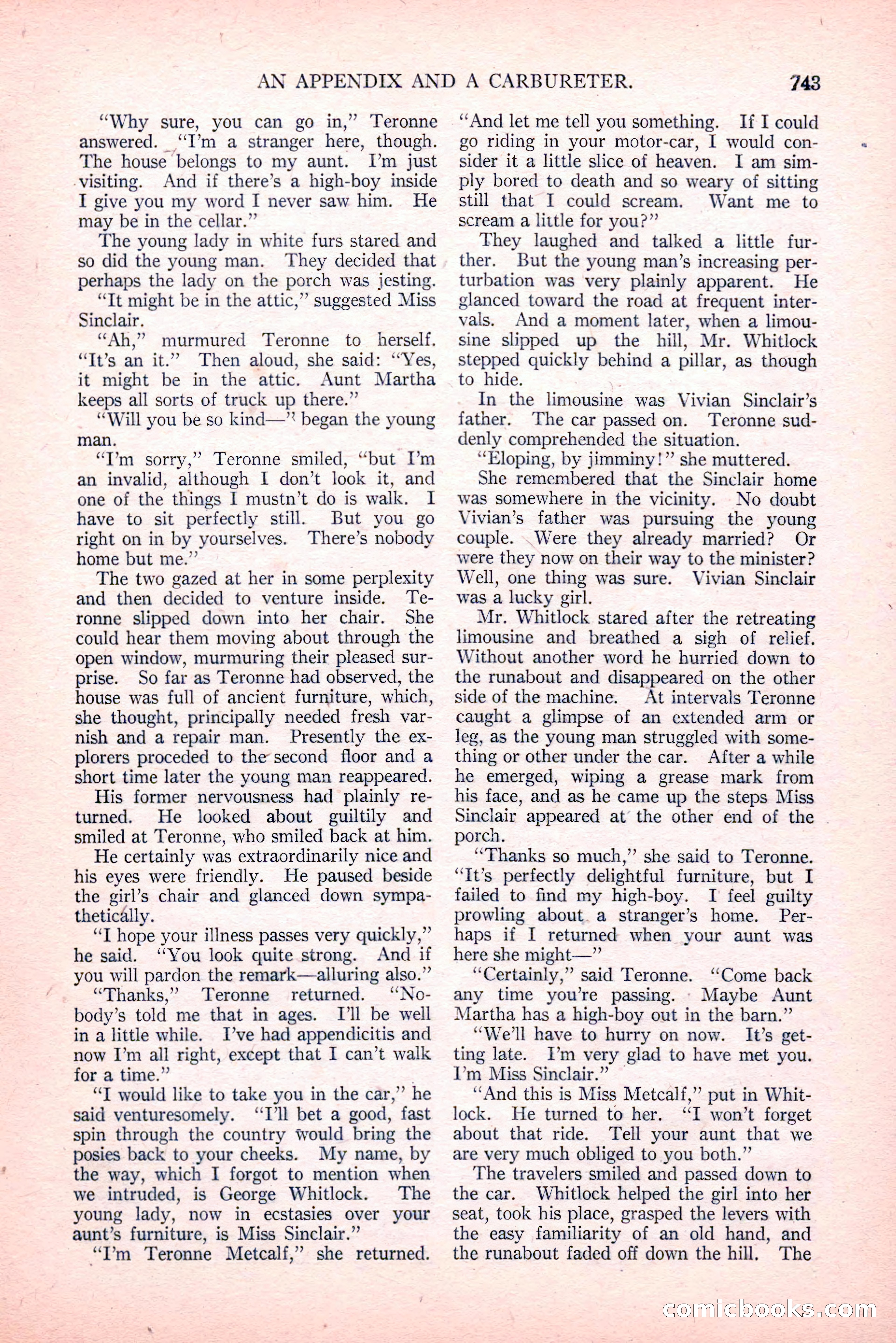
A restored page from Pulp Fiction, 1916. Page through the whole issue in the reader above.
📄 Transcribed text from this page (OCR, searchable)
Machine-transcribed from the original scan — historical spelling and the odd misread are preserved.
AN APPENDIX AND A CARBURETER. “Why sure, you can go in,” Teronne answered. ‘I’m a stranger here, though. The house belongs to my aunt. I’m just visiting. And if there’s a high-boy inside I give you my word I never saw him. He may be in the cellar.” The young lady in white furs stared and so did the young man. They decided that perhaps the lady on the porch was jesting. “Tt might be in the attic,” suggested Miss Sinclair. “Ah,” murmured Teronne to_ herself. “Tt’s an it.””. Then aloud, she said: “Yes, it might be in the attic. Aunt Martha keeps all sorts of truck up there.”’ “Will you be so kind—” began the young man, “I’m sorry,” Teronne smiled, “but I’m an invalid, although I don’t look it, and one of the things I mustn’t do is walk. I have to sit perfectly still. But you go right on in by yourselves. There’s nobody home but me.” The two gazed at her in some perplexity and then decided to venture inside. Te- ronne slipped down into her chair. She could hear them moving about through the Open window, murmuring their pleased sur- prise. So far as Teronne had observed, the house was full of ancient furniture, which, she thought, principally needed fresh var- nish and a repair man. Presently the ex- plorers proceded to the second floor and a short time later the young man reappeared. His former nervousness had plainly re- turned. He looked about guiltily and smiled at Teronne, who smiled back at him. He certainly was extraordinarily nice and his eyes were friendly. He paused beside the girl’s chair and glanced down sympa- thetically. “T hope your illness passes very quickly,” he said. ‘You look quite strong. And if you will pardon the remark—alluring also.” “Thanks,” Teronne returned. “No- body’s told me that in ages. Ill be well in a little while. I’ve had appendicitis and now I’m all right, except that I can’t walk for a time.” “T would like to take you in the car,” he said venturesomely. ‘‘I’ll bet a good, fast spin through the country would bring the posies back to your cheeks. My name, by the way, which I forgot to mention when we intruded, is George Whitlock. The young lady, now in ecstasies over your aunt’s furniture, is Miss Sinclair.” “Tm Teronne Metcalf,” she returned. 743 ‘‘And let me tell you something. If I could go riding in your motor-car, I would con- sider it a little slice of heaven. I am sim- ply bored to death and so weary of sitting still that I could scream. Want me to scream a little for you?” They laughed and talked a little fur- ther. But the young man’s increasing per- turbation was very plainly apparent. He glanced toward the road at frequent inter- vals. And a moment later, when a limou- sine slipped up the hill, Mr. Whitlock stepped quickly behind a pillar, as though to hide. | In the limousine was Vivian Sinclair’s father. The car passed on. Teronne sud- denly comprehended the situation. ‘“Eloping, by jimminy!” she muttered. She remembered that the Sinclair home was somewhere in the vicinity. No doubt Vivian’s father was pursuing the young couple. Were they already married? Or were they now on their way to the minister? Well, one thing was sure. Vivian Sinclair was a lucky girl. Mr. Whitlock stared after the retreating limousine and breathed a sigh of relief. Without another word he hurried down to the runabout and disappeared on the other side of the machine. At intervals Teronne caught a glimpse of an extended arm or leg, as the young man struggled with some- thing or other under the car. After a while he emerged, wiping a grease mark from his face, and as he came up the steps Miss Sinclair appeared at the other end of the | porch. ‘Thanks so much,” she said to Teronne. ‘It’s perfectly delightful furniture, but I failed to find my high-boy. I feel guilty prowling about. a stranger’s home. Per- haps if I returned when your aunt was here she might—”’ “Certainly,” said Teronne. ‘Come back any time you're passing. - Maybe Aunt Martha has a high-boy out in the barn.” “We'll have to hurry on now. It’s get- ting late. I’m very glad to have met you. I’m Miss Sinclair.” — ‘And this is Miss Metcalf,” put in Whit- lock. He turned to her. “I won’t forget about that ride. Tell your aunt that we are very much obliged to you both.” The travelers smiled and passed down to the car. Whitlock helped the girl into her seat, took his place, grasped the levers with the easy familiarity of an old hand, and the runabout faded off down the hill. The CORMMICLOOKS (C@