
Pulp Fiction, 1916 · page 176 of 216
The Argosy, Vol. 81, No. 4 — page 176: what you’re looking at
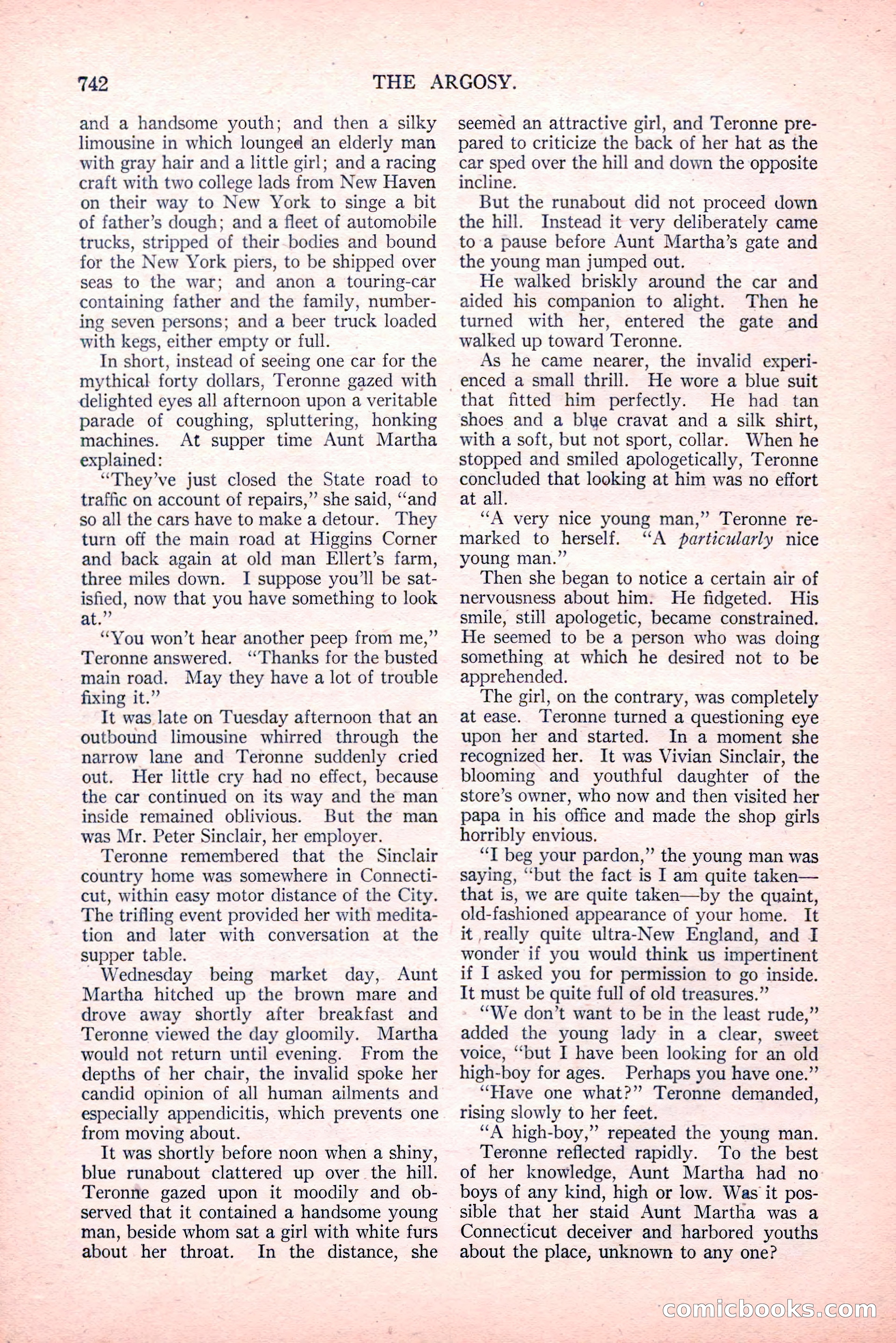
A restored page from Pulp Fiction, 1916. Page through the whole issue in the reader above.
📄 Transcribed text from this page (OCR, searchable)
Machine-transcribed from the original scan — historical spelling and the odd misread are preserved.
742 and a handsome youth; and then a silky limousine in which lounged an elderly man with gray hair and a little girl; and a racing craft with two college lads from New Haven on their way to New York to singe a bit of father’s dough; and a fleet of automobile trucks, stripped of their_bodies and bound for the New York piers, to be shipped over seas to the war; and anon a touring-car containing father and the family, number- ing seven persons; and a beer truck loaded with kegs, either empty or full. In short, instead of seeing one car for the mythical forty dollars, Teronne gazed with delighted eyes all afternoon upon a veritable parade of coughing, spluttering, honking machines. At supper time Aunt Martha explained: “They’ve just closed the State road to traffic on account of repairs,” she said, “‘and so all the cars have to make a detour. They turn off the main road at Higgins Corner and back again at old man Ellert’s farm, three miles down. I suppose you'll be sat- isfied, now that you have something to look at.” “You won’t hear another peep from me,” Teronne answered. ‘Thanks for the busted main road. May they have a lot of trouble fixing it.” It was late on Tuesday afternoon that an outbound limousine whirred through the narrow lane and Teronne suddenly cried out. Her little cry had no effect, because the car continued on its way and the man inside remained oblivious. But the man was Mr. Peter Sinclair, her employer. Teronne remembered that the Sinclair country home was somewhere in Connecti- cut, within easy motor distance of the City. The trifling event provided her with medita- tion and later with conversation at the supper table. - Wednesday being market day, Aunt Martha hitched up the brown mare and drove away shortly after breakfast and Teronne viewed the day gloomily. Martha would not return until evening. From the depths of her chair, the invalid spoke her candid opinion of all human ailments and especially appendicitis, which prevents one from moving about. It was shortly before noon when a shiny, blue runabout clattered up over the hill. Teronne gazed upon it moodily and ob- served that it contained a handsome young man, beside whom sat a girl with white furs about her throat. In the distance, she THE ARGOSY. seemed an attractive girl, and Teronne pre- pared to criticize the back of her hat as the car sped over the hill and down the opposite incline. But the runabout did not proceed down the hill. Instead it very deliberately came to a pause before Aunt Martha’s gate and the young man jumped out. He walked briskly around the car and aided his companion to alight. Then he turned with her, entered the gate and walked up toward Teronne. As he came nearer, the invalid experi- enced a small thrill. He wore a blue suit that fitted him perfectly. He had tan shoes and a blue cravat and a silk shirt, with a soft, but not sport, collar. When he stopped and smiled apologetically, Teronne concluded that looking at him was no effort at all. “A very nice young man,” Teronne re- marked to herself. “A particularly nice young man.” Then she began to notice a certain air of nervousness about him: He fidgeted. His smile, still apologetic, became constrained. He seemed to be a person who was doing something at which he desired not to be apprehended. The girl, on the contrary, was completely at ease. Teronne turned a questioning eye upon her and started. In a moment she recognized her. It was Vivian Sinclair, the blooming and youthful daughter of the store’s owner, who now and then visited her papa in his office and made the shop girls horribly envious. “T beg your pardon,” the young man was saying, “but the fact is I am quite taken— that is, we are quite taken—by the quaint, old-fashioned appearance of your home. It it really quite ultra-New England, and I wonder if you would think us impertinent if I asked you for permission to go inside. It must be quite full of old treasures.” “We don’t want to be in the least rude,” added the young lady in a clear, sweet voice, “but I have been looking for an old high-boy for ages. Perhaps you have one.”’ ‘““Hlave one what?” Teronne demanded, rising slowly to her feet. “A high-boy,” repeated the young man. Teronne reflected rapidly. To the best of her knowledge, Aunt Martha had no boys of any kind, high or low. Was it pos- sible that her staid Aunt Martha was a Connecticut deceiver and harbored youths about the place, unknown to any one? iGO .DOOK AUG (E@)