
Pulp Fiction, 1916 · page 178 of 216
The Argosy, Vol. 81, No. 4 — page 178: what you’re looking at
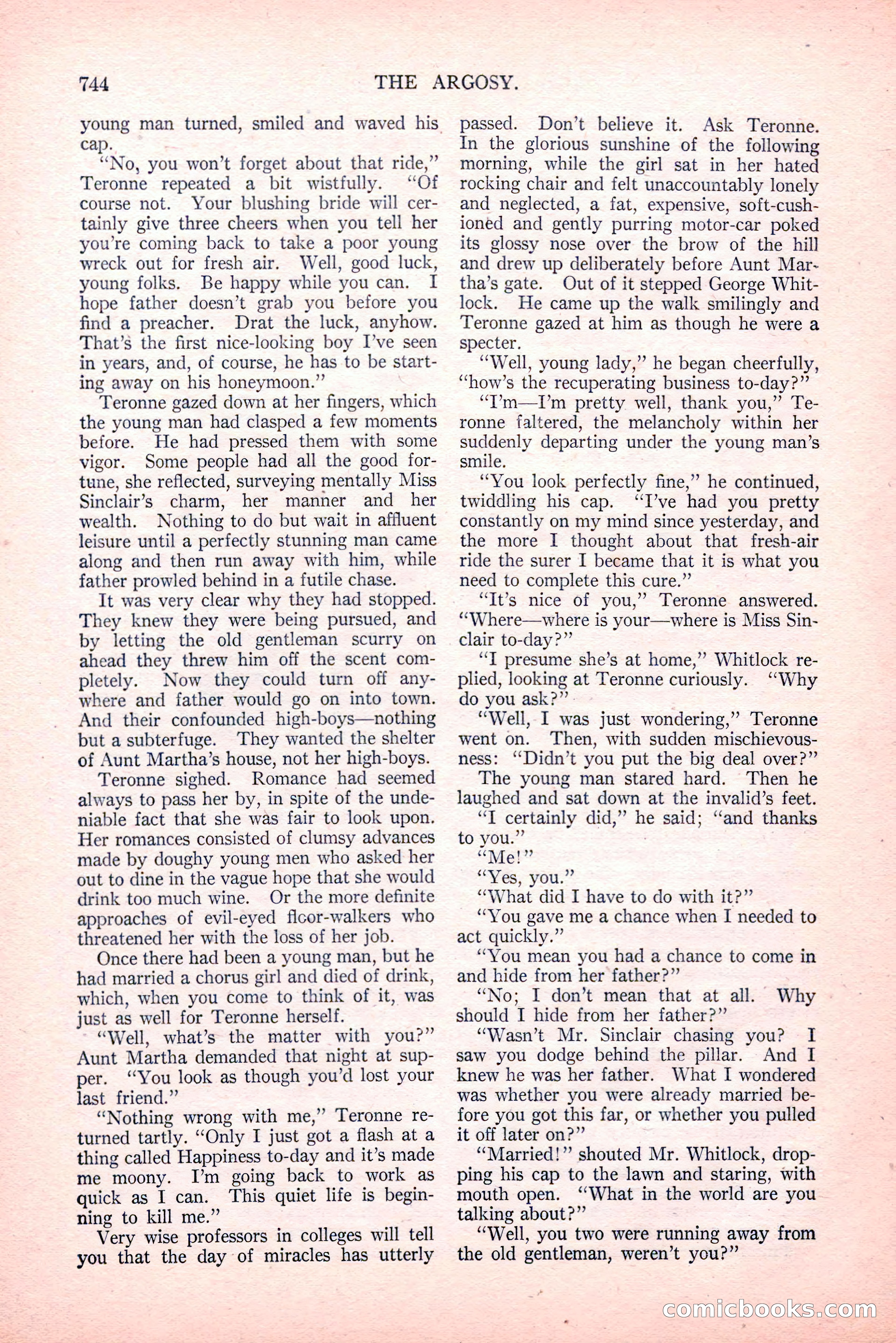
A restored page from Pulp Fiction, 1916. Page through the whole issue in the reader above.
📄 Transcribed text from this page (OCR, searchable)
Machine-transcribed from the original scan — historical spelling and the odd misread are preserved.
744 THE young man turned, smiled and waved his cap. “No, you won’t forget about that ride, Teronne repeated a bit wistfully. “Of course not. Your blushing bride will cer- tainly give three cheers when you tell her you’re coming back to take a poor young wreck out for fresh air. Well, good luck, young folks. Be happy while you can. I hope father doesn’t grab you before you find a preacher. Drat the luck, anyhow. That’s the first nice-looking boy I’ve seen in years, and, of course, he has to be start- ing away on his honeymoon.” Teronne gazed down at her fingers, which the young man had clasped a few moments before. He had pressed them with some vigor. Some people had all the good for- tune, she reflected, surveying mentally Miss Sinclair’s charm, her manner and _ her wealth. Nothing to do but wait in affluent leisure until a perfectly stunning man came along and then run away with him, while father prowled behind in a futile chase. It was very clear why they had stopped. They knew they were being pursued, and by letting the old gentleman scurry on ahead they threw him off the scent com- pletely. Now they could turn off any- where and father would go on into town. And their confounded high-boys—nothing but a subterfuge. They wanted the shelter of Aunt Martha’s house, not her high-boys. Teronne sighed. Romance had seemed always to pass her by, in spite of the unde- niable fact that she was fair to look upon. Her romances consisted of clumsy advances made by doughy young men who asked her out to dine in the vague hope that she would drink too much wine. Or the more definite approaches of evil-eyed flcor-walkers who threatened her with the loss of her job. Once there had been a young man, but he had married a chorus girl and died of drink, which, when you come to think of it, was just as well for Teronne herself. “Well, what’s the matter with you?” Aunt Martha demanded that night at sup- per. ‘You look as though you’d lost your last friend.” 3 “Nothing wrong with me,” Teronne re- turned tartly. “Only I just got a flash at a thing called Happiness to-day and it’s made me moony. I’m going back to work as quick as I can. This quiet life is begin- ning to kill me.” Very wise professors in colleges will tell you that the day of miracles has utterly ? ARGOSY. passed. Don’t believe it. Ask Teronne. In the glorious sunshine of the following morning, while the girl sat in her hated rocking chair and felt unaccountably lonely and neglected, a fat, expensive, soft-cush- ioned and gently purring motor-car poked its glossy nose over the brow of the hill and drew up deliberately before Aunt Mar- tha’s gate. Out of it stepped George Whit- lock. He came up the walk smilingly and Teronne gazed at him as though he were a specter. ‘Well, young lady,” he began cheerfully, ‘“how’s the recuperating business to-day?” “m—l’m pretty well, thank you,” Te- ronne faltered, the melancholy within her suddenly departing under the young man’s smile. ‘You look perfectly fine,” he continued, twiddling his cap. “I’ve had you pretty constantly on my mind since yesterday, and the more I thought about that fresh-air ride the surer I became that it is what you need to complete this cure.” “It’s nice of you,” Teronne answered. “‘Where—where is your—where is Miss Sin- clair to-day?” ‘““T presume she’s at home,”’ Whitlock re- plied, looking at Teronne curiously. ‘‘Why do you ask?” “Well, I was just wondering,” Teronne went on. Then, with sudden mischievous- ness: ‘“‘Didn’t you put the big deal over?” The young man stared hard. Then he laughed and sat down at the invalid’s feet. “T certainly did,” he said; ‘and thanks to you.” . “We! ») “Ves, you.” “What did I have to do with it?” ‘““You gave me a chance when I needed to act quickly.” “You mean you had a chance to come in and hide from her father?” “No; I don’t mean that at all. should I hide from her father?” “Wasn’t Mr. Sinclair chasing you? I saw you dodge behind the pillar. And I knew he was her father. What I wondered was whether you were already married be- fore you got this far, or whether you pulled it off later on?” “Married!” shouted Mr. Whitlock, drop- ping his cap to the lawn and staring, with mouth open. “What in the world are you talking about?” “Well, you two were running away from the old gentleman, weren’t you?” Why CONMUC VOOLKS (C@)