
Pulp Fiction, 1916 · page 175 of 216
The Argosy, Vol. 81, No. 4 — page 175: what you’re looking at
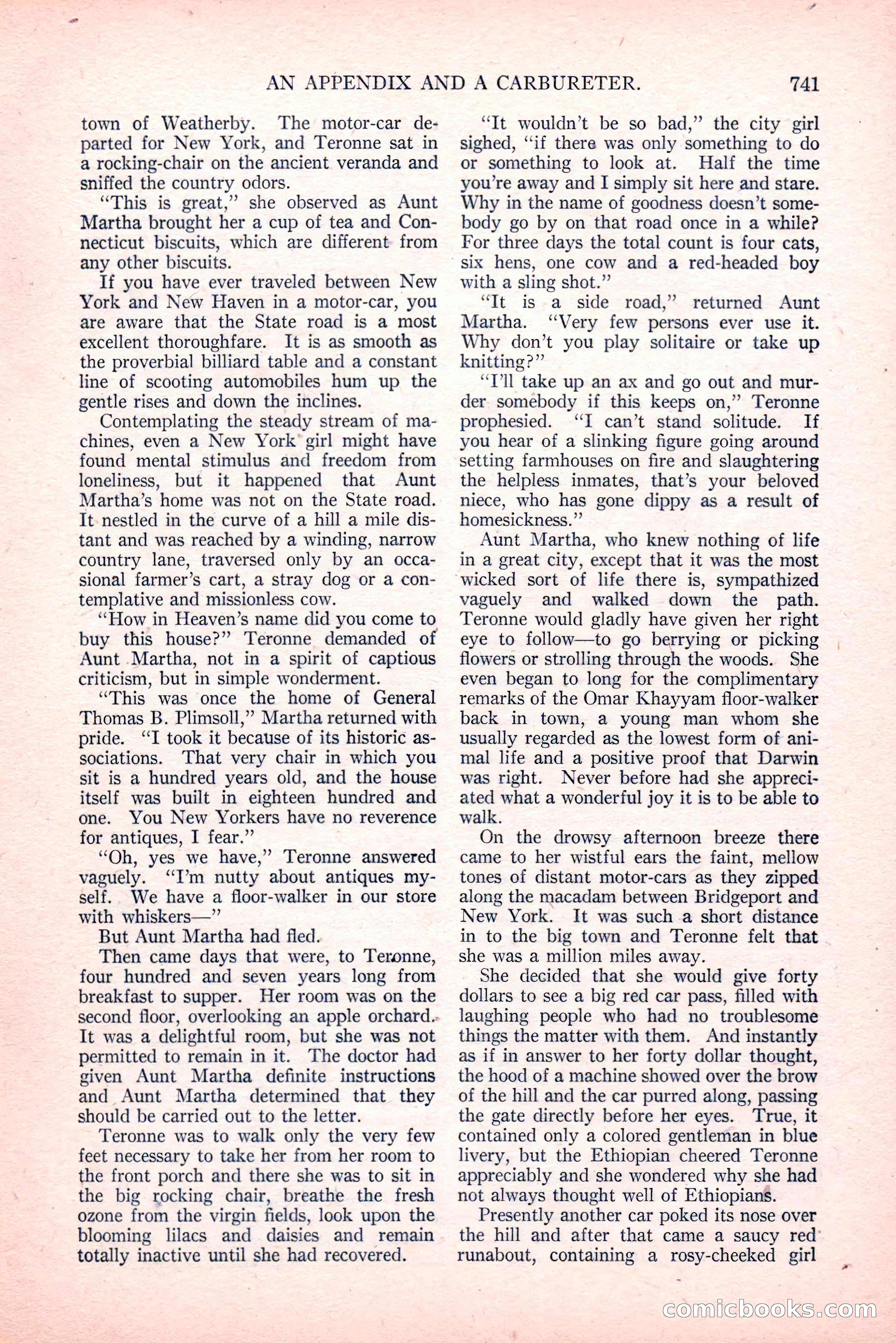
A restored page from Pulp Fiction, 1916. Page through the whole issue in the reader above.
📄 Transcribed text from this page (OCR, searchable)
Machine-transcribed from the original scan — historical spelling and the odd misread are preserved.
AN APPENDIX AND A CARBURETER. town of Weatherby. The motor-car de- parted for New York, and Teronne sat in a rocking-chair on the ancient veranda and sniffed the country odors. “This is great,” she observed as Aunt Martha brought her a cup of tea and Con- necticut biscuits, which are different from any other biscuits. If you have ever traveled between New York and New Haven in a motor-car, you are aware that the State road is a most excellent thoroughfare. It is as smooth as the proverbial billiard table and a constant - line of scooting automobiles hum up the gentle rises and down the inclines. Contemplating the steady stream of ma- chines, even a New York’ girl might have found mental stimulus and freedom from loneliness, but it happened that Aunt Martha’s home was not on the State road. It nestled in the curve of a hill a mile dis- tant and was reached by a winding, narrow country lane, traversed only by an occa- sional farmer’s cart, a stray dog or a con- templative and missionless cow. ‘““How in Heaven’s name did you come to buy this house?” Teronne demanded of Aunt .Martha, not in a spirit of captious criticism, but in simple wonderment. “This was once the home of General Thomas B. Plimsoll,” Martha returned with pride. ‘I took it because of its historic as- sociations. That very chair in which you sit is a hundred years old, and the house itself was built in eighteen hundred and one. You New Yorkers have no reverence for antiques, I fear.”’ “Oh, yes we have,” Teronne answered vaguely. “I’m nutty about antiques my- self. We have a floor-walker in our store with whiskers—”’ But Aunt Martha had fled. Then came days that were, to Teronne, four hundred and seven years long from breakfast to supper. Her room was on the second floor, overlooking an apple orchard.. It was a delightful room, but she was not permitted to remain in it. The doctor had given Aunt Martha definite instructions and Aunt Martha determined that they should be carried out to the letter. Teronne was to walk only the very few feet necessary to take her from her room to the front porch and there she was to sit in the big rocking chair, breathe the fresh ozone from the virgin fields, look upon the blooming lilacs and daisies and remain totally inactive until she had recovered. 741 “Tt wouldn’t be so bad,” the city girl sighed, “if there was only something to do or something to look at. Half the time you're away and I simply sit here and stare. Why in the name of goodness doesn’t some- body go by on that road once in a while? For three days the total count is four cats, six hens, one cow and a red-headed boy with a sling shot.” “It is a side road,” returned Aunt Martha. “Very few persons ever use it. Why don’t you play solitaire or take up knitting?” “Tl take up an ax and go out and mur- der somebody if this keeps on,” Teronne prophesied. ‘I can’t stand solitude. you hear of a slinking figure going around setting farmhouses on fire and slaughtering the helpless inmates, that’s your beloved niece, who has gone dippy as a result of homesickness.” | Aunt Martha, who knew nothing of life in a great city, except that it was the most wicked sort of life there is, sympathized vaguely and walked down the path. Teronne would gladly have given her right eye to follow—to go berrying or picking flowers or strolling through the woods. She even began to long for the complimentary remarks of the Omar Khayyam floor-walker back in town, a young man whom she usually regarded as the lowest form of ani- mal life and a positive proof that Darwin was right. Never before had she appreci- ated what a wonderful joy it is to be able to walk. On the drowsy afternoon breeze there came to her wistful ears the faint, mellow tones of distant motor-cars as they zipped along the macadam between Bridgeport and New York. It was such a short distance in to the big town and Teronne felt that she was a million miles away. She decided that she would give forty dollars to see a big red car pass, filled with laughing people who had no troublesome things the matter with them. And instantly as if in answer to her forty dollar thought, the hood of a machine showed over the brow of the hill and the car purred along, passing the gate directly before her eyes. True, it contained only a colored gentleman in blue livery, but the Ethiopian cheered Teronne appreciably and she wondered why she had not always thought well of Ethiopians. Presently another car poked its nose over the hill and after that came a saucy red’ runabout, containing a rosy-cheeked girl CORNICGLOOOKS If (C@