
Pulp Fiction, 1916 · page 168 of 216
The Argosy, Vol. 81, No. 4 — page 168: what you’re looking at
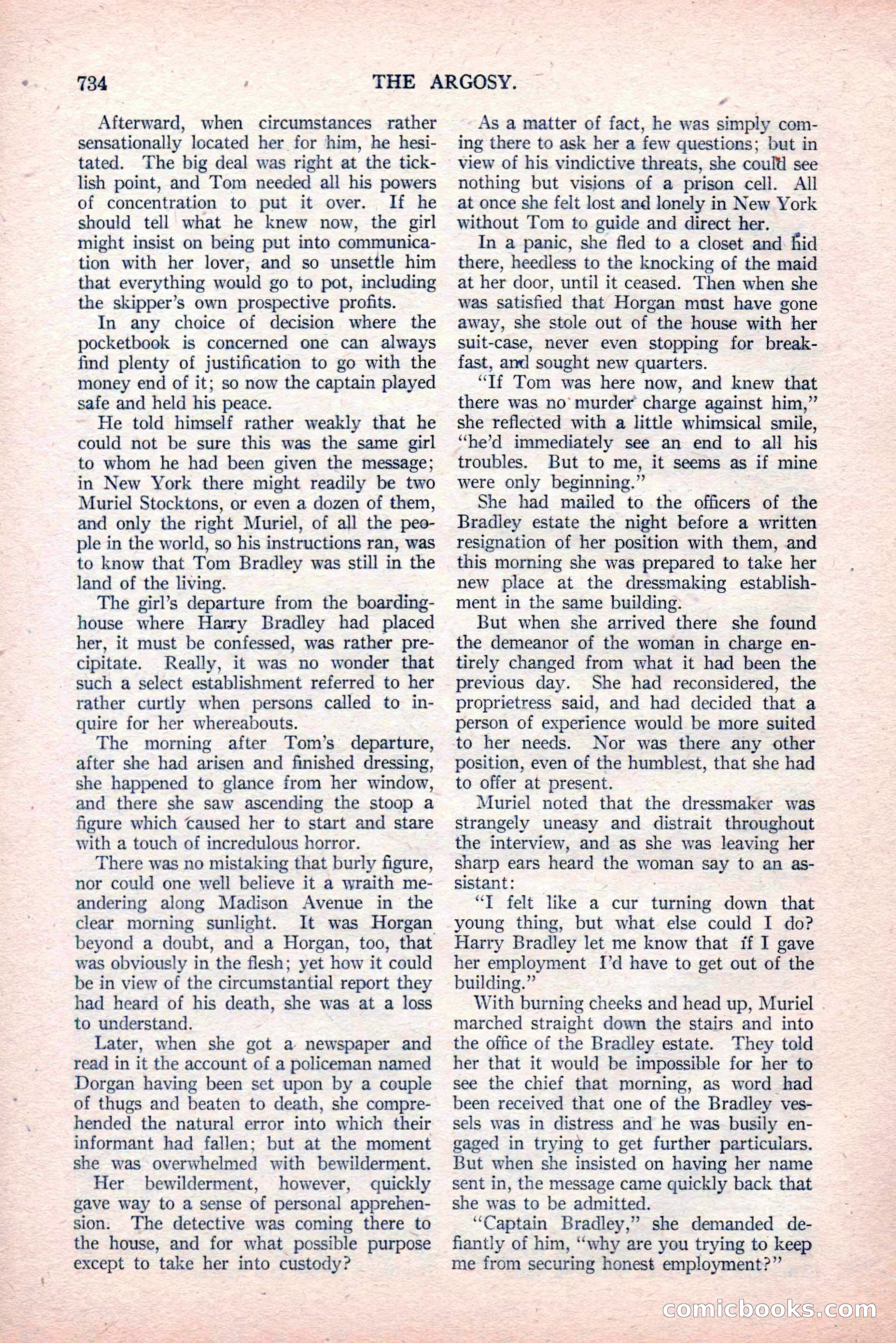
A restored page from Pulp Fiction, 1916. Page through the whole issue in the reader above.
📄 Transcribed text from this page (OCR, searchable)
Machine-transcribed from the original scan — historical spelling and the odd misread are preserved.
734 Afterward, when circumstances rather sensationally located her for him, he hesi- tated. The big deal was right at the tick- lish point, and Tom needed all his powers of concentration to put it over. If he should tell what he knew now, the girl might insist on being put into communica- tion with her lover, and so unsettle him that everything would go to pot, including the skipper’s own prospective profits. In any choice of decision where the pocketbook is concerned one can always find plenty of justification to go with the money end of it; so now the captain played safe and held his peace. He told himself rather weakly that he could not be sure this was the same girl to whom he had been given the message; in New York there might readily be two Muriel Stocktons, or even a dozen of them, and only the right Muriel, of all the peo- ple in the world, so his instructions ran, was to know that Tom Bradley was still in the land of the living. The girl’s departure from the boarding- house where Harry Bradley had placed her, it must be confessed, was rather pre- cipitate. Really, it was no wonder that _ such a select establishment referred to her rather curtly when persons called to in- quire for her whereabouts. The morning after Tom’s_ departure, after she had arisen and finished dressing, she happened to glance from her window, and there she saw ascending the stoop a figure which caused her to start and stare with a touch of incredulous horror. There was no mistaking that burly figure, nor could one well believe it a wraith me- andering along Madison Avenue in the clear morning sunlight. It was Horgan beyond a doubt, and a Horgan, too, that was obviously in the flesh; yet how it could be in view of the circumstantial report they had heard of his death, she was at a loss to understand. Later, when she got a newspaper and read in it the account of a policeman named Dorgan having been set upon by a couple of thugs and beaten to death, she compre- hended the natural error into which their informant had fallen; but at the moment she was overwhelmed with bewilderment. Her bewilderment, however, quickly gave way to a sense of personal apprehen- sion. The detective was coming there to the house, and for what possible purpose except to take her into custody? THE ARGOSY. ¢ As a matter of fact, he was simply com- ing there to ask her a few questions; but in view of his vindictive threats, she could see nothing but visions of a prison cell. All at once she felt lost and lonely in New York without Tom to guide and direct her. In a panic, she fled to a closet and hid there, heedless to the knocking of the maid at her door, until it ceased. Then when she was satisfied that Horgan must have gone away, she stole out of the house with her suit-case, never even stopping for break- fast, and sought new quarters. “Tf Tom was here now, and knew that there was no murder charge against him,” she reflected with a little whimsical smile, “he’d immediately see an end to all his troubles. But to me, it seems as if mine were only beginning.” She had mailed to the officers of the Bradley estate the night before a written resignation of her position with them, and this morning she was prepared to take her new place at the dressmaking establish- ment in the same building: But when she arrived there she found the demeanor of the woman in charge en- tirely changed from what it had been the previous day. She had reconsidered, the proprietress said, and had decided that a person of experience would be more suited to her needs. Nor was there any other position, even of the humblest, that she had to offer at present. Muriel noted that the dressmaker was strangely uneasy and distrait throughout the interview, and as she was leaving her sharp ears heard the woman say to an as- sistant: “T felt like a cur funding down that young thing, but what else could I do? Harry Bradley let me know that if I gave her employment I’d have to get out of the building.” With burning cheeks and head up, Muriel marched straight down the stairs and into the office of the Bradley estate. They told her that it would be impossible for her to see the chief that morning, as word had been received that one of the Bradley ves- sels was in distress and he was busily en- gaged in trying to get further particulars. But when she insisted on having her name sent in, the message came quickly back that she was to be admitted. “Captain Bradley,” she demanded de- fiantly of him, ‘why are you trying to keep me from securing honest employment?” COPMICLOOOKS (E@)