
Pulp Fiction, 1916 · page 167 of 216
The Argosy, Vol. 81, No. 4 — page 167: what you’re looking at
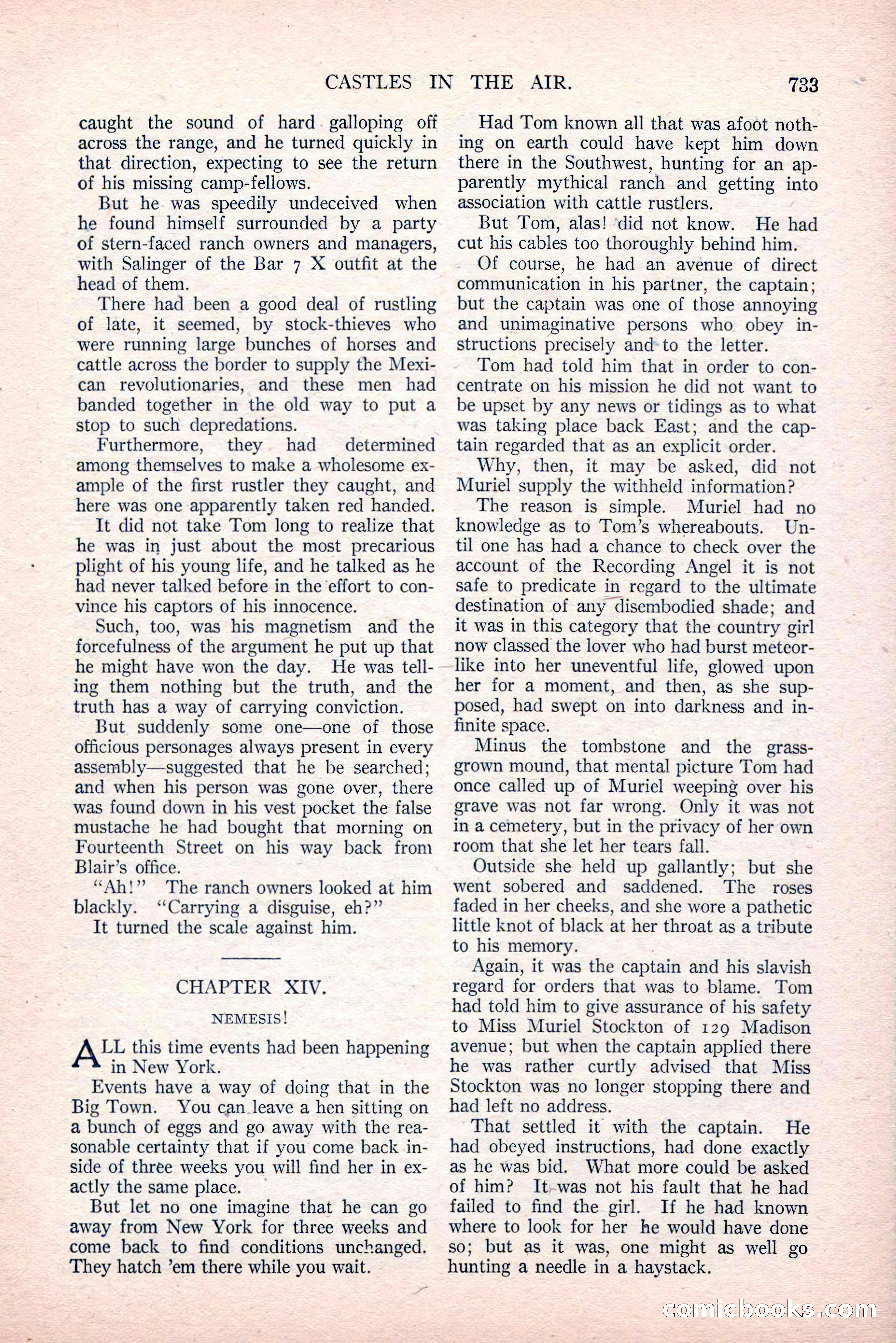
A restored page from Pulp Fiction, 1916. Page through the whole issue in the reader above.
📄 Transcribed text from this page (OCR, searchable)
Machine-transcribed from the original scan — historical spelling and the odd misread are preserved.
CASTLES IN THE caught the sound of hard. galloping off across the range, and he turned quickly in that direction, expecting to see the return of his missing camp-fellows. But he was speedily undeceived when he found himself surrounded by a party of stern-faced ranch owners and managers, with Salinger of the Bar 7 X outfit at the head of them. There had been a good deal of rustling of late, it seemed, by stock-thieves who were running large bunches of horses and cattle across the border to supply the Mexi- can revolutionaries, and these men had banded together in the old way to put a stop to such depredations. Furthermore, they had determined among themselves to make a wholesome ex- ample of the first rustler they caught, and here was one apparently taken red handed. It did not take Tom long to realize that he was in just about the most precarious plight of his young life, and he talked as he had never talked before in the ‘effort to con- vince his captors of his innocence. Such, too, was his magnetism and the forcefulness of the argument he put up that he might have won the day. He was tell- ing them nothing but the truth, and the truth has a way of carrying conviction. But suddenly some one—one of those officious personages always present in every assembly—suggested that he be searched; and when his person was gone over, there was found down in his vest pocket the false mustache he had bought that morning on Fourteenth Street on his way back from Blair’s office. “Ah!” The ranch owners looked at him blackly. “Carrying a disguise, eh?” It turned the scale against him. CHAPTER XIV. NEMESIS! Alt this time events had been happening in New York. Events have a way of doing that in the Big Town. You can leave a hen sitting on a bunch of eggs and go away with the rea- sonable certainty that if you come back in- side of three weeks you will find her in ex- actly the same place. But let no one imagine that he can go away from New York for three weeks and come back to find conditions unchanged. They hatch ’em there while you wait. ATR. 733 Had Tom known all that was afoot noth- ing on earth could have kept him down there in the Southwest, hunting for an ap- parently mythical ranch and getting into association with cattle rustlers. But Tom, alas! ‘did not know. He had cut his cables too thoroughly behind him. Of course, he had an avenue of direct communication in his partner, the captain; but the captain was one of those annoying and unimaginative persons who obey in- structions precisely and-to the letter. Tom had told him that in order to con- centrate on his mission he did not want to be upset by any news or tidings as to what was taking place back East; and the cap- tain regarded that as an explicit order. Why, then, it may be asked, did not Muriel supply the withheld information? The reason is simple. Muriel had no knowledge as to Tom’s whereabouts. Un- til one has had a chance to check over the account of the Recording Angel it is not safe to predicate in regard to the ultimate destination of any disembodied shade; and it was in this category that the country girl now classed the lover who had burst meteor- like into her uneventful life, glowed upon her for a moment, and then, as she sup- posed, had swept on into darkness and in- finite space. Minus the tombstone and the grass- grown mound, that mental picture Tom had once called up of Muriel weeping over his grave was not far wrong. Only it was not in a cemetery, but in the privacy of her own room that she let her tears fall. Outside she held up gallantly; but she went sobered and saddened. The roses faded in her cheeks, and she wore a pathetic little knot of black at her throat as a tribute to his memory. Again, it was the captain and his slavish regard for orders that was to blame. Tom had told him to give assurance of his safety to Miss Muriel Stockton of 129 Madison avenue; but when the captain applied there he was rather curtly advised that Miss Stockton was no longer stopping there and had left no address. That settled it with the captain. He had obeyed instructions, had done exactly as he was bid. What more could be asked of him? It-was not his fault that he had failed to find the girl. If he had known where to look for her he would have done so; but as it was, one might as well go hunting a needle in a haystack. COPMICLOOOKS (C@)