
Pulp Fiction, 1916 · page 169 of 216
The Argosy, Vol. 81, No. 4 — page 169: what you’re looking at
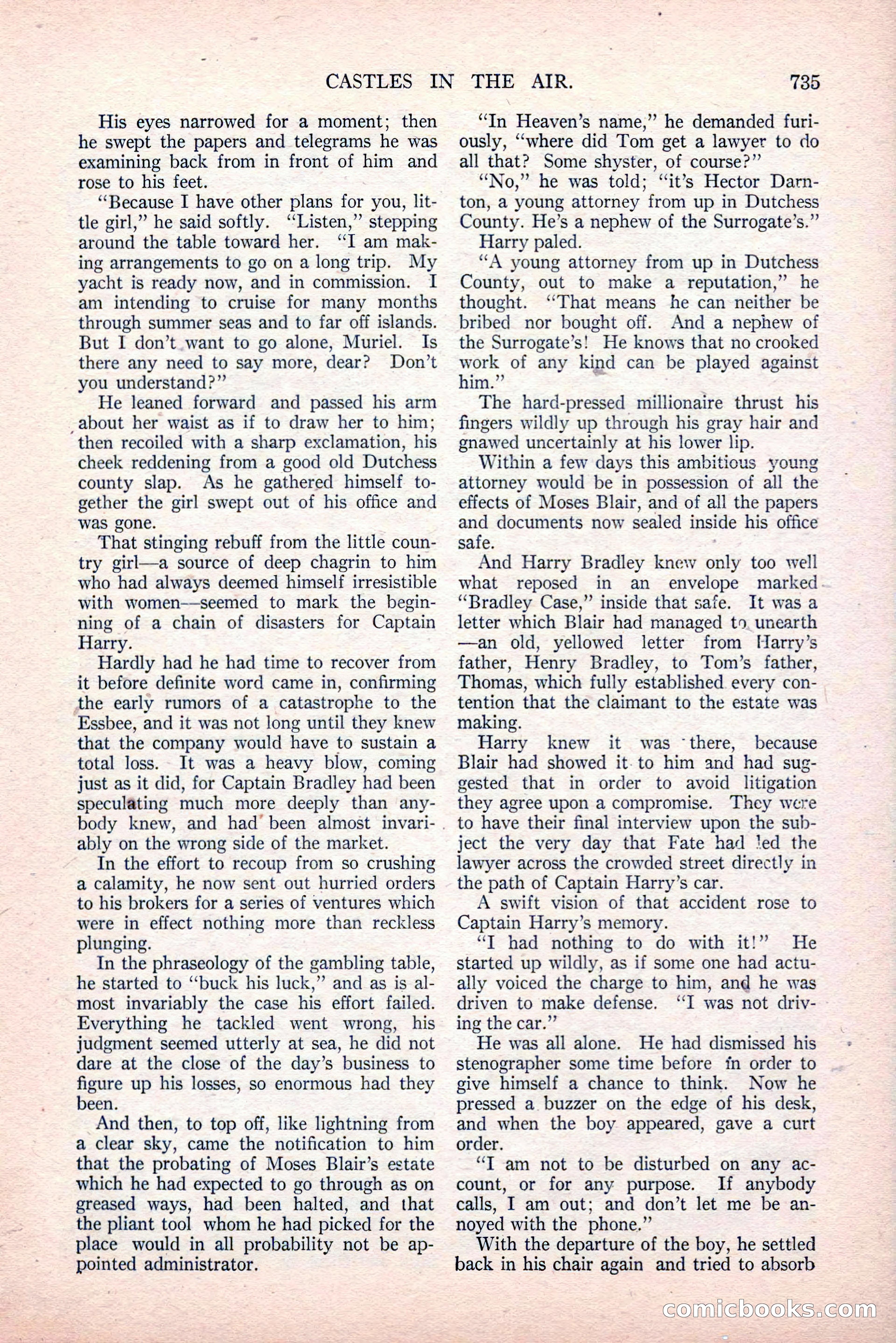
A restored page from Pulp Fiction, 1916. Page through the whole issue in the reader above.
📄 Transcribed text from this page (OCR, searchable)
Machine-transcribed from the original scan — historical spelling and the odd misread are preserved.
CASTLES IN His eyes narrowed for a moment; then he swept the papers and telegrams he was examining back from in front of him and rose to his feet. “Because I have other plans for you, lit- tle girl,” he said softly. “Listen,” stepping around the table toward her. “I am mak- ing arrangements to go on a long trip. My yacht is ready now, and in commission. I am intending to cruise for many months through summer seas and to far off islands. But I don’t want to go alone, Muriel. Is there any need to say more, dear? Don’t you understand?” He leaned forward and passed his arm -about her waist as if to draw her to him; then recoiled with a sharp exclamation, his cheek reddening from a good old Dutchess county slap. As he gathered himself to- gether the girl swept out of his office and was gone. That stinging rebuff from the little coun- try girl—a source of deep chagrin to him who had always deemed himself irresistible with women—seemed to mark the begin- ning of a chain of disasters for Captain Harry. Hardly had he had time to recover from it before definite word came in, confirming the early rumors of a catastrophe to the Essbee, and it was not long until they knew that the company would have to sustain a total loss. It was a heavy blow, coming just as it did, for Captain Bradley had been speculating much more deeply than any- body knew, and had been almost invari- . ably on the wrong side of the market. In the effort to recoup from so crushing a calamity, he now sent out hurried orders to his brokers for a series of ventures which were in effect nothing more than reckless plunging. In the phraseology of the gambling table, he started to “buck his luck,” and as is al- most invariably the case his effort failed. Everything he tackled went wrong, his judgment seemed utterly at sea, he did not dare at the close of the day’s business to figure up his losses, so enormous had they been. And then, to top off, like lightning from a clear sky, came the notification to him that the probating of Moses Blair’s estate which he had expected to go through as on greased ways, had been halted, and that the pliant tool whom he had picked for the place would in all probability not be ap- pointed administrator. THE AIR. 735 “In Heaven’s name,” he demanded furi- ously, ‘where did Tom get a lawyer to do all that? Some shyster, of course?” “No,” he was told; “it’s Hector Darn- ton, a young attorney from up in Dutchess County. He’s a nephew of the Surrogate’s.”’ Harry paled. “A young attorney from up in Dutchess County, out to make a reputation,” he thought. “That means he can neither be bribed nor bought off. And a nephew of the Surrogate’s! He knows that no crooked work of any kind can be played against him.” The hard-pressed millionaire thrust his fingers wildly up through his gray hair and gnawed uncertainly at his lower lip. Within a few days this ambitious young attorney would be in possession of all the effects of Moses Blair, and of all the papers and documents now sealed inside his office safe. : And Harry Bradley knew only too well what reposed “Bradley Case,” inside that safe. It was a letter which Blair had managed to. unearth —an old, yellowed letter from Harry’s father, Henry Bradley, to Tom’s father, Thomas, which fully established every con- tention that the claimant to the estate was making. Harry knew it was “there, because Blair had showed it. to him and had sug- gested that in order to avoid litigation they agree upon a compromise. They were to have their final interview upon the sub- ject the very day that Fate had !ed the lawyer across the crowded street directly in the path of Captain Harry’s car. A swift vision of that accident rose to Captain Harry’s memory. “T had nothing to do with it!” He started up wildly, as if some one had actu- ally voiced the charge to him, and he was driven to make defense. “I was not driv- ing the car.” He was all alone. He had dismissed his stenographer some time before in order to give himself a chance to think. Now he pressed a buzzer on the edge of his desk, and when the boy appeared, gave a curt order. “T am not to be disturbed on any ac- count, or for any purpose. If anybody calls, I am out; and don’t let me be an- noyed with the phone.” With the departure of the boy, he settled back in his chair again and tried to absorb COMIC S in an envelope marked. 0)(0\0) (E@)