
Pulp Fiction, 1916 · page 122 of 216
The Argosy, Vol. 81, No. 4 — page 122: what you’re looking at
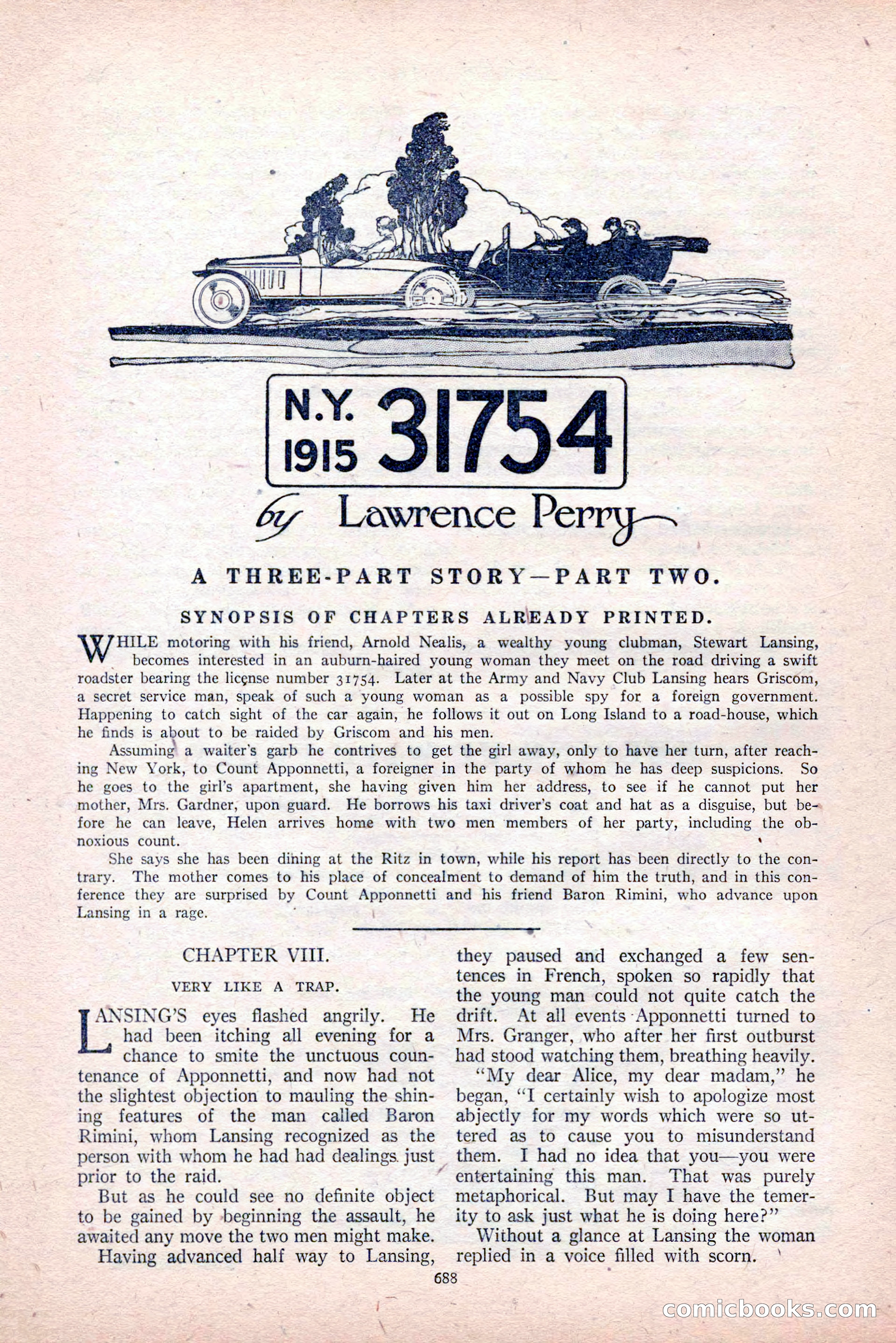
A restored page from Pulp Fiction, 1916. Page through the whole issue in the reader above.
📄 Transcribed text from this page (OCR, searchable)
Machine-transcribed from the original scan — historical spelling and the odd misread are preserved.
ae 3175: 6 Lawrence Perry— A THREE-PART STORY—PART TWO. SYNOPSIS OF CHAPTERS ALREADY PRINTED. HILE motoring with his friend, Arnold Nealis, a wealthy young clubman, Stewart Lansing, _ becomes interested in an auburn-haired young woman they meet on the road driving a swift roadster bearing the license number 31754. Later at the Army and Navy Club Lansing hears Griscom, a secret service man, speak of such a young woman as a possible spy for a foreign government. Happening to catch sight of the car again, he follows it out on Long Island to a road-house, which he finds is about to be raided by Griscom and his men. Assuming a waiter’s garb he contrives to get the girl away, only to have her turn, after reach- ing New York, to Count Apponnetti, a foreigner in the party of whom he has deep suspicions. So he goes to the girl’s apartment, she having given him her address, to see if he cannot put her mother, Mrs. Gardner, upon guard. He borrows his taxi driver’s coat and hat as a disguise, but be— fore he can leave, Helen arrives home with two men members of her party, including the ob- noxious count. ‘ She says she has been dining at the Ritz in town, while his report has been directly to the con- trary. The mother comes to his place of concealment to demand of him the truth, and in this con- ference they are surprised by Count Apponnetti and his friend Baron Rimini, who advance upon Lansing in a rage. | CHAPTER VIII. VERY LIKE A TRAP. ANSING’S eyes flashed angrily. He had been itching all evening for a they paused and exchanged a few sen- tences in French, spoken so rapidly that the young man could not quite catch the drift. At all events Apponnetti turned to Mrs. Granger, who after her first outburst chance to smite the unctuous coun- tenance of Apponnetti, and now had not the slightest objection to mauling the shin- ing features of the man called Baron Rimini, whom Lansing recognized as the person ‘with whom he had had dealings. just | prior to the raid. But as he could see no definite object to be gained by beginning the assault, he awaited any move the two men might make. Having advanced half way to Lansing, had stood watching them, breathing heavily. “My dear Alice, my dear madam,” he began, “I certainly wish to apologize most abjectly for my words which were so ut- tered as to cause you to misunderstand them. I had no idea that you—you were ' entertaining this man. That was purely metaphorical. But may I have the temer- ity to ask just what he is doing here?” Without a glance at Lansing the woman replied in a voice filled with scorn. ' 688 EORMICLOOOLK< (C (©)