
Pulp Fiction, 1916 · page 121 of 216
The Argosy, Vol. 81, No. 4 — page 121: what you’re looking at
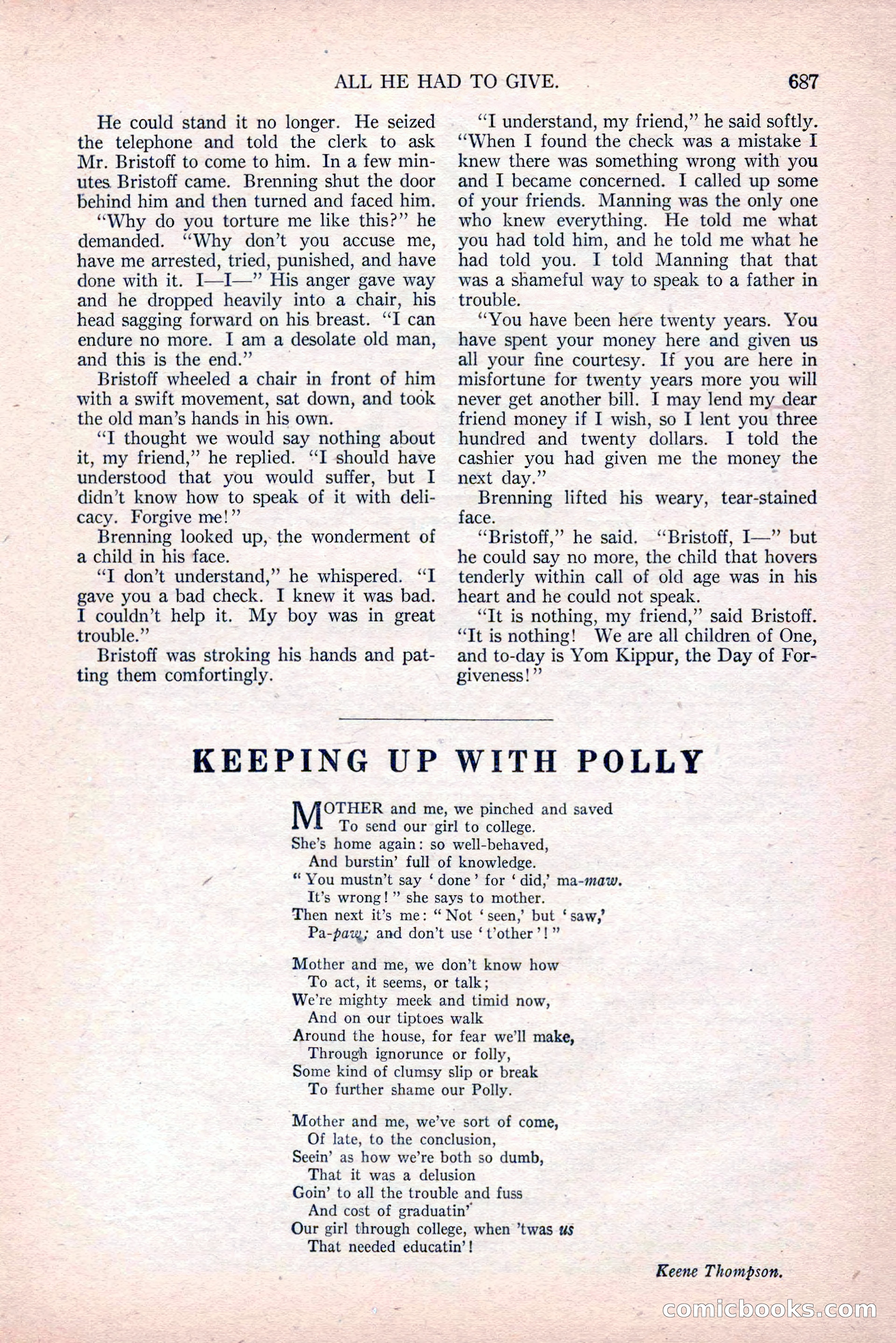
A restored page from Pulp Fiction, 1916. Page through the whole issue in the reader above.
📄 Transcribed text from this page (OCR, searchable)
Machine-transcribed from the original scan — historical spelling and the odd misread are preserved.
ALL HE HAD TO GIVE. He could stand it no longer. He seized the telephone and told the clerk to ask Mr. Bristoff to come to him. In a few min- utes. Bristoff came. Brenning shut the door behind him and then turned and faced him. “Why do you torture me like this?” he demanded. ‘‘Why don’t you accuse me, have me arrested, tried, punished, and have done with it. I—I—” His anger gave way and he dropped heavily into a chair, his head sagging forward on his breast. “I can endure no more. I am a desolate old man, and this is the end.” | Bristoff wheeled a chair in front of him with a swift movement, sat down, and took the old man’s hands in his own. “T thought we would say nothing about it, my friend,” he replied. “I should have understood that you would suffer, but I didn’t know how to speak of it with deli- cacy. Forgive me!”’ Brenning looked up, the wonderment of a child in his face. “YT don’t understand,” he whispered. “I gave you a bad check. I knew it was bad. I couldn’t help it. My boy was in great trouble.”’ Bristoff was stroking his hands and pat- ting them comfortingly. 687 “T understand, my friend,” he said softly. “When I found the check was a mistake I knew there was something wrong with you and I became concerned. I called up some of your friends. Manning was the only one who knew everything. He told me what you had told him, and he told me what he had told you. I told Manning that that was a shameful way to speak to a father in trouble. “You have been here twenty years. You have spent your money here and given us all your fine courtesy. If you are here in misfortune for twenty years more you will never get another bill. I may lend my dear friend money if I wish, so I lent you three hundred and twenty dollars. I told the cashier you had given me the money the next day.” Brenning lifted his weary, tear-stained face. “Bristoff,” he said. ‘Bristoff, I—” but he could say no more, the child that hovers tenderly within call of old age was in his heart and he could not speak. “Tt is nothing, my friend,” said Bristoff. “Tt is nothing! We are all children of One, and to-day is Yom Kippur, the Day of For- giveness!” KEEPING UP WITH POLLY OTHER and me, we pinched and saved To send our girl to college. She’s home again: so well-behaved, And burstin’ full of knowledge. * You mustn’t say ‘ done’ for ‘ did,’ ma-maw. It’s wrong!” she says to mother. Then next it’s me: “ Not ‘seen,’ but ‘saw,’ Pa-paw; and don’t use ‘t’other’!” Mother and me, we don’t know how To act, it seems, or talk; We're mighty meek and timid now, And on our tiptoes walk Around the house, for fear we'll make, Through ignorunce or folly, Some kind of clumsy slip or break To further shame our Polly. Mother and me, we’ve sort of come, Of late, to the conclusion, Seein’ as how we’re both so dumb, That it was a delusion Goin’ to all the trouble and fuss And cost of graduatin” Our girl through college, when ’twas us That needed educatin’! Keene Thompson. Gomichook (E@)