
Pulp Fiction, 1916 · page 123 of 216
The Argosy, Vol. 81, No. 4 — page 123: what you’re looking at
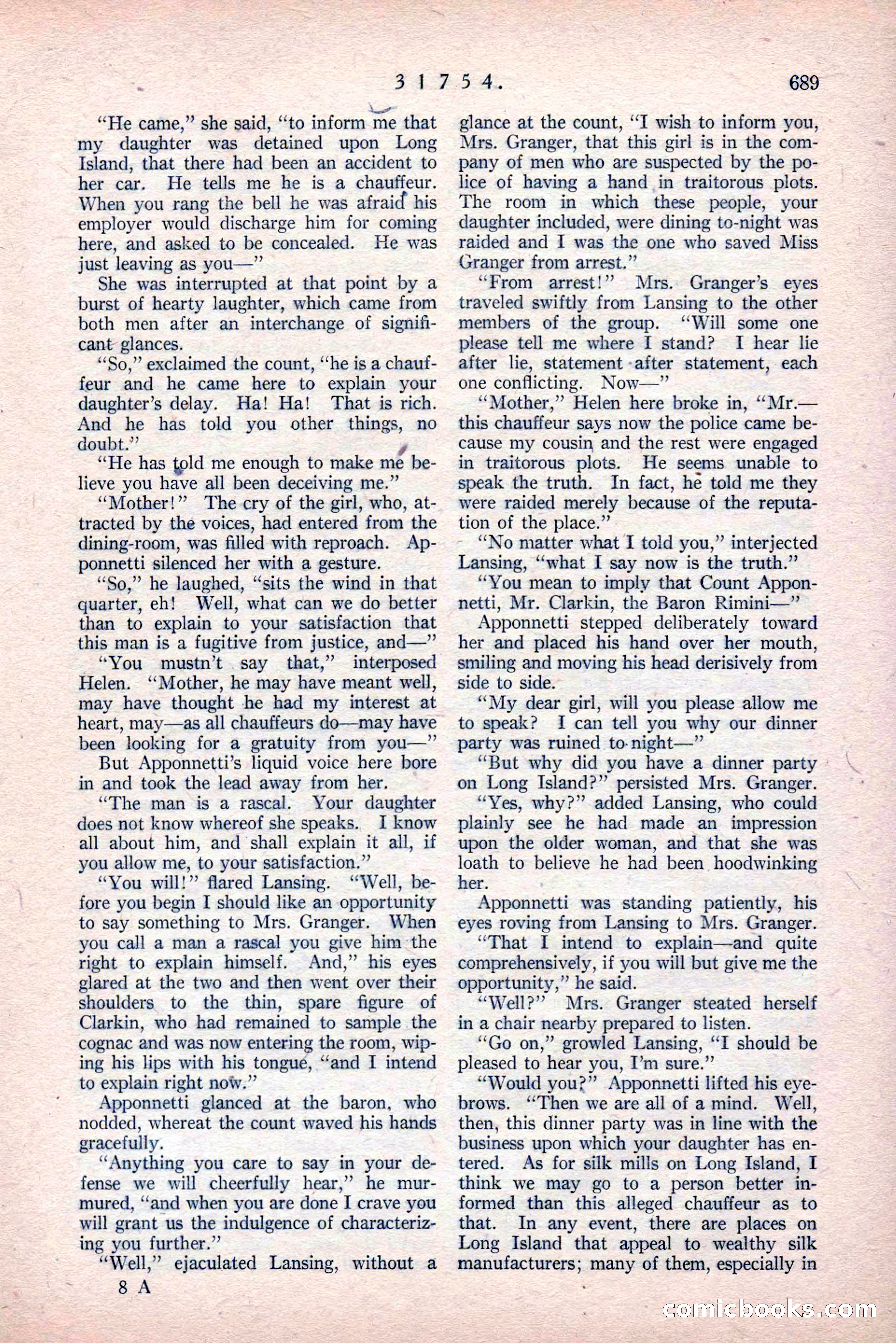
A restored page from Pulp Fiction, 1916. Page through the whole issue in the reader above.
📄 Transcribed text from this page (OCR, searchable)
Machine-transcribed from the original scan — historical spelling and the odd misread are preserved.
= Se er ee Be oe “Fe came,” she said, ‘“‘to inform me that my daughter was detained upon Long Island, that there had been an accident to her car. He tells me he is a chauffeur. When you rang the bell he was afraid his employer would discharge him for coming here, and asked to be concealed. He was just leaving as you—”’ She was interrupted at that point by a burst of hearty laughter, which came from both men after an interchange of signifi- cant glances. “So,” exclaimed the count, ‘he is a chauf- feur and he came here to explain your daughter’s delay. Ha! Ha! That is rich. And he has told you other things, no doubt.” P “He has told me enough to make me be- lieve you have all been deceiving me.” “Mother!” The cry of the girl, who, at- tracted by the voices, had entered from the dining-room, was filled with reproach. Ap- ponnetti silenced her with a gesture. “So,” he laughed, “sits the wind in that quarter, eh! Well, what can we do better than to explain to your satisfaction that this man is a fugitive from justice, and—” “You mustn’t say that,” interposed Helen. ‘‘Mother, he may have meant well, may have thought he had my interest at heart, may—as all chauffeurs do—may have been looking for a gratuity from you—” But Apponnetti’s liquid voice here bore in and took the lead away from her. “The man is a rascal. Your daughter does not know whereof she speaks. I know all about him, and shall explain it all, if you allow me, to your satisfaction.” “You will!” flared Lansing. ‘Well, be- fore you begin I should like an opportunity to say something to Mrs. Granger. When you call a man a rascal you give him the right to explain himself. And,” his eyes glared at the two and then went over their shoulders to the thin, spare figure of Clarkin, who had remained to sample the cognac and was now entering the room, wip- ing his lips with his tongue, “and I intend to explain right now.” Apponnetti glanced at the baron, who nodded, whereat the count waved his hands gracefully. “Anything you care to say in your de- fense we will cheerfully hear,” he mur- mured, “and when you are done I crave you will grant us the indulgence of characteriz- ing you further.” “Well,” ejaculated Lansing, without a 8 A 89 glance at the count, “I wish to inform you, Mrs. Granger, that this girl is in the com- pany of men who are suspected by the po- lice of having a hand in traitorous plots. The room in which these people, your daughter included, were dining to-night was raided and I was the one who saved Miss Granger from arrest.” “From arrest!” Mrs. Granger’s eyes traveled swiftly from Lansing to the other members of the group. “Will some one please tell me where I stand? I hear lie after lie, statement -after statement, each one conflicting. Now—” ‘““Mother,”’ Helen here broke in, ““Mr.— this chauffeur says now the police came be- cause my cousin and the rest were engaged in traitorous plots. He seems unable to speak the truth. In fact, he told me they were raided merely because of the reputa- tion of the place.” “No matter what I told you,” interjected Lansing, ‘what I say now is the truth.” “You mean to imply that Count Appon- netti, Mr. Clarkin, the Baron Rimini—” Apponnetti stepped deliberately toward her and placed his hand over her mouth, smiling and moving his head derisively from side to side. “My dear girl, will you please allow me to speak? I can tell you why our dinner party was ruined to-night—” “But why did you have a dinner party on Long Island?” persisted Mrs. Granger. “Ves, why?” added Lansing, who could plainly see he had made an impression upon the older woman, and that she was loath to believe he had been hoodwinking her. Apponnetti was standing patiently, his eyes roving from Lansing to Mrs. Granger. “That I intend to explain—and quite comprehensively, if you will but give me the opportunity,” he said. “Well?” Mrs. Granger steated herself in a chair nearby prepared to listen. “Go on,” growled Lansing, “‘I should be pleased to hear you, I’m sure.” “Would you?” Apponnetti lifted his eve- brows. ‘Then we are all of a mind. Well, then, this dinner party was in line with the business upon which your daughter has en- tered. As for silk mills on Long Island, I think we may go to a person better in- formed than this alleged chauffeur as to that. In any event, there are places on Long Island that appeal to wealthy silk manufacturers; many of them, especially in IOOKS COLMMUC (E@)