
Pulp Fiction, 1916 · page 118 of 216
The Argosy, Vol. 81, No. 4 — page 118: what you’re looking at
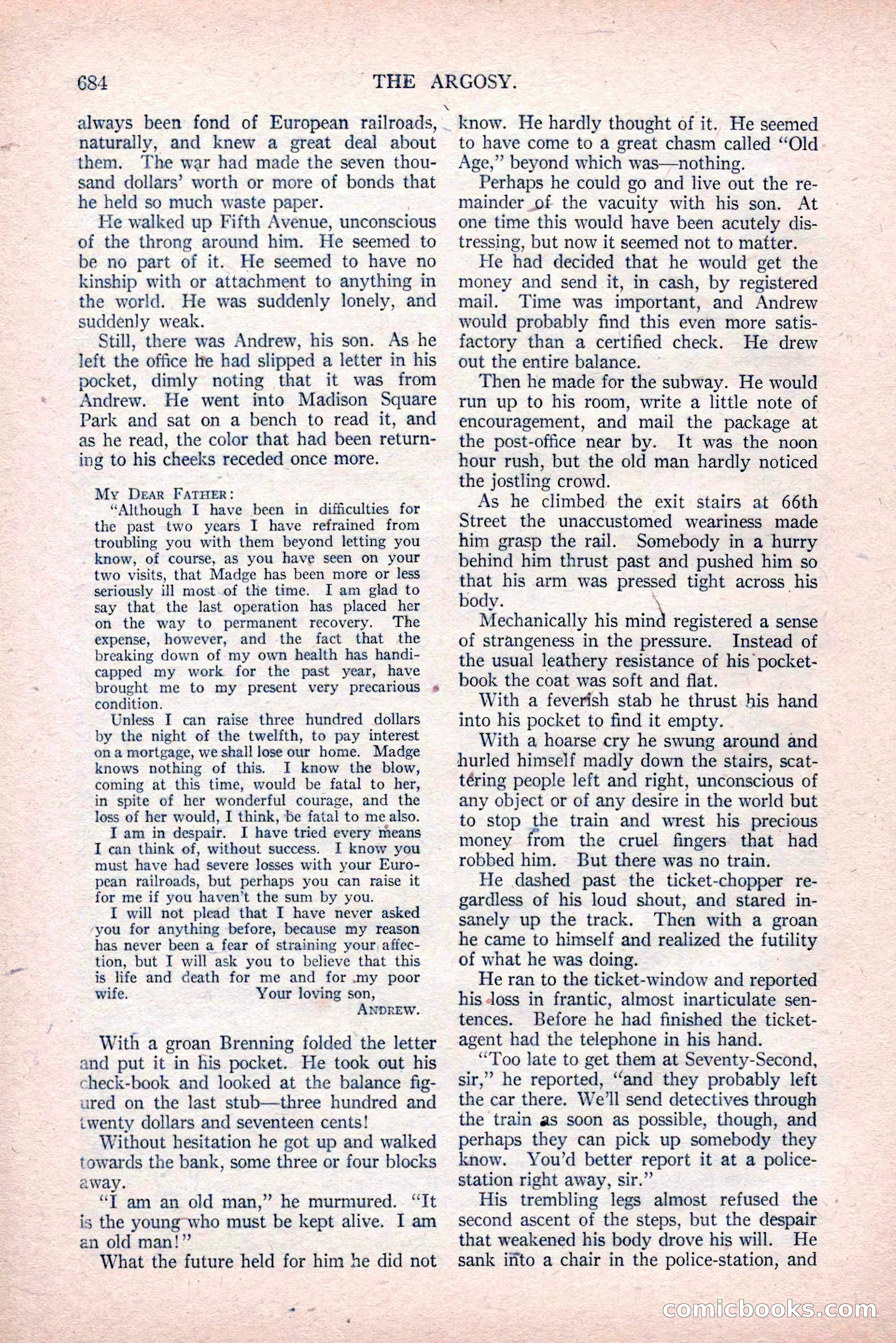
A restored page from Pulp Fiction, 1916. Page through the whole issue in the reader above.
📄 Transcribed text from this page (OCR, searchable)
Machine-transcribed from the original scan — historical spelling and the odd misread are preserved.
, ll 684 always been fond of European railroads, naturally, and knew a great deal about them. The war had made the seven thou- sand dollars’ worth or more of bonds that he held so much waste paper. te walked up Fifth Avenue, unconscious of the throng around him. He seemed to be no part of it. He seemed to have no kinship with or attachment to anything in the world. He was suddenly lonely, and suddenly weak. Still, there was Andrew, his son. As he left the office he had slipped a letter in his pocket, dimly noting that it was from Andrew. He went into Madison Square Park and sat on a bench to read it, and as he read, the color that had been return- ing to his cheeks receded once more. My Dear FATHER: “Although I have been in difficulties for the past two years I have refrained from troubling you with them beyond letting you know, of course, as you have seen on your two visits, that Madge has been more or less seriously ill most of the time. I am glad to say that the last operation has placed her on the way to permanent recovery. The expense, however, and the fact that the breaking down of my own health has handi- capped my work for the past year, have brought me to my present very precarious « condition. Unless I can raise three hundred dollars by the night of the twelfth, to pay interest on a mortgage, we shall lose our home. Madge knows nothing of this. I know the blow, coming at this time, would be fatal to her, in spite of her wonderful courage, and the loss of her would, I think, be fatal to me also. I am in despair. I have tried every means I can think of, without success. I know you must have had severe losses with your Euro- pean railroads, but perhaps you can raise it for me if you haven’t the sum by you. I will not plead that I have never asked you for anything before, because my reason has never been a fear of straining your, affec- tion, but I will ask you to believe that this is life and ceath for me and for .my poor wife. Your loving son, ANDREW. With a groan Brenning folded the letter and put it in his pocket. He took out his check-book and looked at the balance fig- ured on the last stub—three hundred and twenty dollars and seventeen cents! Without hesitation he got up and walked towards the bank, some three or four blocks away. “T am an old man,” he murmured. “It is the young who must be kept alive. I am an old man!” What the future held for him he did not 2 x THE ARGOSY. know. He hardly thought of it. He seemed to have come to a great chasm called “Old Age,” beyond which was—nothing. Perhaps he could go and live out the re- mainder of the vacuity with his son. At one time this would have been acutely dis- tressing, but now it seemed not to matter. He had decided that he would get the money and send it, in cash, by registered mail. Time was important, and Andrew would probably find this even more satis- factory than a certified check. He drew out the entire balance. Then he made for the subway. He would run up to his room, write a little note of encouragement, and mail the package at the post-office near by. It was the noon hour rush, but the old man hardly noticed the jostling crowd. As he climbed the exit stairs at 66th Street the unaccustomed weariness made him grasp the rail. Somebody in a hurry behind him thrust past and pushed him so that his arm was pressed tight across his body. | Mechanically his sind registered a sense of strangeness in the pressure. Instead of the usual leathery resistance of his pocket- book the coat was soft and flat. With a feverish stab he thrust his hand into his pocket to find it empty. With a hoarse cry he swung around and hurled himself madly down the stairs, scat- téring people left and right, unconscious of any object or of any desire in the world but to stop the train and wrest his precious money from the cruel fingers that had robbed him. But there was no train. He dashed past the ticket-chopper re- gardless of his loud shout, and stared in- sanely up the track. Then with a groan he came to himself and realized the futility of what he was doing. He ran to the ticket-window and reported his doss in frantic, almost inarticulate sen- tences. Before he had finished the ticket- agent had the telephone in his hand. ‘Too late to get them at Seventy-Second, sir,’ he reported, ‘and they probably left the car there. We'll send detectives through the train as soon as possible, though, and perhaps they can pick up somebody they know. You’d better report it at a police- station right away, sir.” His trembling legs almost refused the second ascent of the steps, but the despair that weakened his body drove his will. He sank ifto a chair in the police-station, and EOMICLOOOKS (E@)