
Pulp Fiction, 1916 · page 117 of 216
The Argosy, Vol. 81, No. 4 — page 117: what you’re looking at
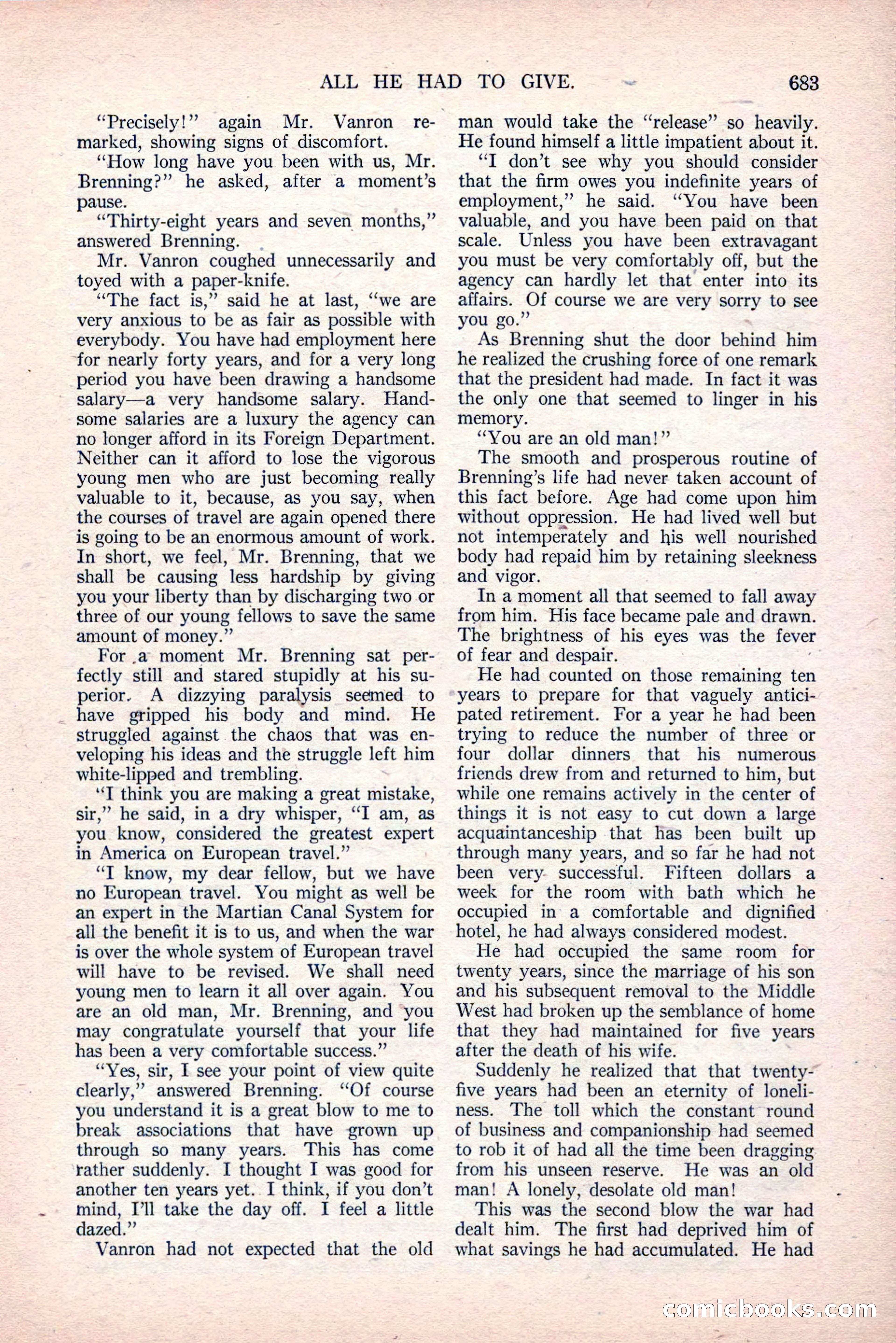
A restored page from Pulp Fiction, 1916. Page through the whole issue in the reader above.
📄 Transcribed text from this page (OCR, searchable)
Machine-transcribed from the original scan — historical spelling and the odd misread are preserved.
ALL HE HAD TO GIVE. “Precisely!”? again Mr. Vanron marked, showing signs of discomfort. “How long have you been with us, Mr. Brenning?” he asked, after a moment’s pause. “Thirty-eight years and seven months,” answered Brenning. Mr. Vanron coughed unnecessarily and toyed with a paper-knife. “The fact is,’ said he at last, “we are very anxious to be as fair as possible with everybody. You have had employment here for nearly forty years, and for a very long period you have been drawing a handsome salary—a very handsome salary. Hand- some salaries are a luxury the agency can no longer afford in its Foreign Department. Neither can it afford to lose the vigorous young men who are just becoming really valuable to it, because, as you say, when the courses of travel are again opened there is going to be an enormous amount of work. In short, we feel, Mr. Brenning, that we shall be causing less hardship by giving you your liberty than by discharging two or three of our young fellows to save the same amount of money.” For .a moment Mr. Brenning sat per- fectly still and stared stupidly at his su- perior. A dizzying paralysis seemed to _ have gripped his body and mind. He struggled against the chaos that was en- veloping his ideas and the struggle left him white-lipped and trembling. “T think you are making a great mistake, sir,” he said, in a dry whisper, “I am, as you know, considered the greatest expert in America on European travel.” “T know, my dear fellow, but we have no European travel. You might as well be an expert in the Martian Canal System for all the benefit it is to us, and when the war is over the whole system of European travel will have to be revised. We shall need young men to learn it all over again. You are an old man, Mr. Brenning, and you may congratulate yourself that your life has been a very comfortable success.” “Yes, sir, I see your point of view quite clearly,” answered Brenning. “Of course you understand it is a great blow to me to break associations that have grown up through so many years. This has come rather suddenly. I thought I was good for another ten years yet.. I think, if you don’t mind, I’ll take the day off. I feel a little dazed.” Vanron had not expected that the old re- 683 man would take the “release” so heavily. He found himself a little impatient about it. “T don’t see why you should consider that the firm owes you indefinite years of employment,” he said. “You have been valuable, and you have been paid on that scale. Unless you have been extravagant you must be very comfortably off, but the agency can hardly let that enter into its affairs. Of course we are very sorry to see you go.” As Brenning shut the door behind him he realized the crushing force of one remark that the president had made. In fact it was the only one that seemed to linger in his memory. “You are an old man!” The smooth and prosperous routine of Brenning’s life had never taken account of this fact before. Age had come upon him without oppression. He had lived well but not intemperately and his well nourished body had repaid him by retaining sleekness and vigor. In a moment all that seemed to fall away from him. His face became pale and drawn. The brightness of his eyes was the fever of fear and despair. He had counted on those remaining ten years to prepare for that vaguely antici- pated retirement. For a year he had been trying to reduce the number of three or four dollar dinners that his numerous friends drew from and returned to him, but while one remains actively in the center of things it is not easy to cut down a large acquaintanceship that has been built up through many years, and so far he had not been very- successful. Fifteen dollars a week for the room with bath which he occupied in a comfortable and dignified — hotel, he had always considered modest. He had occupied the same room for twenty years, since the marriage of his son and his subsequent removal to the Middle West had broken up the semblance of home that they had maintained for five years after the death of his wife. Suddenly he realized that that twenty- five years had been an eternity of loneli- ness. The toll which the constant round of business and companionship had seemed to rob it of had all the time been dragging from his unseen reserve. He was an old man! A lonely, desolate old man! This was the second blow the war had dealt him. The first had deprived him of what savings he had accumulated. He had COMMICOOOKS (C@)