
Pulp Fiction, 1916 · page 119 of 216
The Argosy, Vol. 81, No. 4 — page 119: what you’re looking at
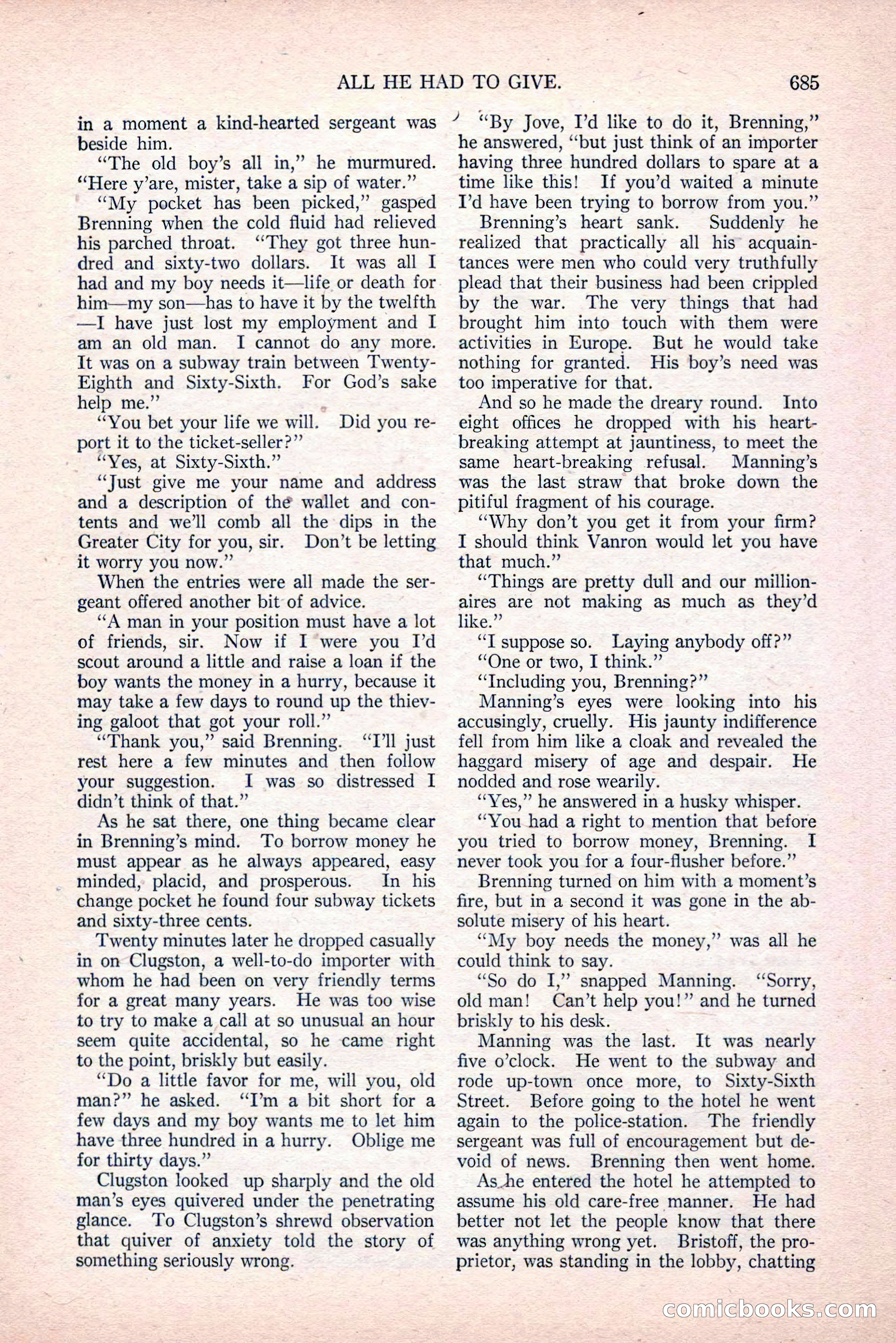
A restored page from Pulp Fiction, 1916. Page through the whole issue in the reader above.
📄 Transcribed text from this page (OCR, searchable)
Machine-transcribed from the original scan — historical spelling and the odd misread are preserved.
ALL HE HAD TO GIVE. 685 in a moment a kind-hearted sergeant was ’ “By Jove, I’d like to do it, Brenning,” beside him. “The old boy’s all in,” he murmured. “Here y’are, mister, take a sip of water.” “My pocket has been picked,” gasped Brenning when the cold fluid had relieved his parched throat. “They got three hun- dred and sixty-two dollars. It was all I had and my boy needs it—life or death for him—my son—has to have it by the twelfth —I have just lost my employment and I am an old man. I cannot do any more. It was on a subway train between Twenty- Eighth and Sixty-Sixth. For God’s sake help me.” | “Vou bet your life we will. port it to the ticket-seller?”’ “Ves, at Sixty-Sixth.” “Just give me your name and address and a description of thé wallet and con- tents and we'll comb all the dips in the Greater City for you, sir. Don’t be letting it worry you now.” When the entries were all made the ser- geant offered another bit of advice. ‘“‘A man in your position must have a lot of friends, sir. Now if I were you I’d scout around a little and raise a loan if the boy wants the money in a hurry, because it may take a few days to round up the thiev- ing galoot that got your roll.” “Thank you,” said Brenning. “I'll just rest here a few minutes and then follow your suggestion. I was so distressed I didn’t think of that.” As he sat there, one thing became clear in Brenning’s mind. To borrow money he must appear as he always appeared, easy minded, placid, and prosperous. In his change pocket he found four subway tickets and sixty-three cents. Twenty minutes later he dropped casually in on Clugston, a well-to-do importer with whom he had been on very friendly terms for a great many years. He was too wise to try to make a call at so unusual an hour seem quite accidental, so he came right to the point, briskly but easily. “Do a little favor for me, will you, old man?” he asked. “I’m a bit short for a few days and my boy wants me to let him have three hundred in a hurry. Oblige me for thirty days.” Clugston looked up sharply and the old man’s eyes quivered under the penetrating glance. To Clugston’s shrewd observation that quiver of anxiety told the story of something seriously wrong. Did you re- he answered, “but just think of an importer having three hundred dollars to spare at a time like this! If you’d waited a minute I’d have been trying to borrow from you.” Brenning’s heart sank. Suddenly he realized that practically all his acquain- tances were men who could very truthfully plead that their business had been crippled by the war. The very things that had brought him into touch with them were activities in Europe. But he would take nothing for granted. His boy’s need was too imperative for that. And so he made the dreary round. Into eight offices he dropped with his heart- breaking attempt at jauntiness, to meet the same heart-breaking refusal. Manning’s was the last straw that broke down the pitiful fragment of his courage. “Why don’t you get it from your firm? I should think Vanron would let you have that much.” “Things are pretty dull and our million- aires are not making as much as they’d like.” “T suppose so. Laying anybody off?” “One or two, I think.” “Including you, Brenning?” Manning’s eyes were looking into his accusingly, cruelly. His jaunty indifference fell from him like a cloak and revealed the haggard misery of age and despair. He nodded and rose wearily. “Ves,” he answered in a husky whisper. “You had a right to mention that before you tried to borrow money, Brenning. I never took you for a four-flusher before.” Brenning turned on him with a moment’s fire, but in a second it was gone in the ab- solute misery of his heart. ‘““My boy needs the money,’ was all he could think to say. “So do I,” snapped Manning. “Sorry, old man! Can’t help you!” and he turned briskly to his desk. Manning was the last. It was nearly five o’clock. He went to the subway and rode up-town once more, to Sixty-Sixth Street. Before going to the hotel he went again to the police-station. The friendly sergeant was full of encouragement but de- void of news. Brenning then went home. As_he entered the hotel he attempted to assume his old care-free manner. He had better not let the people know that there was anything wrong yet. Bristoff, the pro- prietor, was standing in the lobby, chatting COPMICGLOOOKS (E@)