
Pulp Fiction, 1915 · page 228 of 246
The Argosy, September 1915 — page 228: what you’re looking at
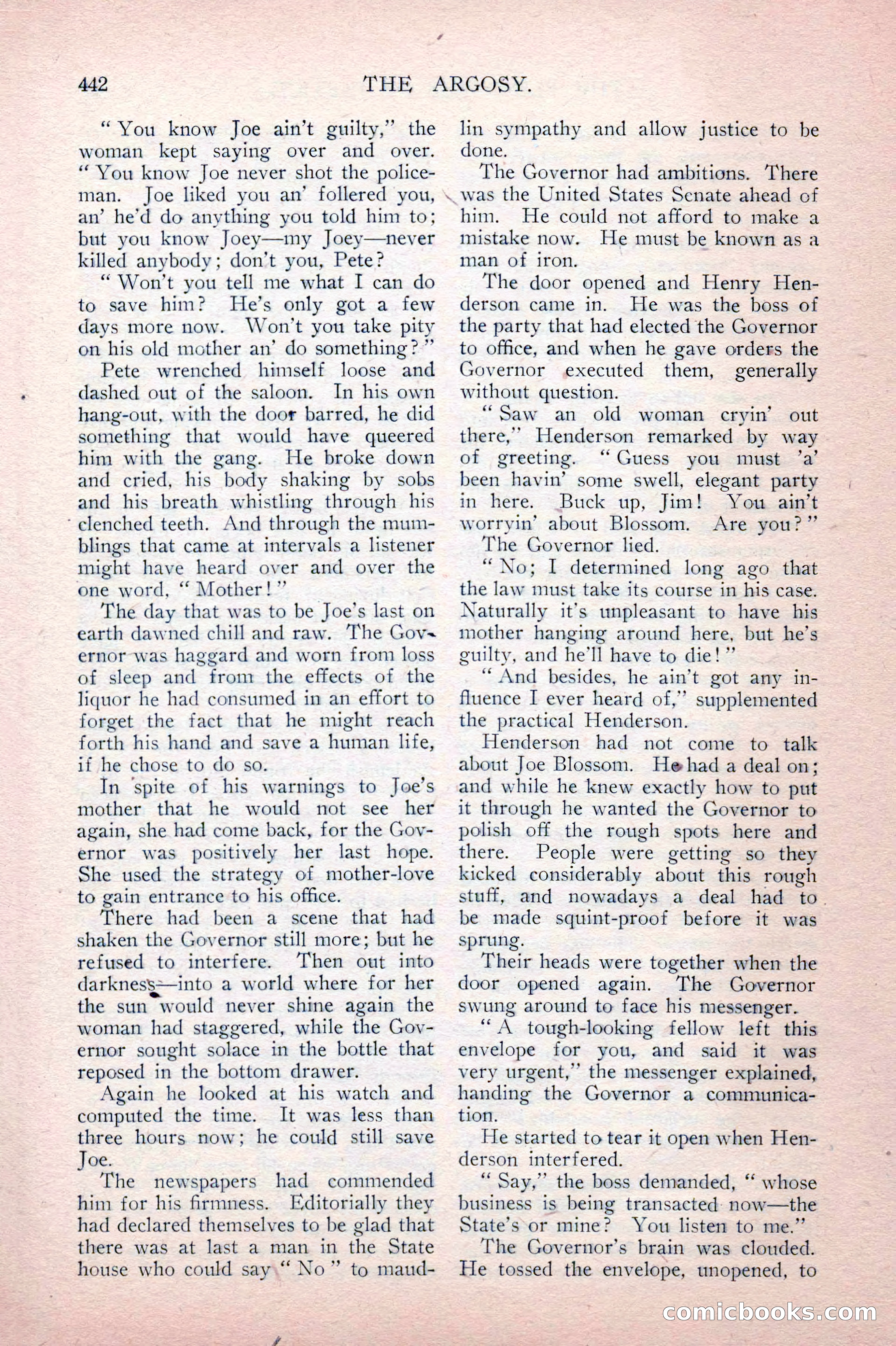
A restored page from Pulp Fiction, 1915. Page through the whole issue in the reader above.
📄 Transcribed text from this page (OCR, searchable)
Machine-transcribed from the original scan — historical spelling and the odd misread are preserved.
442 “You know Joe ain't guilty,” the woman kept saying over and over. “You know Joe never shot the police- man. Joe liked you an’ follered you, an’ he'd do anything you told him to; but you know Joey—my Joey—never killed anybody; don’t you, Pete? “Won't you tell me what I can do to save him? He’s only got a few days more now. Won't you take pity on his old mother an’ do something?”’ Pete wrenched himself loose and dashed out of the saloon. In his own hang-out, with the door barred, he did something that would have queered him with the gang. He broke down and cried, his body shaking by sobs and his breath whistling through his ‘elenched teeth. And through the mum- blings that came at intervals a listener might have heard over and over the one word, “ Mother!” | The day that was to be Joe’s last on earth dawned chill and raw. The Gov~ ernor was haggard and worn from loss of sleep and from the effects of the liquor he had consumed in an effort to forget the fact that he might reach forth his hand and save a human life, if he chose to do so. In ‘spite of his warnings to Joe’s mother that he would not see her again, she had come back, for the Gov- ernor was positively her last hope. She used the strategy of mother-love to gain entrance to his office. There had been a scene that had shaken the Governor still more; but he refused to interfere. Then out into darknessinto a world where for her the sun would never shine again the woman had staggered, while the Goy- ernor sought solace in the bottle that reposed in the bottom drawer. Again he looked at his watch and computed the time. It was less than three hours now; he could still save Joe. The newspapers had commended him for his firmness. Editorially they had declared themselves to be glad that there was at last a man in the State house who could say.“ No” to maud- THE ARGOSY. lin sympathy and allow justice to be done. The Governor had ambitions. ‘There ~ was the United States Senate ahead cf him. He could not afford to make a mistake now. He must be known as a man of iron. The door opened and Henry Hen- derson came in. He was the boss of the party that had elected the Governor to office, and when he gave orders the Governor executed them, generally without question. “Saw an old woman cryin’ out there,’ Henderson remarked by way of greeting. ‘Guess you must ’a’ been havin’ some swell, elegant party in here. Buck up, Jim! You ain’t worryin’ about Blossom. Are you?” The Governor lied. “No; I determined long ago that the law must take its course in his case. Naturally it’s unpleasant to have his mother hanging around here, but he’s guilty, and he’ll have to die!” ‘“ And besides, he ain’t got any in- fluence I ever heard of,’ supplemented the practical Henderson. Henderson had not come to talk about Joe Blossom. Hehad a deal on; and while he knew exactly how to put it through he wanted the Governor to polish off the rough spots here and there. People were getting so they kicked considerably about this rough stuff, and nowadays a deal had to. be made squint-proof before it was sprung. Their heads were together when the door opened again. The Governor swung around to face his messenger. ‘A tough-looking fellow left this envelope for you, and said it was very urgent,’ the messenger explained, handing the Governor a communica- tion. He started to tear it open when Hen- derson interfered. ‘Say,’ the boss demanded, ‘‘ whose business is being transacted: now—the State’s or mine? You listen to me.” The Governor’s brain was clouded. He tossed the envelope, unopened, to Gomichbooks (E@)