
Pulp Fiction, 1915 · page 227 of 246
The Argosy, September 1915 — page 227: what you’re looking at
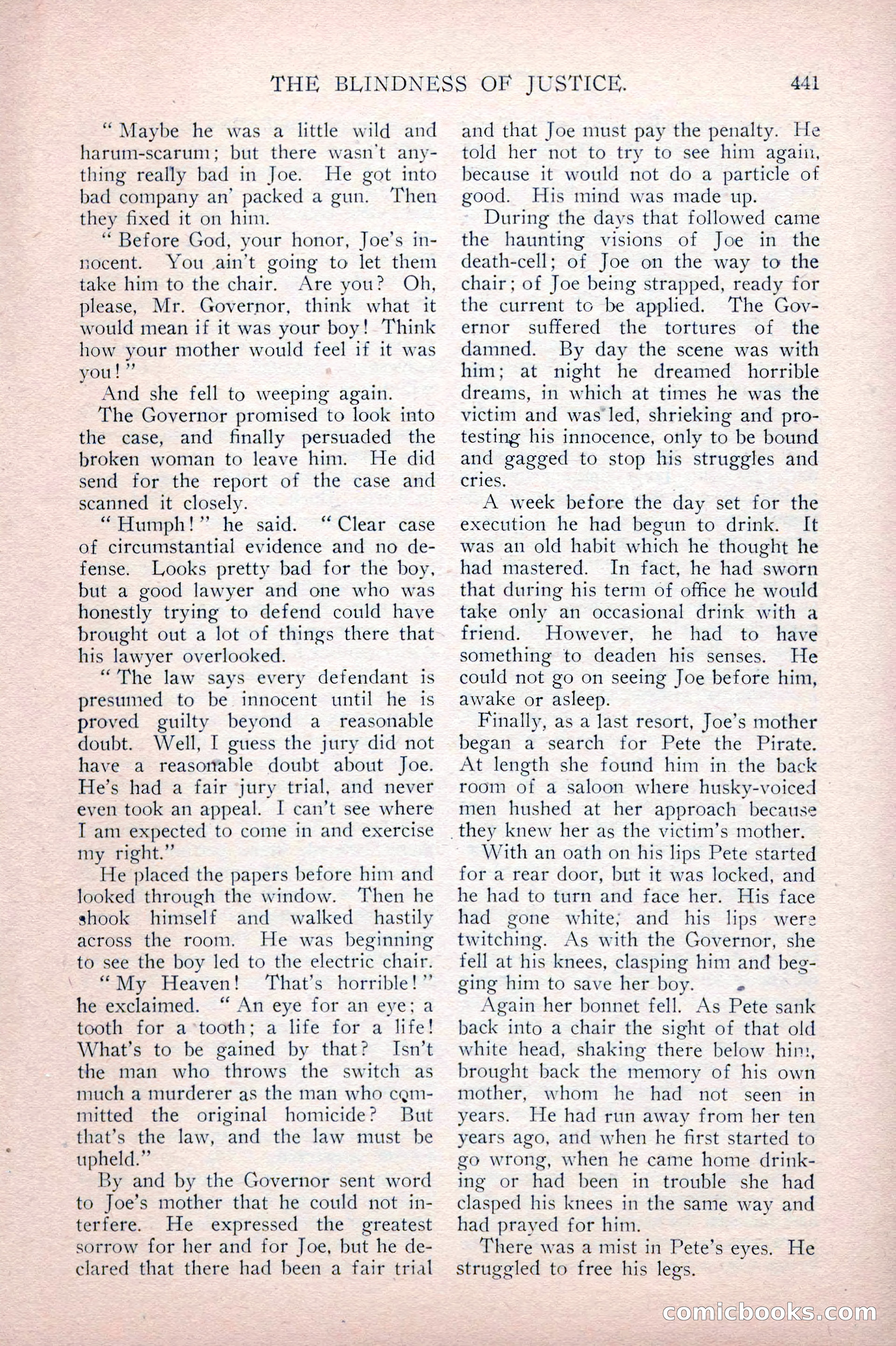
A restored page from Pulp Fiction, 1915. Page through the whole issue in the reader above.
📄 Transcribed text from this page (OCR, searchable)
Machine-transcribed from the original scan — historical spelling and the odd misread are preserved.
THE BLINDNESS OF JUSTICE. “Maybe he was a little wild and harum-scarum; but there wasn't any- thing really bad in Joe. He got into bad company an’ packed a gun. Then they fixed it on him. ‘Before God, your honor, Joe's in- nocent. You ain't going to let them take him to the chair. Are you? Oh, please, Mr. Governor, think what it would mean if it was your boy! Think how your mother would feel if it was you!” And she fell to weeping again. The Governor promised to look into the case, and finally persuaded the broken woman to leave him. He did send for the report of the case and scanned it closely. ““Humph!” he said. “Clear case of circumstantial evidence and no de- fense. Looks pretty bad for the boy, but a good lawyer and one who was honestly trying to defend could have brought out a lot of things there that his lawyer overlooked. “The law says every defendant is presumed to be innocent until he is proved guilty beyond a_ reasonable doubt. Well, I guess the jury did not have a reasortable doubt about Joe. He’s had a fair jury trial, and never even took an appeal. I can’t see where I am expected to come in and exercise my right.” He placed the papers before him and looked through the window. Then he shook himself and walked hastily across the room. He was beginning to see the boy led to the electric chair. “My Heaven! That’s horrible!” he exclaimed. “ An eye for an eye; a tooth for a ‘tooth; a life for a life! What’s to be gained by that? Isn’t the man who throws the switch as much a murderer as the man who cem- mitted the original homicide? But that’s the law, and the law must be upheld.” By and by the Governor sent word to Joe’s mother that he could not in- terfere. He expressed the greatest sorrow for her and for Joe, but he de- clared that there had been a fair trial 441 and that Joe must pay the penalty. He told her not to try to see him again, because it would not do a particle of good. His mind was made up. During the days that followed came the haunting visions of Joe in the death-cell; of Joe on the way to the chair; of Joe being strapped, ready for the current to be applied. The Gov- ernor suffered the tortures of the damned. By day the scene was with him; at night he dreamed horrible dreams, in which at times he was the victim and was led, shrieking and pro- testing his innocence, only to be bound and gagged to stop his struggles and cries. | A week before the day set for the execution he had begun to drink. It was an old habit which he thought he had mastered. In fact, he had sworn that during his term of office he would take only an occasional drink with a friend. However, he had to have something to deaden his senses. He could not go on seeing Joe before him, awake or asleep. Finally, as a last resort, Joe’s mother began a search for Pete the Pirate. At length she found him in the back room of a saloon where husky-voiced men hushed at her approach because _they knew her as the victim’s mother. With an oath on his lips Pete started for a rear door, but it was locked, and he had to turn and face her. His face had gone white; and his lips wera twitching. As with the Governor, she fell at his knees, clasping him and beg- ging him to save her boy. ° Again her bonnet fell. As Pete sank back into a chair the sight of that old white head, shaking there below hin:, brought back the memory of his own mother, whom he had not seen in years. He had run away from her ten years ago, and when he first started to go wrong, when he came home drink- ing or had been in trouble she had clasped his knees in the same way and had prayed for him. There was a mist in Pete’s eyes. He struggled to free his legs. EOPMIG LOOKS (E@)