
Pulp Fiction, 1915 · page 226 of 246
The Argosy, September 1915 — page 226: what you’re looking at
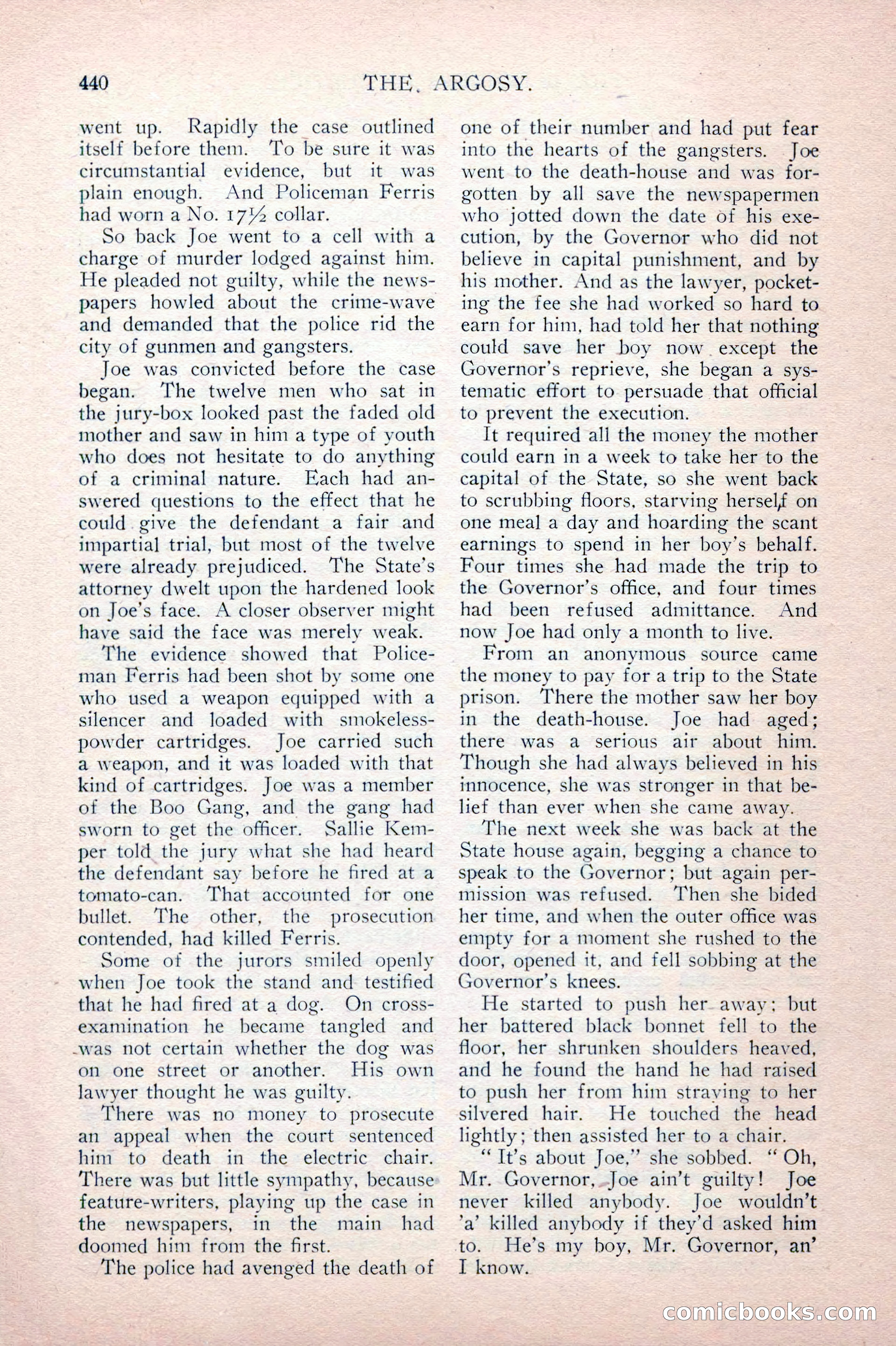
A restored page from Pulp Fiction, 1915. Page through the whole issue in the reader above.
📄 Transcribed text from this page (OCR, searchable)
Machine-transcribed from the original scan — historical spelling and the odd misread are preserved.
440) Rapidly the case outlined itself before them. ‘To be sure it was circumstantial evidence, but it was plain enough. And Policeman Ferris had worn a No. 17% collar. So back Joe went to a cell with a charge of murder lodged against him. He pleaded not guilty, while the news- papers howled about the crime-wave and demanded that the police rid the city of gunmen and gangsters. Joe was convicted before the case began. The twelve men who sat in the jury-box looked past the faded old mother and saw in him a type of youth who does not hesitate to do anything of a criminal nature. Each had an- swered questions to the effect that he could. give the defendant a fair and impartial trial, but most of the twelve were already prejudiced. The State’s attorney dwelt upon the hardened look on Joe’s face. A closer observer might have said the face was merely weak. The evidence showed that Police- man Ferris had been shot by some one who used a weapon equipped with a silencer and loaded with smokeless- powder cartridges. Joe carried such a weapon, and it was loaded with that kind of cartridges. Joe was a member of the Boo Gang, and the gang had sworn to get the officer. Sallie Kem- per told the jury what she had heard the defendant say before he fired at a tomato-can. That accounted for one bullet. The other, the prosecution contended, had killed Ferris. Some of the jurors smiled openly when Joe took the stand and testified that he had fired at a dog. On cross- examination he became tangled and -was not certain whether the dog was on one street or another. His own lawyer thought he was guilty. There was no money to prosecute an appeal when the court sentenced him to death in the electric chair. There was but little sympathy, because feature-writers, playing up the case in the newspapers, in the main had doomed him from the first. The police had avenged the death of went up. to. THE, ARGOSY. one of their number and had put fear into the hearts of the gangsters. Joe went to the death-house and was for- gotten by all save the newspapermen who jotted down the date of his exe- cution, by the Governor who did not believe in capital punishment, and by his mother. And as the lawyer, pocket- ing the fee she had worked so hard to earn for him, had told her that nothing could save her boy now. except the Governor’s reprieve, she began a sys- tematic effort to persuade that official to prevent the execution. It required all the money the mother could earn in a week to take her to the capital of the State, so she went back to scrubbing floors, starving herself on one meal a day and hoarding the scant earnings to spend in her boy’s behalf. Four times she had made the trip to the Governor’s office, and four times had been refused admittance. And now Joe had only a month to live. From an anonymous source came the money to pay for a trip to the State prison. There the mother saw her boy in the death-house. Joe had aged; there was a serious air about him. Though she had always believed in his innocence, she was stronger in that be- lief than ever when she came away. The next week she was back at the State house again, begging a chance to speak to the Governor; but again per- mission was refused. ‘Then she bided her time, and when the outer office was empty for a moment she rushed to the door, opened it, and fell sobbing at the Governor’s knees. He started to push her away; but her battered black bonnet fell to the floor, her shrunken shoulders heaved, and he found the hand he had raised to push her from him straving to her silvered hair. He touched the head lightly; then assisted her to a chair. “It’s about Joe,” she sobbed. *“ Oh, Mr. Governor,.Joe ain’t guilty! Joe never killed anybody. Joe wouldn’t ‘a’ killed anybody if they'd asked him He’s my boy, Mr. Governor, an’ I know. Gomichbooks (E@)