
Pulp Fiction, 1914 · page 61 of 258
The Argosy, August 1914 — page 61: what you’re looking at
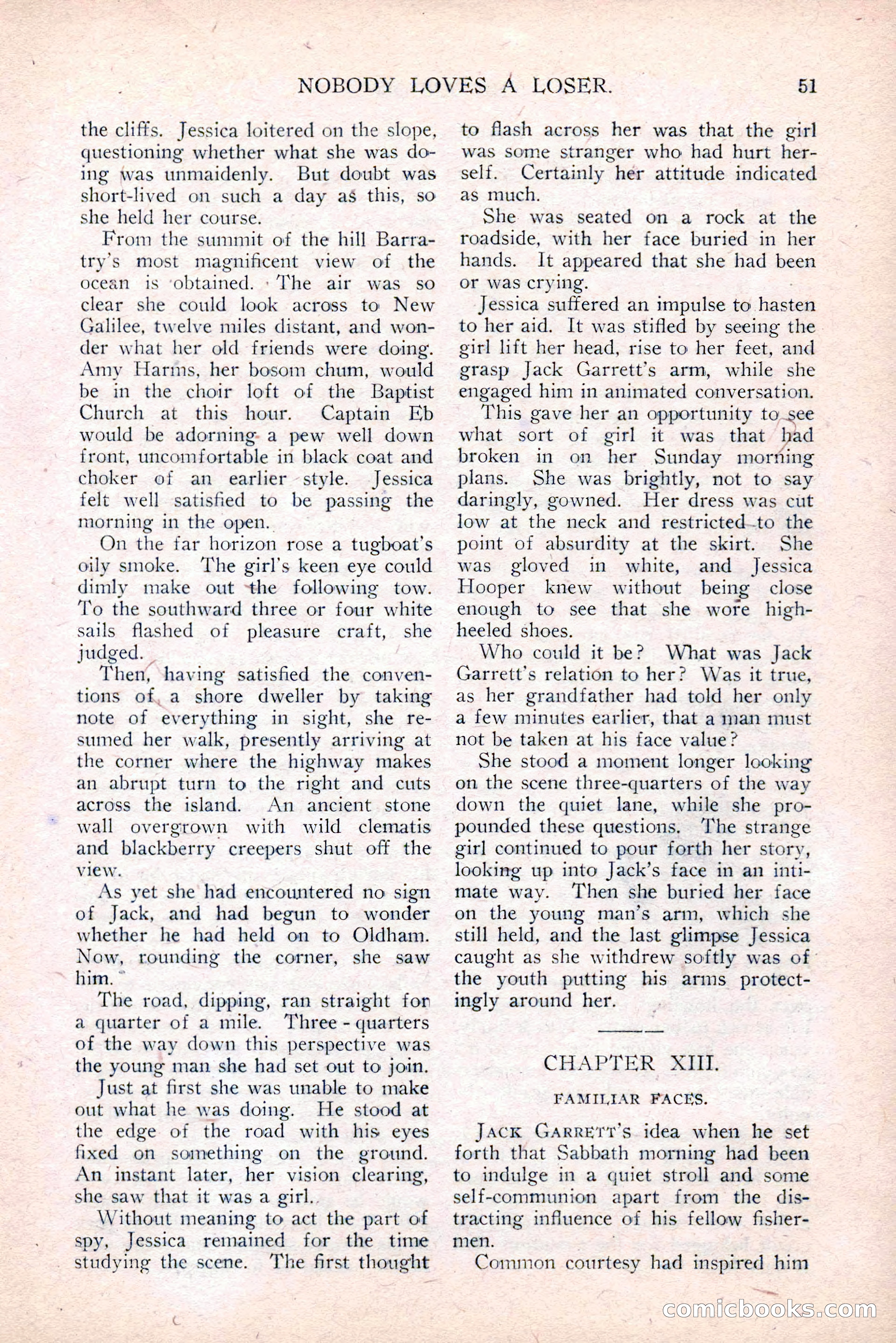
A restored page from Pulp Fiction, 1914. Page through the whole issue in the reader above.
📄 Transcribed text from this page (OCR, searchable)
Machine-transcribed from the original scan — historical spelling and the odd misread are preserved.
NOBODY LOVES A LOSER. the cliffs. Jessica loitered on the slope, questioning whether what she was do- ing was unmaidenly. But doubt was short-lived on such a day as this, so she held her course. From the summit of the hill Barra- try’s most magnificent view of the ocean is ‘obtained. 'The air was so clear she could look across to New Galilee, twelve miles distant, and won- der what her old friends were doing. Amy Harms, her bosom chum, would be in the choir loft of the Baptist Church at this hour. Captain Eb would be adorning- a pew well down front, uncomfortable in black coat and choker of an earlier style. Jessica felt well satisfied to be passing the morning in the open. On the far horizon rose a tugboat’s oily smoke. The girl's keen eye could dimly make out -the following tow. To the southward three or four white sails flashed of pleasure craft, she judged. — Then, having satisfied the conven- tions of, a shore dweller by taking note of everything in sight, she re- sumed her walk, presently arriving at the corner where the highway makes an abrupt turn to the right and cuts across the island. An ancient stone wall overgrown with wild clematis and blackberry creepers shut off the view. As yet she had encountered no sign of Jack, and had begun to wonder whether he had held on to Oldham. Now, rounding the corner, she saw him. © The road, dipping, ran straight for a quarter of a mile. Three - quarters of the way down this perspective was the young man she had set out to join. Just at first she was unable to make out what he was doing. He stood at the edge of the road with his eyes fixed on something on the ground. An instant later, her vision clearing, she saw that it was a girl. Without meaning to act the part of spy, Jessica remained for the time studying the scene. The first thought 51 to flash across her was that the girl was some stranger who had hurt her- self. Certainly her attitude indicated as much. she was seated on a rock at the roadside, with her face buried in her hands. It appeared that she had been or was crying. Jessica suffered an impulse to hasten to her aid. It was stifled by seeing the girl lift her head, rise to her feet, and grasp Jack Garrett’s arm, while she engaged him in animated conversation. This gave her an opportunity to-see what sort of girl it was that had broken in on her Sunday morning plans. She was brightly, not to say daringly, gowned. Her dress was cut low at the neck and restricted—to the point of absurdity at the skirt. She was gloved in white, and _ Jessica Hooper knew without being close enough to see that she wore high- heeled shoes. Who could it be? What was Jack Garrett's relation to her? Was it true, as her grandfather had told her only a few minutes earlier, that a man must not be taken at his face value? She stood a moment longer looking on the scene three-quarters of the way down the quiet lane, while she pro- pounded these questions. The strange girl continued to pour forth her story, looking up into Jack’s face in an inti- mate way. Then she buried her face on the young man’s arm, which she still held, and the last glimpse Jessica caught as she withdrew softly was of: the youth putting his arms _ protect- ingly around her. od CHAPTER XIII. FAMILIAR FACES. Jack Garrert’s idea when he set forth that Sabbath morning had been to indulge in a quiet stroll and some self-communion apart from the dis- tracting influence of his fellow fisher- men. ; | Common courtesy had inspired him a S COMMICLOO® (C@