
Pulp Fiction, 1914 · page 60 of 258
The Argosy, August 1914 — page 60: what you’re looking at
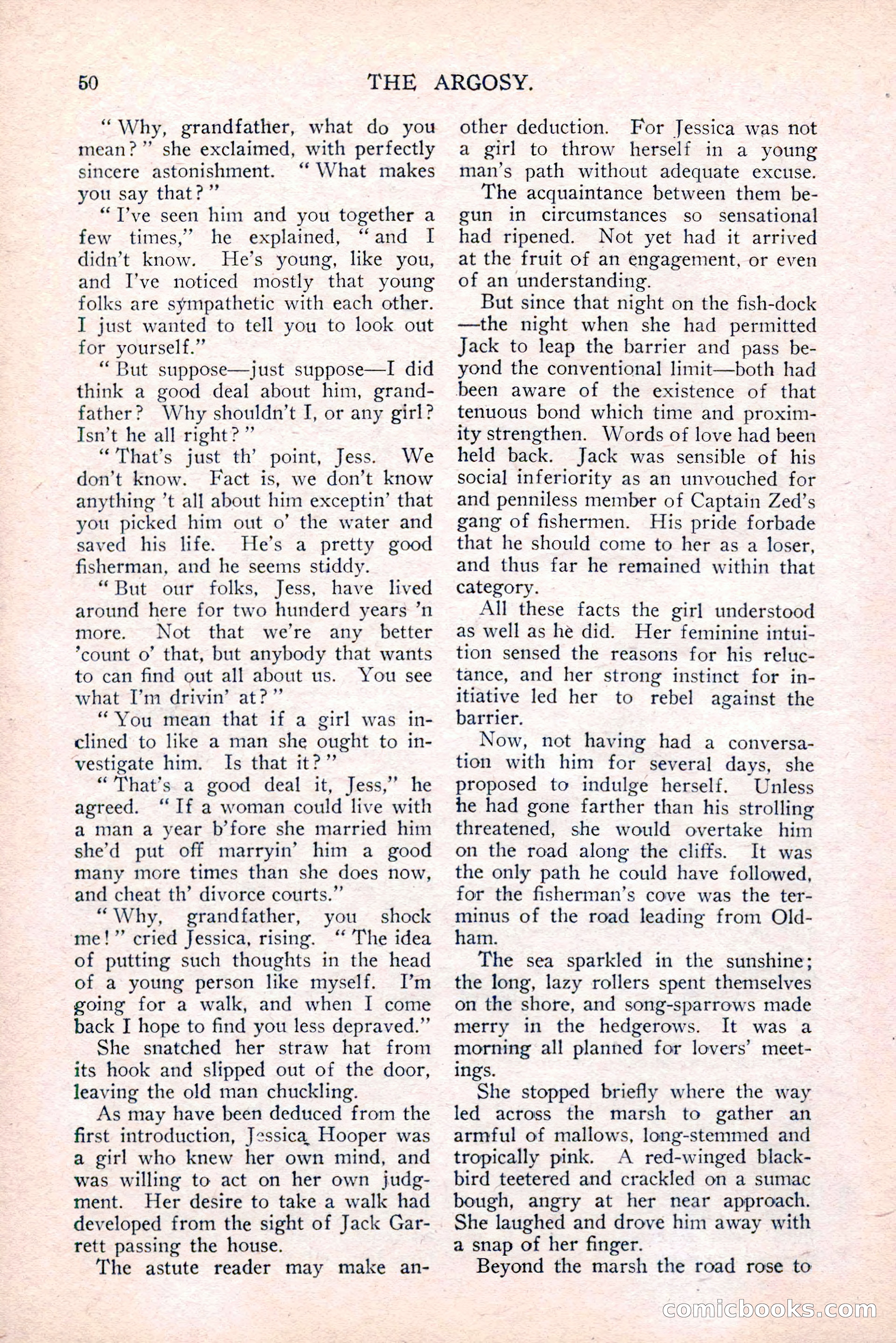
A restored page from Pulp Fiction, 1914. Page through the whole issue in the reader above.
📄 Transcribed text from this page (OCR, searchable)
Machine-transcribed from the original scan — historical spelling and the odd misread are preserved.
50 “Why, grandfather, what do you mean?’’ she exclaimed, with perfectly sincere astonishment. ‘“‘ What makes you say that?” “T’ve seen him and you together a few times,” he explained, “and I didn’t know. He’s young, like you, and I’ve noticed mostly that young folks are sympathetic with each other. I just wanted to tell you to look out for yourself.” “ But suppose—just suppose—I did think a good deal about him, grand- father? Why shouldn’t I, or any girl? Isn’t he all right?” “That’s just th’ point, Jess. We don’t know. Fact is, we don’t know anything ’t all about him exceptin’ that you picked him out o’ the water and saved his life. He's a pretty good fisherman, and he seems stiddy. “But our folks, Jess, have lived around here for two hunderd years ’n more. Not that we're any better ‘count o’ that, but anybody that wants to can find out all about us. You see what I’m drivin’ at?” “You mean that if a girl was in- clined to like a man she ought to in- vestigate him. Is that it?” “That’s a good deal it, Jess,” he agreed. “If a woman could live with a man a year b’fore she married him she’d put off marryin’ him a good many more times than she does now, and cheat th’ divorce courts.” “Why, grandfather, you shock me!” cried Jessica, rising. “‘ The idea of putting such thoughts in the head of a young person like myself. I’m going for a walk, and when I come back I hope to find you less depraved.”’ She snatched her straw hat from its hook and slipped out of the door, leaving the old man chuckling. As may have been deduced from the first introduction, Jessica. Hooper was a girl who knew her own mind, and was willing to act on her own judg- ment. Her desire to take a walk had developed from the sight of Jack Gar- rett passing the house. The astute reader may make an- THE ARGOSY. other deduction. For Jessica was not a girl to throw herself in a young man’s path without adequate excuse. The acquaintance between them be- gun in circumstances so sensational had ripened. Not yet had it arrived at the fruit of an engagement, or even of an understanding. But since that night on the fish-dock —the night when she had permitted Jack to leap the barrier and pass be- yond the conventional limit—both had been aware of the existence of that tenuous bond which time and proxim- ity strengthen. Words of love had been held back. Jack was sensible of his social inferiority as an unvouched for and penniless member of Captain Zed’s gang of fishermen. His pride forbade that he should come to her as a loser, and thus far he remained within that category. All these facts the girl understood as well as he did. Her feminine intui- tion sensed the reasons for his reluc- tance, and her strong instinct for in- itiative led her to rebel against the barrier. Now, not having had a conversa- tion with him for several days, she proposed to indulge herself. Unless he had gone farther than his strolling threatened, she would overtake him on the road along the cliffs. It was the only path he could have followed, for the fisherman’s cove was the ter- minus of the road leading from Old- ham. The sea sparkled in the sunshine; the long, lazy rollers spent themselves on the shore, and song-sparrows made merry in the hedgerows. It was a morning all planned for lovers’ meet- ings. led across the marsh to gather an armful of mallows, long-stemmed and tropically pink. A red-winged black- bird teetered and crackled on a sumac bough, angry at her near approach. She laughed and drove him away with a snap of her finger. Beyond the marsh the road rose to COniclboookKks She stopped briefly where the way (C@