
Pulp Fiction, 1914 · page 62 of 258
The Argosy, August 1914 — page 62: what you’re looking at
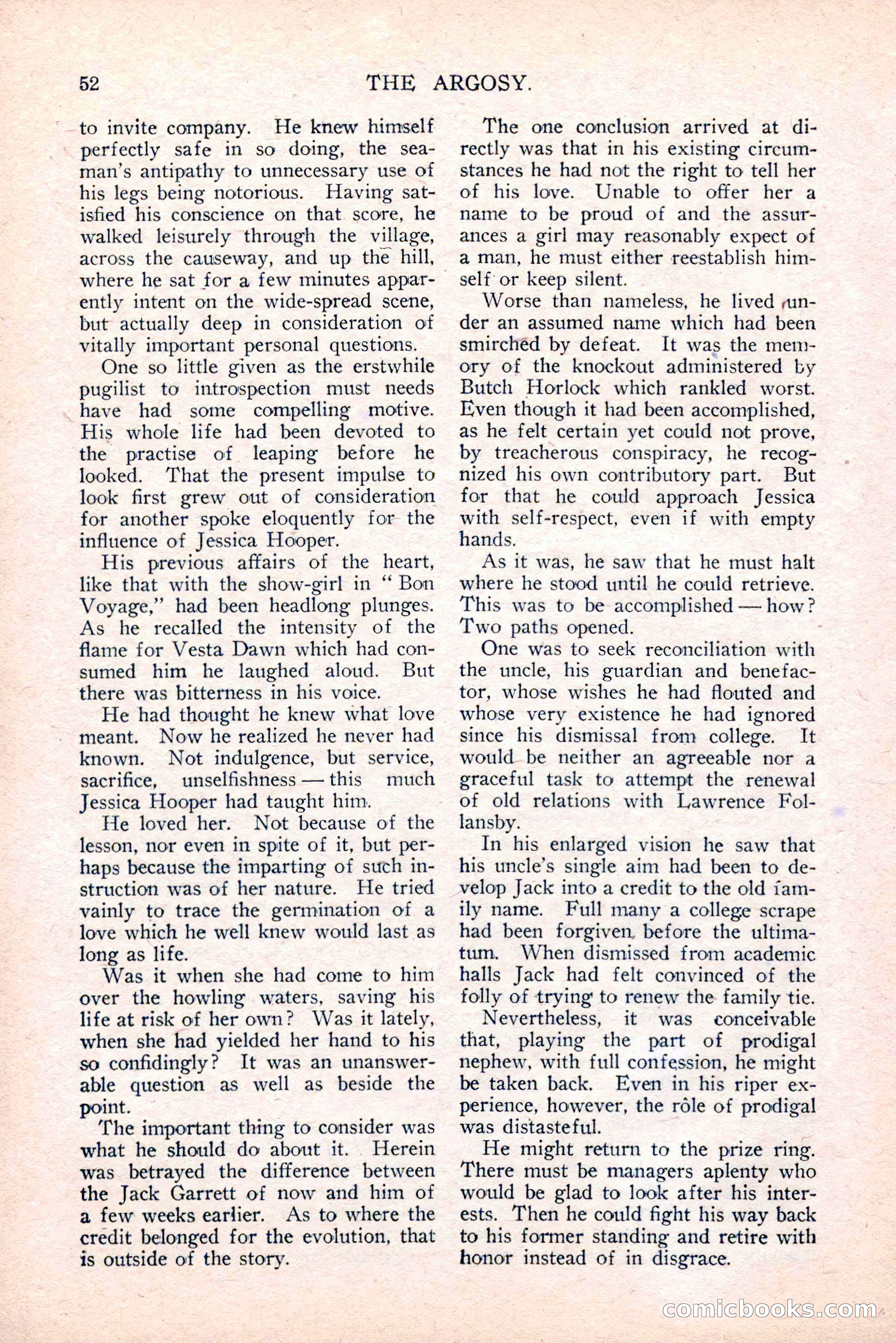
A restored page from Pulp Fiction, 1914. Page through the whole issue in the reader above.
📄 Transcribed text from this page (OCR, searchable)
Machine-transcribed from the original scan — historical spelling and the odd misread are preserved.
D2 to invite company. He knew himself perfectly safe in so doing, the sea- man’s antipathy to unnecessary use of his legs being notorious. Having sat- isfied his conscience on that score, he walked leisurely through the village, across the causeway, and up the hill, where he sat for a few minutes appar- ently intent on the wide-spread scene, but actually deep in consideration of vitally important personal questions. One so little given as the erstwhile pugilist to introspection must needs have had some compelling motive. His whole life had been devoted to the practise of leaping before he looked. That the present impulse to look first grew out of consideration for another spoke eloquently for the influence of Jessica Hooper. His previous affairs of the heart, like that with the show-girl in “ Bon Voyage,” had been headlong plunges. As he recalled the intensity of the flame for Vesta Dawn which had con- sumed him he laughed aloud. But there was bitterness in his voice. He had thought he knew what love meant. Now he realized he never had known. Not indulgence, but service, sacrifice, unselfishness —this much Jessica Hooper had taught him. He loved her. Not because of the lesson, nor even in spite of it, but per- haps because the imparting of such 1n- struction was of her nature. He tried vainly to trace the germination of a love which he well knew would last as long as life. Was it when she had come to him over the howling waters, saving his life at risk of her own? Was it lately, when she had yielded her hand to his so confidingly? It was an unanswer- able question as well as beside the point. — The important thing to consider was what he should do about it. Herein was betrayed the difference between the Jack Garrett of now and him of a few weeks earlier. As to where the credit belonged for the evolution, that is outside of the story. THE ARGOSY. The one conclusion arrived at di- rectly was that in his existing circum- stances he had not the right to tell her of his love. Unable to offer her a name to be proud of and the assur- ances a girl may reasonably expect of a man, he must either reestablish him- self or keep silent. Worse than nameless, he lived aun- der an assumed name which had been smirchéd by defeat. It was the mem- ory of the knockout administered by Butch Horlock which rankled worst. Iven though it had been accomplished, as he felt certain yet could not prove, by treacherous conspiracy, he recog- nized his own contributory part. But for that he could approach Jessica with self-respect, even if with empty hands. As it was, he saw that he must halt where he stood until he could retrieve. This was to be accomplished — how? Two paths opened. One was to seek reconciliation with the uncle, his guardian and _ benefac- tor, whose wishes he had flouted and whose very existence he had ignored since his dismissal from college. It would be neither an agreeable nor a graceful task to attempt the renewal of old relations with Lawrence Fol- lansby. In his enlarged vision he saw that his uncle’s single aim had been to de- velop Jack into a credit to the old iam- ily name. Full many a college scrape had been forgiven. before the ultima- tum. When dismissed from academic halls Jack had felt convinced of the folly of trying to renew the family tie. Nevertheless, it was conceivable that, playing the part of prodigal nephew, with full confession, he might be taken back. Even in his riper ex- perience, however, the rdle of prodigal was distasteful. He might return to the prize ring. There must be managers aplenty who would be glad to look after his inter- ests. Then he could fight his way back to his former standing and retire with honor instead of in disgrace. COMMICLOOOLK (C@