
Pulp Fiction, 1914 · page 250 of 268
The Argosy, Vol. 75, No. 4 — page 250: what you’re looking at
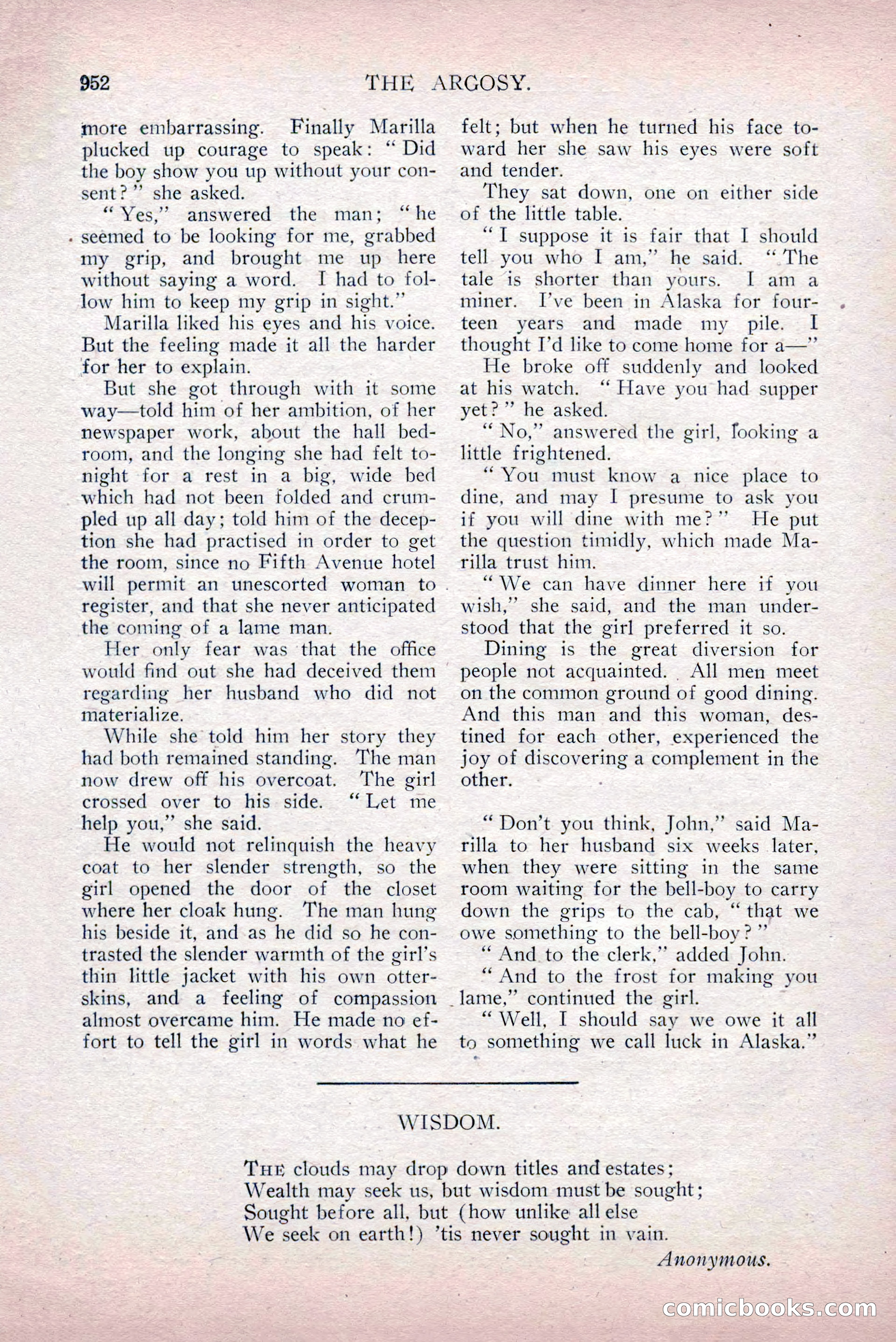
A restored page from Pulp Fiction, 1914. Page through the whole issue in the reader above.
📄 Transcribed text from this page (OCR, searchable)
Machine-transcribed from the original scan — historical spelling and the odd misread are preserved.
952 more embarrassing. Finally Marilla plucked up courage to speak: “ Did the boy show you up without your con- sent?” she asked. “Yes,” answered the man; “he . seemed to be looking for me, grabbed my grip, and brought me up here without saying a word. I had to fol- low him to keep my grip in sight.” Marilla liked his eyes and his voice. But the feeling made it all the harder for her to explain. But she got through with it some way—told him of her ambition, of her newspaper work, about the hall bed- room, and the longing she had felt to- night for a rest in a big, wide bed which had not been folded and crum- pled up all day; told him of the decep- tion she had practised in order to get the room, since no Fifth Avenue hotel will permit an unescorted woman to . register, and that she never anticipated the coming of a lame man. Her only fear was that the office would find out she had deceived them regarding her husband who did not materialize. While she told him her story they had both remained standing. The man now drew off his overcoat. The girl crossed over to his side. “Let me help you,” she said. He would not relinquish the heavy coat to her slender strength, so the girl opened the door of the closet where her cloak hung. The man hung his beside it, and as he did so he con- trasted the slender warmth of the girl’s thin little jacket with his own otter- skins, and a feeling of compassion almost overcame him. He made no ef- fort to tell the girl in words what he THE ARGOSY. felt; but when he turned his face to- ward her she saw his eyes were soft and tender. They sat down, one on either side of the little table. ‘““T suppose it is fair that I should tell you who I am,” he said. “ The tale is shorter than yours. I am a miner. I’ve been in Alaska for four- teen years and made my pile. I thought I’d like to come home for a—’”’ He broke off suddenly and looked at his watch. “‘ Have you had supper yet?” he asked. “No,” answered the girl, looking a little frightened. “You must know a nice place to dine, and may I presume to ask you if you will dine with me?” He put the question timidly, which made Ma- rilla trust him. “We can have dinner here if you wish,’ she said, and the man under- stood that the girl preferred it so. Dining is the great diversion for people not acquainted. All men meet on the common ground of good dining. And this man and this woman, des- tined for each other, experienced the joy of discovering a complement in the other. “Don’t you think, John,” said Ma- rilla to her husband six weeks later, when they were sitting in the same room waiting for the bell-boy to carry down the grips to the cab, “that we owe something to the bell-boy?”’ ‘And to the clerk,” added John. “And to the frost for making you _lame,” continued the girl. “Well, I should say we owe it all to something we call luck in Alaska.” WISDOM. Tue clouds may drop down titles and estates; Wealth may seek us, but wisdom must be sought; Sought before all, but (how unlike all else We seek on earth!) ’tis never sought in vain. Anonymous. GEomiechbooks (E@)