
Pulp Fiction, 1914 · page 249 of 268
The Argosy, Vol. 75, No. 4 — page 249: what you’re looking at
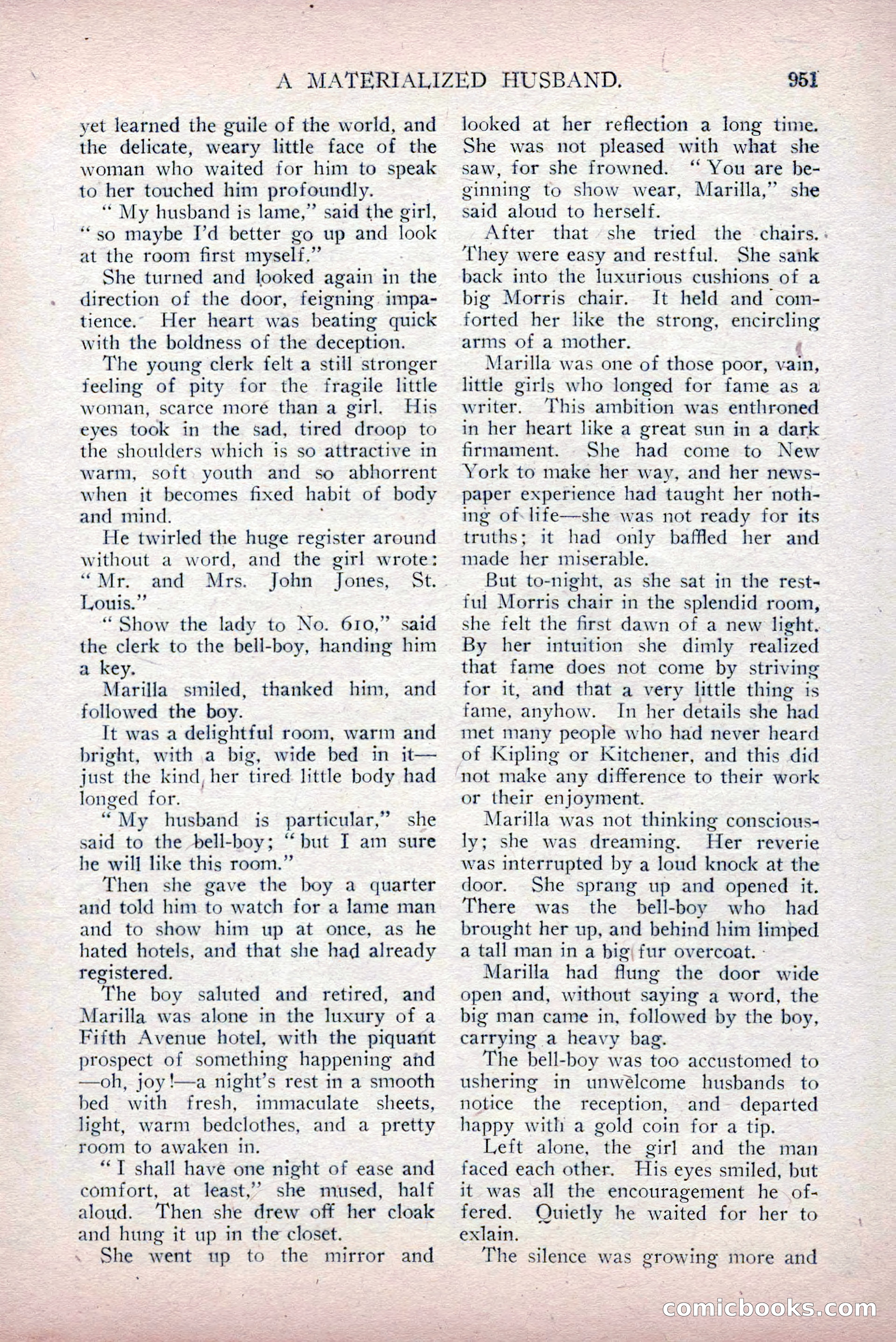
A restored page from Pulp Fiction, 1914. Page through the whole issue in the reader above.
📄 Transcribed text from this page (OCR, searchable)
Machine-transcribed from the original scan — historical spelling and the odd misread are preserved.
A MATERIALIZED HUSBAND. yet learned the guile of the world, and the delicate, weary little face of the woman who waited for him to speak to her touched him profoundly. ‘“ My husband is lame,” said the girl, ‘“so maybe I’d better go up and look at the room first myself, = She turned and looked again in the direction of the door, feigning. impa- tience. Her heart was beating quick with the boldness of the deception. The young clerk felt a still stronger feeling of pity for the fragile little woman, scarce more than a girl. His eyes took in the sad, tired droop to the shoulders which 1s so attractive in warm, soft youth and so abhorrent when it becomes fixed habit of body and mind. He twirled the huge register around without a word, and the girl wrote: “Mr. and Mrs. John Jones, St. Louis.” “Show the lady to No. 610,” said the clerk to the bell- -boy, handing him a key. Marilla smiled, followed the boy. It was a delightful room, warm and bright, with a “big, wide bed in it— just the kind, her tired: little body had longed for. © My husband is particular,” she said to the bell-boy; “but I am sure he will like this room.” Then she gave the boy a quarter and told him to watch for a lame man and to show him up at once, as he hated hotels, and that she had already registered. The boy saluted and retired, and Marilla was alone in the luxury of a Fifth Avenue hotel, with the piquant prospect of something happening and —oh, joy!—a night’s rest in a smooth bed with fresh, immaculate sheets, light, warm bedclothes, and a pretty thanked him, and -~yoom to awaken in. “T shall have one night of ease and comfort, at least,’’ she mused, half aloud. Then she drew off her cloak and hung it up in the closet. . She went up to the mirror and ! 951 looked at her reflection a long time. She was not pleased with what she saw, for she frowned. ‘“ You are be- ginning to show wear, Marilla,” she said aloud to herself. After that ‘They were easy and restful. She sank back into the luxurious cushions of a big Morris chair. It held and com- forted her like the strong, encircling arms of a mother. ‘ Marilla was one of those poor, vain, little girls who longed for fame as a writer. This ambition was enthroned in her heart like a great sun in a dark firmament. She had come to New York to make her way, and her news- paper experience had taught her noth- ing of: lite—she was not ready for its truths; it had only baffled her and made her miserable. But to-night, as she sat in the rest- ful Morris chair in the splendid room, she felt the first dawn of a new light. By her intuition she dimly realized that fame does not come by striving for it, and that a very little thing is fame, anyhow. In her details she had met many people who had never heard of Kipling or Kitchener, and this did not make any difference to their work or their enjoyment. Marilla was not thinking conscious- ly; she was dreaming. Her reverie was interrupted by a loud knock at the door. She sprang up and opened it. There was the bell-boy who had brought her up, and behind him limped a tall man in a big) fur overcoat. - Marilla had flung the door wide open and, without saying a word, the big man came in, followed by the boy, carrying a heavy bag. The bell-boy was too accustomed to ushering in unwelcome husbands to notice the reception, and departed happy with a gold coin for a tip. Left alone, the girl and the man faced each other. His eyes smiled, but it was all the encouragement he of- fered. Quietly he waited for her to exlain. The silence was growing more and Gomichbooks she tried the chairs. ; (E@)