
Pulp Fiction, 1914 · page 234 of 268
The Argosy, Vol. 75, No. 4 — page 234: what you’re looking at
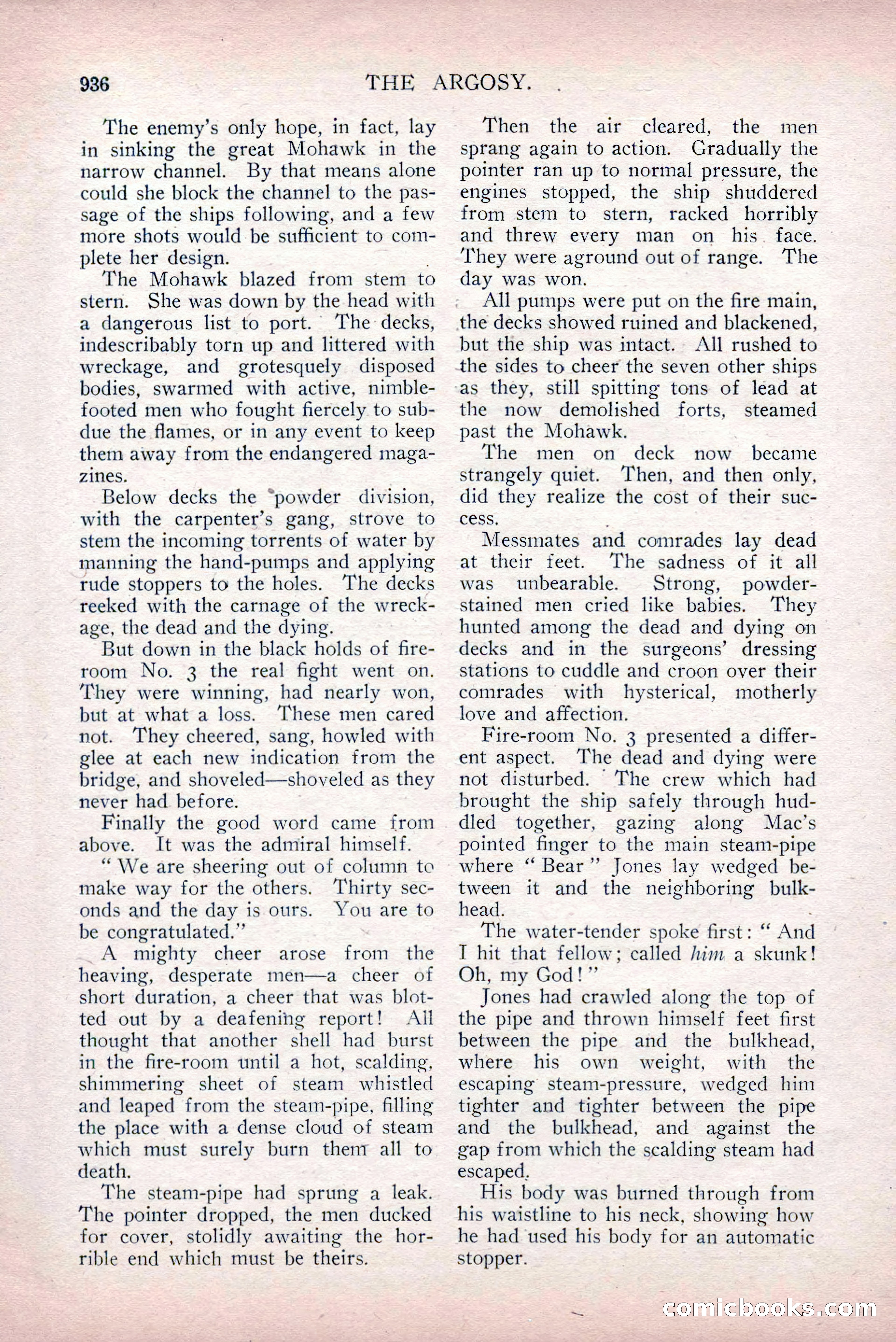
A restored page from Pulp Fiction, 1914. Page through the whole issue in the reader above.
📄 Transcribed text from this page (OCR, searchable)
Machine-transcribed from the original scan — historical spelling and the odd misread are preserved.
936 THE The enemy’s only hope, in fact, lay in sinking the great Mohawk in the narrow channel. By that means alone could she block the channel to the pas- sage of the ships following, and a few more shots would be sufficient to com- plete her design. The Mohawk blazed from stem to stern. She was down by the head with a dangerous list to port. The decks, indescribably torn up and littered with wreckage, and grotesquely disposed bodies, swarmed with active, nimble- footed men who fought fiercely to sub- due the flames, or in any event to keep them away from the endangered maga- zines. Below decks the “powder division, with the carpenter’s gang, strove to stem the incoming torrents of water by manning the hand-pumps and applying rude stoppers to the holes. The decks reeked with the carnage of the wreck- age, the dead and the dying. But down in the black holds of fire- room No. 3 the real fight went on. They were winning, had nearly won, but at what a loss. These men cared not. They cheered, sang, howled with glee at each new indication from the bridge, and shoveled—shoveled as they never had. before. Finally the good word came from above. It was the admiral himself. “We are sheering out of column to make way for the others. Thirty sec- onds and the day is ours. You are to be congratulated.” A mighty cheer arose from the heaving, desperate men—a cheer of short duration, a cheer that was blot- ted out by a deafening report! A\jll thought that another shell had burst in the fire-room until a hot, scalding, shimmering sheet of steam whistled and leaped from the steam-pipe, filling the place with a dense cloud of steam which must surely burn thent all to death. The steam-pipe had sprung a leak. The pointer dropped, the men ducked for cover, stolidly awaiting the hor- rible end which must be theirs. ARGOSY. Then the air cleared, the men sprang again to action. Gradually the pointer ran up to normal pressure, the engines stopped, the ship shuddered from stem to stern, racked horribly and threw every man on his. face. © They were aground out of range. The day was won. All pumps were put on the fire main, the decks showed ruined and blackened, but the ship was intact. All rushed to the sides to cheer the seven other ships ‘as they, still spitting tons of lead at the now demolished forts, steamed past the Mohawk. The men on deck now became strangely quiet. Then, and then only, did they realize the cost of their suc- cess. Messmates and comrades lay dead at their feet. The sadness of it all was unbearable. Strong, powder- stained men cried like babies. They hunted among the dead and dying on decks and in the surgeons’ dressing stations to cuddle and croon over their comrades with hysterical, motherly love and affection. Fire-room No. 3 presented a differ- ent aspect. The dead and dying were not disturbed. The crew which had brought the ship safely through hud- dled together, gazing along Mac’s pointed finger to the main steam-pipe where “ Bear” Jones lay wedged be- tween it and the neighboring bulk- head. The water-tender spoke first: ‘‘ And I hit that fellow; called jim a skunk! Oh, my God!” Jones had crawled along the top of the pipe and thrown himself feet first between the pipe and the bulkhead, where his own weight, with the escaping steam-pressure, wedged him tighter and tighter between the pipe and the bulkhead, and against the gap from which the scalding steam had escaped. His body was burned through from his waistline to his neck, showing how he had used his body for an automatic stopper. = EOPMICLOOKS 1c O