
Pulp Fiction, 1914 · page 233 of 268
The Argosy, Vol. 75, No. 4 — page 233: what you’re looking at
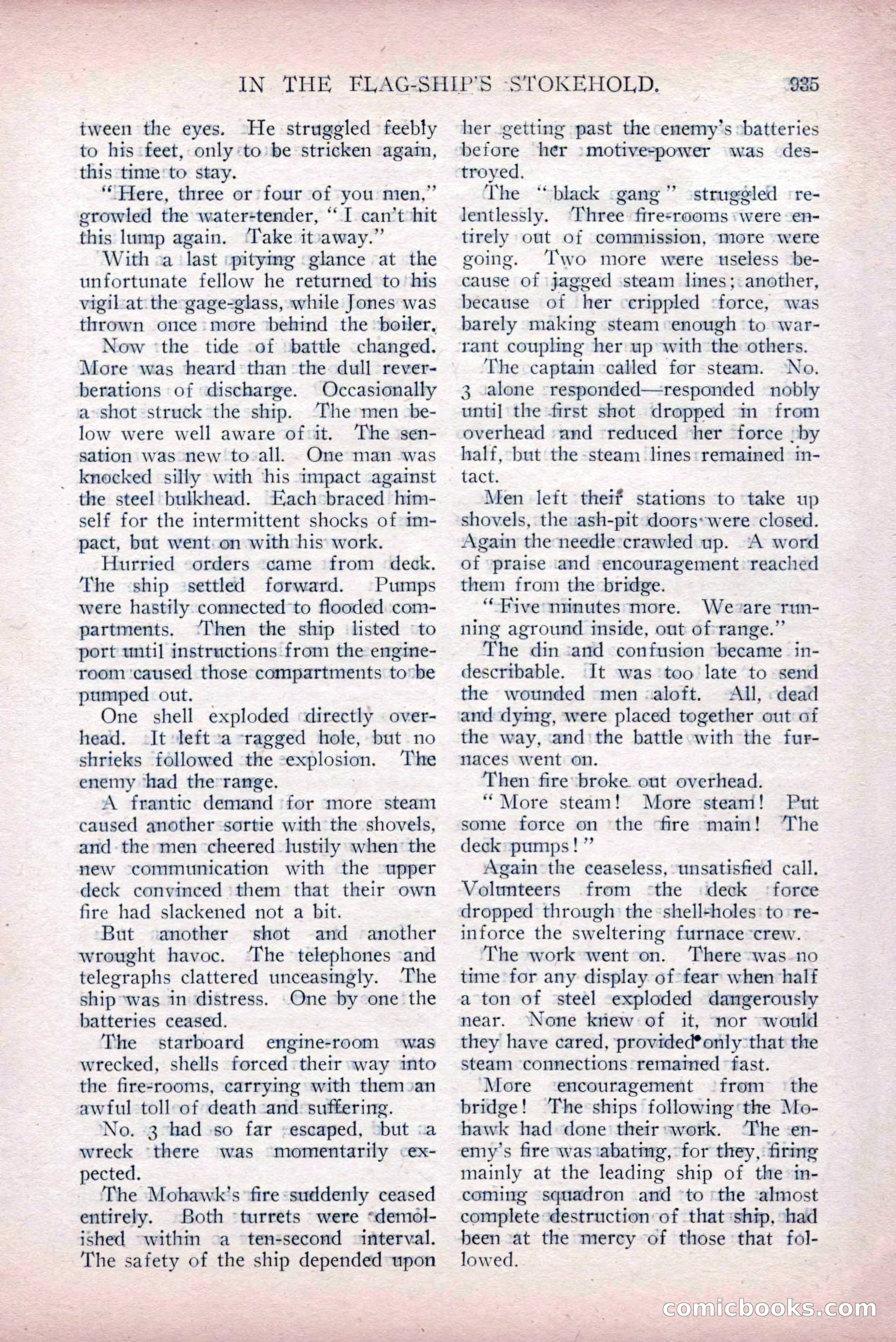
A restored page from Pulp Fiction, 1914. Page through the whole issue in the reader above.
📄 Transcribed text from this page (OCR, searchable)
Machine-transcribed from the original scan — historical spelling and the odd misread are preserved.
IN THE FLAG-SHIP’S STOKEHOLD. tween the eyes. ‘He struggled feebly to his feet, only to: be stricken agam, this time to stay. ‘Here, three or four of you men,” erowled the water+tender, ‘I can’t hit this luntp again. ‘Take it away.” With -a last pitymg glance at the unfortunate fellow he returned to’ his vigil at the gage-glass, while Jones was thrown once: more ‘behind the boiler, Now ‘the tide of battle changed. More was heard than the dull rever- berations of discharge. Occasionally a shot struck the ship. ‘The men be- low were well aware of it. The sen- sation was new to all. One man was _ knocked silly with his impact against the steel bulkhead. Each braced him- self for the intermittent shocks of 1m- pact, but went. on with his work. Hurried orders came from deck. The ship settled forward. Pumps were hastily connected to flooded com- partments. “I‘hen the ship listed to port until instructions from the engine- room ‘caused those compartments to™be pumped out. — One shell exploded directly over- head. It left a ragged hole, but no shrieks followed the “explosion. The enemy ‘had the range. A frantic demand for more steam caused another sortie with the shovels, and the men cheered lustily when’ the new ‘communication with the upper deck convinced them that their own fire had slackened not a bit. But another shot and another wrought havoc. ‘The telephones and telegraphs clattered unceasingly. The ship was in distress. One by one the batteries ceased. The starboard engine-room was wrecked, shells forced thetr way into the fire-rooms, carrying with them an awful toll of death and: suftering. No. 3 had so far -escaped, “but «a wreck ‘there was momentarily ex- pected. The Mohawk’s ‘fire suddenly ceased entirely. Both ‘turrets were “demol- ished within -a ten-second interval. The safety of the ship depended upon 335 her getting past the enemy’s -batteries before her -motivespower was des- troyed. The “black gang” strugeled -re- lentlessly. ‘Three fire-rooms ‘were -en- tirely out of commission, more were going. ‘Two more were useless be- cause of jagged steam lines;.another, because of her crippled «force, was barely making steam enough to war- rant coupling her up with the others. The captain called for steam. ‘No. 3 alone responded—responded nobly until the first shot dropped m from overhead and reduced her force »by half, but the steam lines:remained in- tact. Men left thet stations to take up shovels, the ash-pit doors*were closed. Again the needle crawled up. A word of praise and encouragement reached them from the bridge. “Five minutes more. Weare run- ning aground inside, out of-range.”’ The din ‘and confusion became _ in- describable. It was too late to send the wounded men -aloft. All, dead and dymeg, were placed together out of the way, ‘and the battle with the fur- naces went on. Then fire broke out overhead. “More steam! More steam! some force on the fire maim! deck pumps!” Again the ceaseless, unsatisfied call. Volunteers from ‘the deck ‘force dropped through the ‘shell+holes to re- inforce the sweltering furnace ‘crew. The work went on. ‘There was no time for any display of fear when half a ton of steel exploded dangerously near. ‘None knew of it, nor would they have cared, provided*only that the steam connections remained fast. More ‘encouragement ‘from the bridge! The ships following: the Mo- hawk had done their work. ‘The -en- emy’s fire was abating, for they, firme mainly at the leading ship of the in- coming squadron and ‘to ‘the ‘almost complete destruction of that ship, had been at the mercy of those that fol- lowed. Put ‘The COPMICLOOOKS (E@)