
Pulp Fiction, 1912 · page 95 of 238
The Argosy, April 1912 — page 95: what you’re looking at
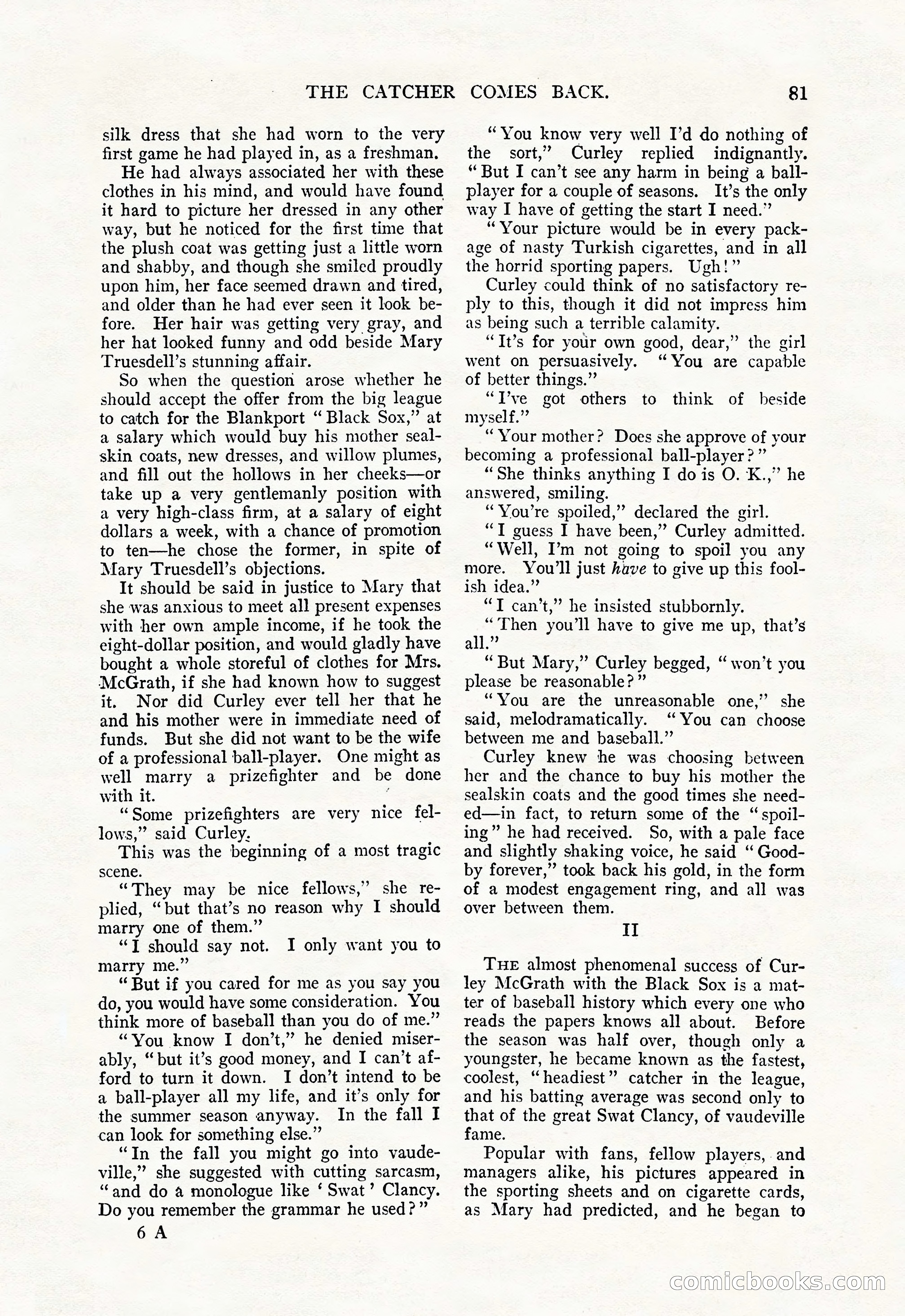
A restored page from Pulp Fiction, 1912. Page through the whole issue in the reader above.
📄 Transcribed text from this page (OCR, searchable)
Machine-transcribed from the original scan — historical spelling and the odd misread are preserved.
THE CATCHER COMES BACK. silk dress that she had worn to the very first game he had played in, as a freshman. He had always associated her with these clothes in his mind, and would have found it hard to picture her dressed in any other way, but he noticed for the first time that the plush coat was getting just a little worn and shabby, and though she smiled proudly upon him, her face seemed drawn and tired, and older than he had ever seen it look be- fore. Her hair was getting very gray, and her hat looked funny and odd beside Mary Truesdell’s stunning affair. So when the question arose whether he should accept the offer from the big league to catch for the Blankport ‘“ Black Sox,” at a salary which would buy his mother seal- skin coats, new dresses, and willow plumes, and fill out the hollows in her cheeks—or take up a very gentlemanly position with a very high-class firm, at a salary of eight dollars a week, with a chance of promotion to ten—he chose the former, in spite of Mary Truesdell’s objections. It should be said in justice to Mary that she was anxious to meet all present expenses with her own ample income, if he took the eight-dollar position, and would gladly have bought a whole storeful of clothes for Mrs. McGrath, if she had known how to suggest it. Nor did Curley ever tell her that he and his mother were in immediate need of funds. But she did not want to be the wife of a professional ball-player. One might as well marry a prizefighter and be done with it. : “Some prizefighters are very nice fel- lows,” said Curley. This was the beginning of a most tragic scene. “They may be nice fellows,’ she re- plied, “but that’s no reason why I should marry one of them.” ““T should say not. marry me.” “But if you cared for me as you say you do, you would have some consideration. You think more of baseball than you do of me.” “Vou know I don’t,” he denied miser- ably, “but it’s good money, and I can’t af- ford to turn it down. I don’t intend to be a ball-player all my life, and it’s only for the summer season anyway. In the fall I can look for something else.”’ “In the fall you might go into vaude- ville,” she suggested with cutting sarcasm, “and do a monologue like ‘ Swat’ Clancy. Do you remember the grammar he used?” 6A I only want you to 81 “You know very well I’d do nothing of the sort,” Curley replied indignantly. “But I can’t see any harm in being a ball- player for a couple of seasons. It’s the only way I have of getting the start I need.” “Your picture would be in every pack- age of nasty Turkish cigarettes, and in all the horrid sporting papers. Ugh!” Curley could think of no satisfactory re- ply to this, though it did not impress him as being such a terrible calamity. “It’s for your own good, dear,” the girl went on persuasively. “You are capable of better things.” “T’ve got others to think of beside myself.” “Your mother? Does she approve of your becoming a professional ball-player ?” “She thinks anything I do is O. K.,” he answered, smiling. ‘““You’re spoiled,” declared the girl. “T guess I have been,’”’ Curley admitted. “Well, I’m not going to spoil you any more. You'll just have to give up this fool- ish idea.” “T can’t,” he insisted stubbornly. a hen you'll have to give me up, that’s all. “But Mary,” Curley begged, “ won’t you please be reasonable?” “You are the unreasonable one,’ she said, melodramatically. ‘You can choose between me and baseball.” Curley knew he was choosing between her and the chance to buy his mother the sealskin coats and the good times she need- ed—in fact, to return some of the “spoil- ing” he had received. So, with a pale face and slightly shaking voice, he said ‘‘ Good- by forever,” took back his gold, in the form of a modest engagement ring, and all was over between them. IT THE almost phenomenal success of Cur- ley McGrath with the Black Sox is a mat- ter of baseball history which every one who reads the papers knows all about. Before the season was half over, though only a youngster, he became known as the fastest, coolest, “headiest” catcher in the league, and his batting average was second only to that of the great Swat Clancy, of vaudeville fame. Popular with fans, fellow players, and managers alike, his pictures appeared in the sporting sheets and on cigarette cards, as Mary had predicted, and he began to comicoool. CO