
Pulp Fiction, 1912 · page 96 of 238
The Argosy, April 1912 — page 96: what you’re looking at
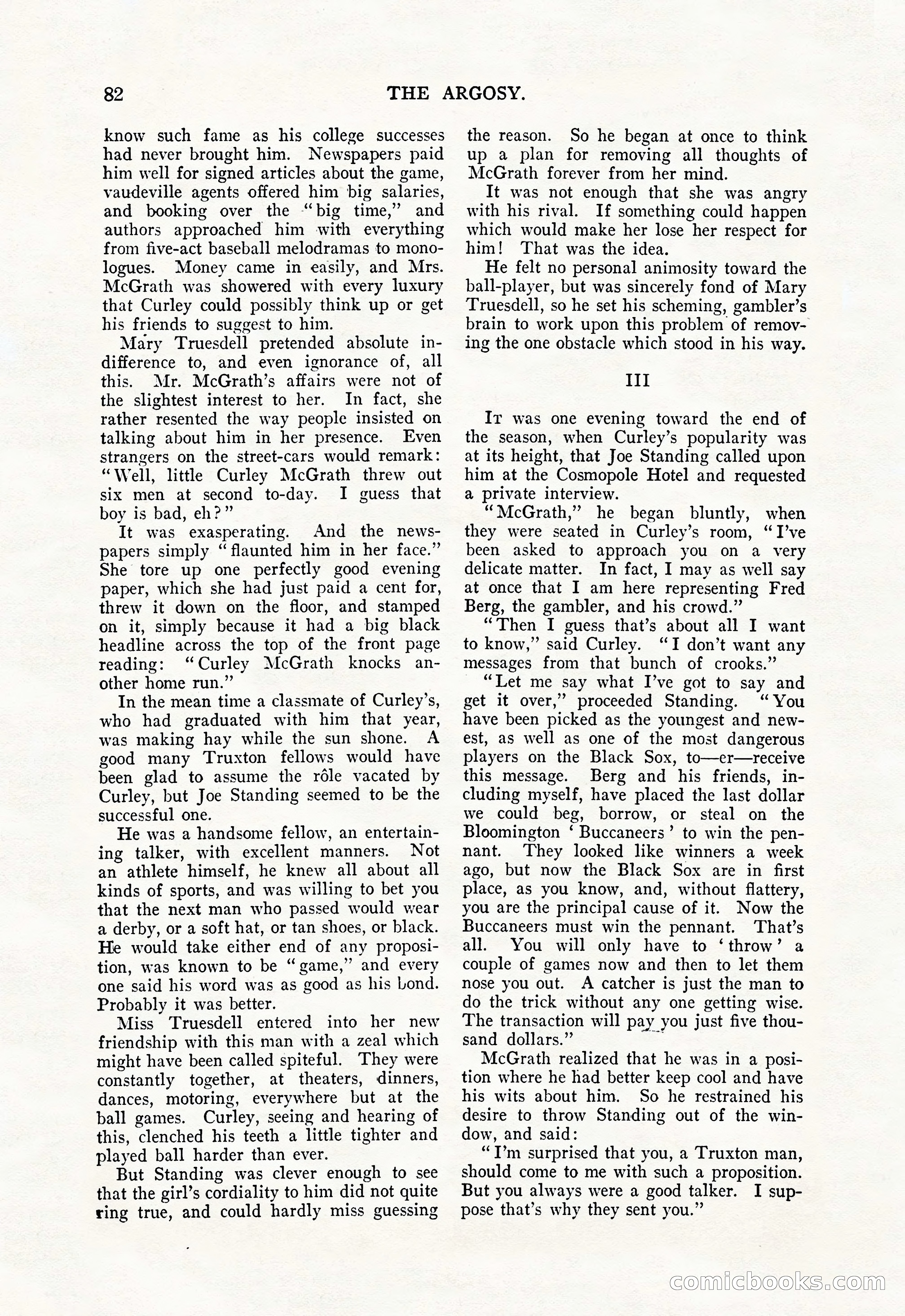
A restored page from Pulp Fiction, 1912. Page through the whole issue in the reader above.
📄 Transcribed text from this page (OCR, searchable)
Machine-transcribed from the original scan — historical spelling and the odd misread are preserved.
82 know such fame as his college successes had never brought him. Newspapers paid him well for signed articles about the game, vaudeville agents offered him big salaries, and booking over the “‘big time,’ and authors approached him with everything from five-act baseball melodramas to mono- logues. Money came in easily, and Mrs. McGrath was showered with every luxury that Curley could possibly think up or get his friends to suggest to him. Mary Truesdell pretended absolute in- difference to, and even ignorance of, all this. Mr. McGrath’s affairs were not of the slightest interest to her. In fact, she rather resented the way people insisted on talking about him in her presence. Even strangers on the street-cars would remark: “Well, little Curley McGrath threw out six men at second to-day. I guess that boy is bad, eh?” It was exasperating. And the news- papers simply “flaunted him in her face.” She tore up one perfectly good evening paper, which she had just paid a cent for, threw it down on the floor, and stamped on it, simply because it had a big black headline across the top of the front page reading: “Curley McGrath knocks an- other home run.” In the mean time a classmate of Curley’s, who had graduated with him that year, was making hay while the sun shone. A good many Truxton fellows would have been glad to assume the role vacated by Curley, but Joe Standing seemed to be the successful one. He was a handsome fellow, an entertain- ing talker, with excellent manners. Not an athlete himself, he knew all about all kinds of sports, and was willing to bet you that the next man who passed would wear a derby, or a soft hat, or tan shoes, or black. He would take either end of any proposi- tion, was known to be “game,” and every one said his word was as good as his Lond. Probably it was better. Miss Truesdell entered into her new friendship with this man with a zeal which might have been called spiteful. They were constantly together, at theaters, dinners, dances, motoring, everywhere but at the ball games. Curley, seeing and hearing of this, clenched his teeth a little tighter and played ball harder than ever. But Standing was clever enough to see that the girl’s cordiality to him did not quite cing true, and could hardly miss guessing THE ARGOSY. the reason. So he began at once to think up a plan for removing all thoughts of McGrath forever from her mind. It was not enough that she was angry with his rival. If something could happen which would make her lose her respect for him! That was the idea. He felt no personal animosity toward the ball-player, but was sincerely fond of Mary Truesdell, so he set his scheming, gambler’s brain to work upon this problem of remov- ing the one obstacle which stood in his way. Ill Ir was one evening toward the end of the season, when Curley’s popularity was at its height, that Joe Standing called upon him at the Cosmopole Hotel and requested a private interview. “McGrath,” he began bluntly, when they were seated in Curley’s room, “I’ve been asked to approach you on a very delicate matter. In fact, I may as well say at once that I am here representing Fred Berg, the gambler, and his crowd.” “Then I guess that’s about all I want to know,” said Curley. “I don’t want any messages from that bunch of crooks.” “Let me say what I’ve got to say and get it over,” proceeded Standing. “You have been picked as the youngest and new- est, as well as one of the most dangerous players on the Black Sox, to—er—receive this message. Berg and his friends, in- cluding myself, have placed the last dollar we could beg, borrow, or steal on the Bloomington ‘ Buccaneers’ to win the pen- nant. They looked like winners a week ago, but now the Black Sox are in first place, as you know, and, without flattery, you are the principal cause of it. Now the Buccaneers must win the pennant. ‘That’s all. You will only have to ‘throw’ a couple of games now and then to let them nose you out. A catcher is just the man to do the trick without any one getting wise. The transaction will pay you just five thou- sand dollars.” McGrath realized that he was in a posi- tion where he had better keep cool and have his wits about him. So he restrained his desire to throw Standing out of the win- dow, and said: “T’m surprised that you, a Truxton man, should come to me with such a proposition. But you always were a good talker. I sup- pose that’s why they sent you.” ComiclOoks.com