
Pulp Fiction, 1912 · page 94 of 238
The Argosy, April 1912 — page 94: what you’re looking at
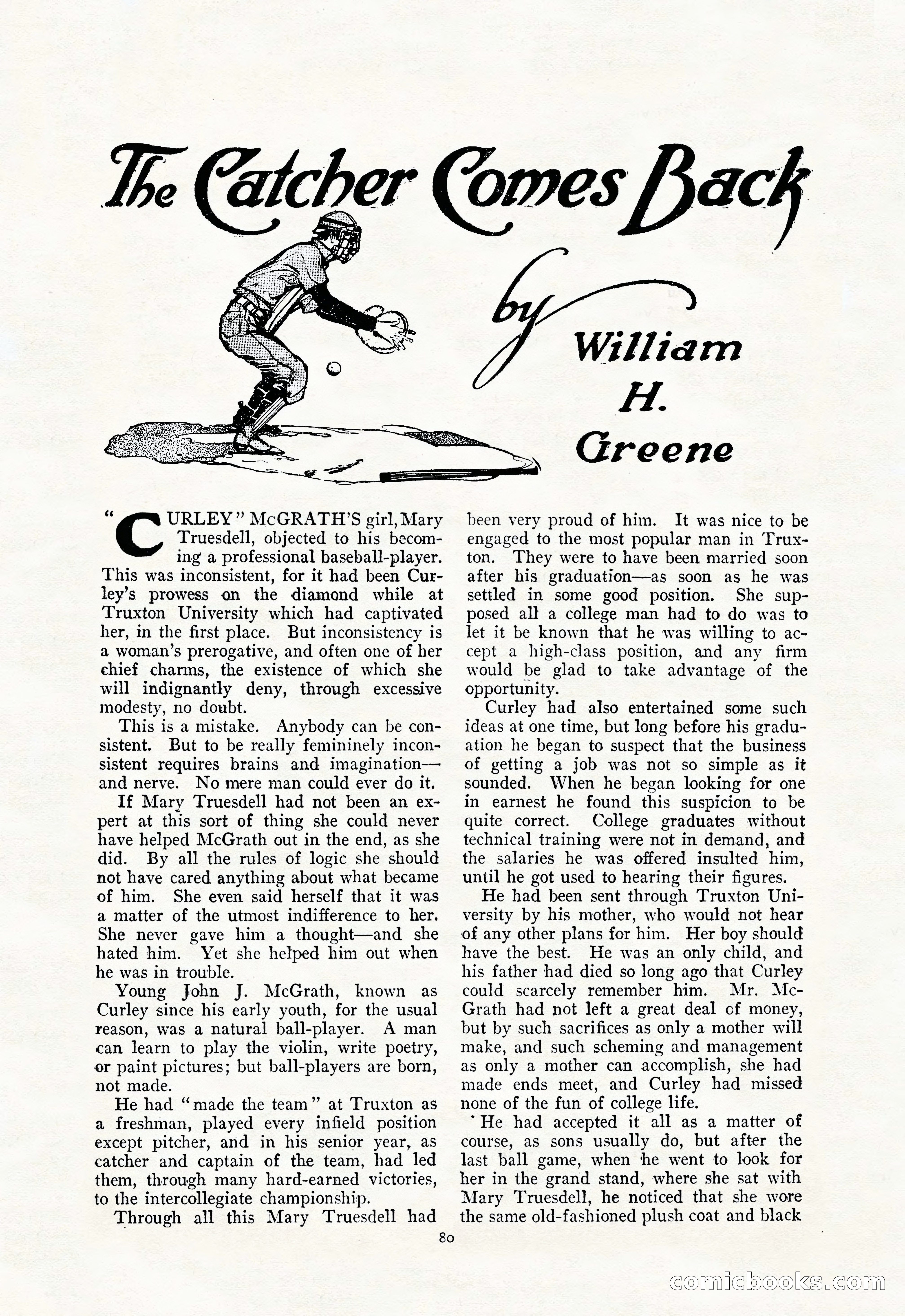
A restored page from Pulp Fiction, 1912. Page through the whole issue in the reader above.
📄 Transcribed text from this page (OCR, searchable)
Machine-transcribed from the original scan — historical spelling and the odd misread are preserved.
URLEY” McGRATH’S girl, Mary Truesdell, objected to his becom- ing a professional baseball-player. This was inconsistent, for it had been Cur- ley’s prowess on the diamond while at Truxton University which had captivated Cc her, in the first place. But inconsistency is a woman’s prerogative, and often one of her chief charms, the existence of which she will indignantly deny, through excessive modesty, no doubt. This is a mistake. Anybody can be con- sistent. But to be really femininely incon- sistent requires brains and imagination-— and nerve. No mere man could ever do it. If Mary Truesdell had not been an ex- pert at this sort of thing she could never have helped McGrath out in the end, as she did. By all the rules of logic she should not have cared anything about what became of him. She even said herself that it was a matter of the utmost indifference to her. She never gave him a thought—and she hated him. Yet she helped him out when he was in trouble. Young john J. McGrath, known as Curley since his early youth, for the usual reason, was a natural ball-player. A man can learn to play the violin, write poetry, or paint pictures; but ball-players are born, not made. He had “made the team” at Truxton as a freshman, played every infield position except pitcher, and in his senior year, as catcher and captain of the team, had led them, through many hard-earned victories, to the intercollegiate championship. Through all this Mary Truesdell had 80 William 7. . Greene been very proud of him. It was nice to be engaged to the most popular man in Trux- ton. They were to have been married soon after his graduation—as soon as he was settled in some good position. She sup- posed allt a college man had to do was to let it be known that he was willing to ac- cept a high-class position, and any firm would be glad to take advantage of the opportunity. Curley had also entertained some such ideas at one time, but long before his gradu- ation he began to suspect that the business of getting a job was not so simple as it sounded. When he began looking for one in earnest he found this suspicion to be quite correct. College graduates without technical training were not in demand, and the salaries he was offered insulted him, until he got used to hearing their figures. He had been sent through Truxton Uni- versity by his mother, who would not hear of any other plans for him. Her boy should have the best. He was an only child, and his father had died so long ago that Curley could scarcely remember him. Mr. Mc- Grath had not left a great deal cf money, but by such sacrifices as only a mother will make, and such scheming and management as only a mother can accomplish, she had made ends meet, and Curley had missed none of the fun of college life. “He had accepted it all as a matter of course, as sons usually do, but after the last ball game, when he went to look for her in the grand stand, where she sat with Mary Truesdell, he noticed that she wore the same old-fashioned plush coat and black COM Ghook