
Pulp Fiction, 1912 · page 93 of 238
The Argosy, April 1912 — page 93: what you’re looking at
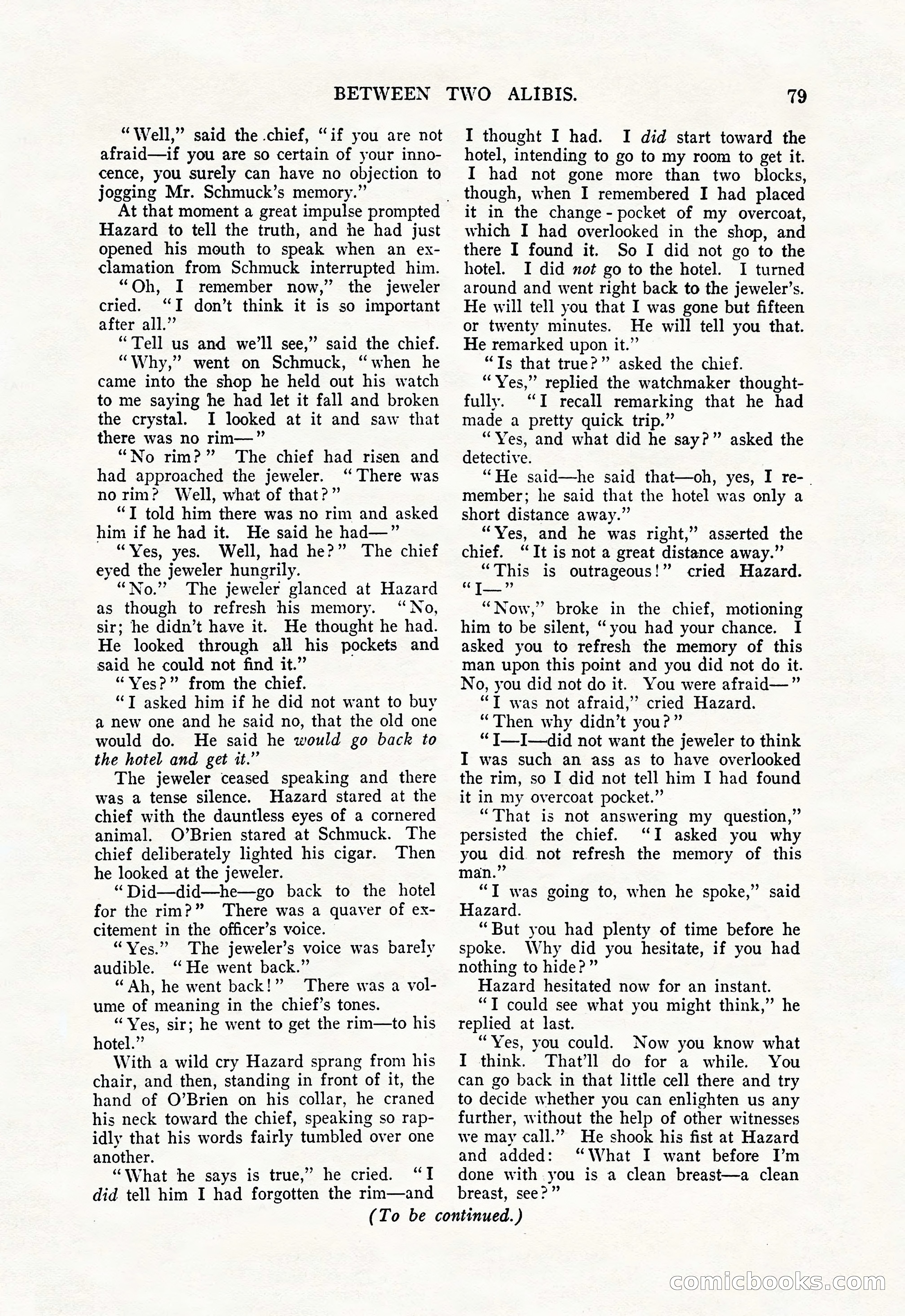
A restored page from Pulp Fiction, 1912. Page through the whole issue in the reader above.
📄 Transcribed text from this page (OCR, searchable)
Machine-transcribed from the original scan — historical spelling and the odd misread are preserved.
BETWEEN “Well,” said the .chief, “if you are not afraid—if you are so certain of your inno- cence, you surely can have no objection to jogging Mr. Schmuck’s memory.” At that moment a great impulse prompted | Hazard to tell the truth, and he had just opened his mouth to speak when an ex- clamation from Schmuck interrupted him. “Oh, I remember now,” the jeweler cried. “I don’t think it is so important after all.” “Tell us and we'll see,” said the chief. “Why,” went on Schmuck, “when he came into the shop he held out his watch to me saying he had let it fall and broken the crystal. I looked at it and saw that there was no rim—” “No rim?” The chief had risen and had approached the jeweler. “There was norim? Well, what of that?” “TI told him there was no rim and asked him if he had it. He said he had—” “Yes, yes. Well, had he?” The chief eyed the jeweler hungrily. “No.” The jeweler glanced at Hazard as though to refresh his memory. “No, sir; he didn’t have it. He thought he had. He looked through all his pockets and said he could not find it.” “Yes?” from the chief. “T asked him if he did not want to buy a new one and he said no, that the old one would do. He said he would go back to the hotel and get it.” The jeweler ceased speaking and there was a tense silence. Hazard stared at the chief with the dauntless eyes of a cornered animal. O’Brien stared at Schmuck. The chief deliberately lighted his cigar. Then he looked at the jeweler. “ Did—did—he—go back to the hotel for the rim?” There was a quaver of ex- citement in the officer’s voice. “Yes.” The jeweler’s voice was barely audible. “He went back.” “Ah, he went back!” There was a vol- ume of meaning in the chief’s tones. “Ves, sir; he went to get the rim—to his hotel.”’ With a wild cry Hazard sprang from his chair, and then, standing in front of it, the hand of O’Brien on his collar, he craned his neck toward the chief, speaking so rap- idly that his words fairly tumbled over one another. “What he says is true,” he cried. “I did tell him I had forgotten the rim—and TWO ALIBIS. 79 I thought I had. I did start toward the hotel, intending to go to my room to get it. I had not gone more than two blocks, though, when I remembered I had placed it in the change - pocket of my overcoat, which I had overlooked in the shop, and there I found it. So I did not go to the hotel. I did not go to the hotel. I turned around and went right back to the jeweler’s. He will tell you that I was gone but fifteen or twenty minutes. He will tell you that. He remarked upon it.”’ “Ts that true?” asked the chief. “Yes,” replied the watchmaker thought- fully. “I recall remarking that he had made a pretty quick trip.” “Yes, and what did he say?” asked the detective. “He said—he said that—oh, yes, I re- | member; he said that the hotel was only a short distance away.” “Yes, and he was right,” asserted the chief. “It is not a great distance away.” “This is outrageous!” cried Hazard. 6c ; 99 “Now,” broke in the chief, motioning him to be silent, “you had your chance. I asked you to refresh the memory of this man upon this point and you did not do it. No, you did not do it. You were afraid—” “T was not afraid,” cried Hazard. “Then why didn’t you?” “‘ [—I—did not want the jeweler to think I was such an ass as to have overlooked the rim, so I did not tell him I had found it in my overcoat pocket.” “That is not answering my question,” persisted the chief. “I asked you why you did not refresh the memory of this man.” “T was going to, when he spoke,” said Hazard. “But you had plenty of time before he spoke. Why did you hesitate, if you had nothing to hide?” Hazard hesitated now for an instant. “T could see what you might think,” he replied at last. “Yes, you could. Now you know what I think. That'll do for a while. You can go back in that little cell there and try to decide whether you can enlighten us any further, without the help of other witnesses we may call.” He shook his fist at Hazard and added: “What I want before I’m done with you is a clean breast—a clean breast, see?” (To be continued.) (C@ NOOK CO