
Pulp Fiction, 1912 · page 92 of 238
The Argosy, April 1912 — page 92: what you’re looking at
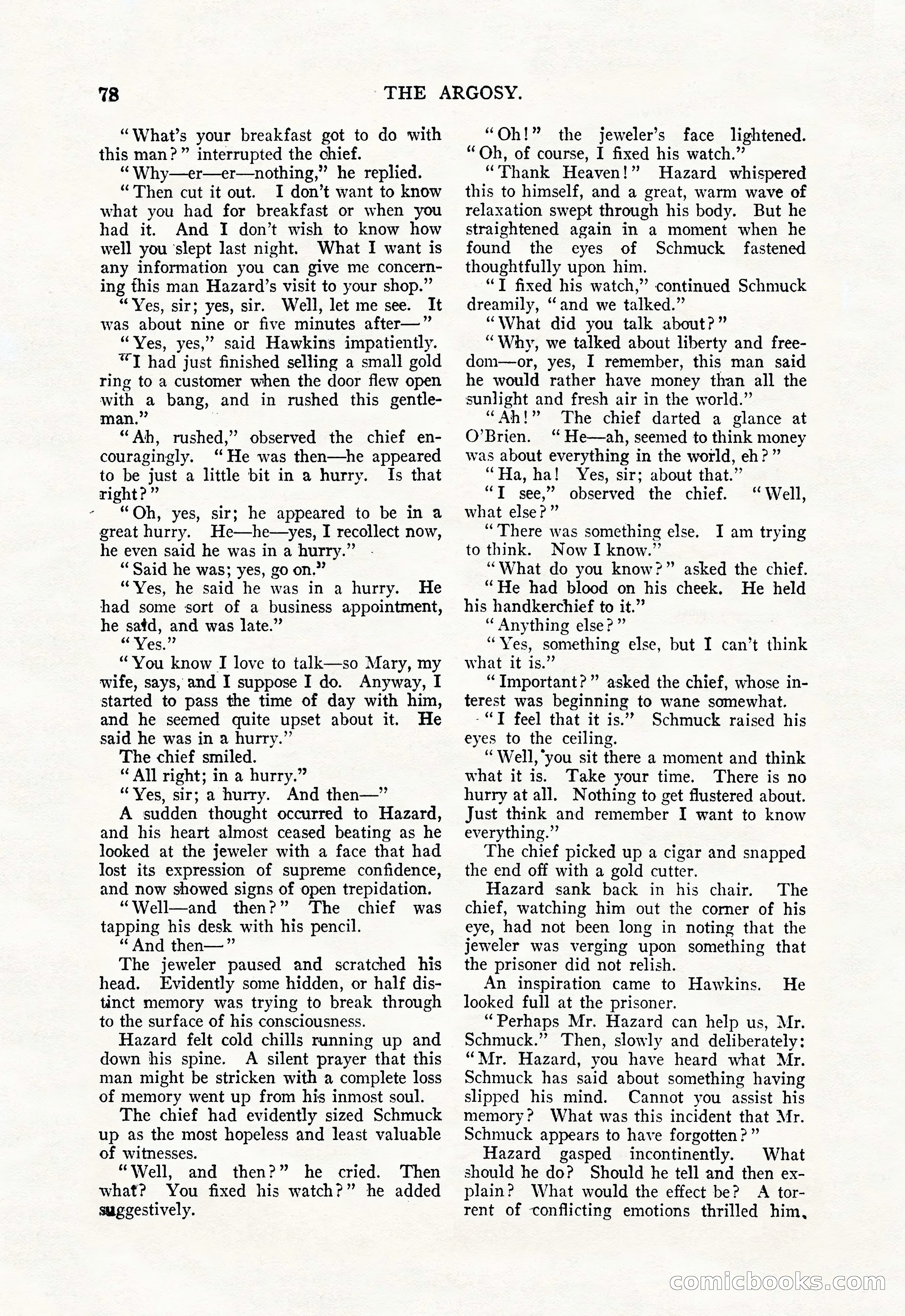
A restored page from Pulp Fiction, 1912. Page through the whole issue in the reader above.
📄 Transcribed text from this page (OCR, searchable)
Machine-transcribed from the original scan — historical spelling and the odd misread are preserved.
78 “What’s your breakfast got to do with this man?” interrupted the chief. “ Why—er—er—nothing,” he replied. “Then cut it out. I don’t want to know what you had for breakfast or when you had it. And I don’t wish to know how well you ‘slept last night. What I want is any information you can give me concern- ing this man Hazard’s visit to your shop.” “Yes, sir; yes, sir. Well, let me see. It was about nine or five minutes after—” “Yes, yes,” said Hawkins impatiently. “T had just finished selling a small gold ring to a customer when the door flew open with a bang, and in rushed this gentle- man.” : “Ah, rushed,” observed the chief en- couragingly. ‘He was then—he appeared to be just a little bit in a hurry. Is that right?” “Oh, yes, sir; he appeared to be in a great hurry. He—he—yes, I recollect now, he even said he was in a hurry.” “Said he was; yes, go on.” “Yes, he said he was in a hurry. He had some sort of a business appointment, he satd, and was late.” 66 Yes.” “You know I love to talk—so Mary, my wife, says, and I suppose I do. Anyway, I started to pass the time of day with him, and he seemed quite upset about it. He said he was in a hurry.” The chief smiled. “ All right; in a hurry.” “Yes, sir; a hurry. And then—” A sudden thought occurred to Hazard, and his heart almost ceased beating as he looked at the jeweler with a face that had lost its expression of supreme confidence, and now showed signs of open trepidation. “Well—and then?” The chief was tapping his desk with his pencil. “And then—” The jeweler paused and scratched his head. Evidently some hidden, or half dis- tinct memory was trying to break through to the surface of his consciousness. Hazard felt cold chills running up and down his spine. A silent prayer that this man might be stricken with a complete loss of memory went up from his inmost soul. The chief had evidently sized Schmuck up as the most hopeless and least valuable of witnesses. “Well, and then?” he cried. Then what? You fixed his watch?” he added suggestively. THE ARGOSY. “Oh!” the jeweler’s face lightened. “Oh, of course, I fixed his watch.” “Thank Heaven!” Hazard whispered this to himself, and a great, warm wave of relaxation swept through his body. But he straightened again in a moment when he found the eyes of Schmuck fastened thoughtfully upon him. “T fixed his watch,” continued Schmuck dreamily, “and we talked.” “What did you talk about?” “Why, we talked about liberty and free- dom—or, yes, I remember, this man said he would rather have money than all the sunlight and fresh air in the world.” “Ah!” The chief darted a glance at O’Brien. ‘“ He—ah, seemed to think money was about everything in the world, eh?” “Ha, ha! Yes, sir; about that.” “TI see,” observed the chief. what else?” “There was something else. to think. Now I know.” “What do you know?” asked the chief. “He had blood on his cheek. He held his handkerchief to it.” ‘Anything else?” “Yes, something else, but I can’t think what it is.” “Important?” asked the chief, whose in- terest was beginning to wane somewhat. -“T feel that it is.” Schmuck raised his eyes to the ceiling. ‘Well, you sit there a moment and think what it is. Take your time. There is no hurry at all. Nothing to get flustered about. Just think and remember I want to know everything.” The chief picked up a cigar and snapped the end off with a gold cutter. Hazard sank back in his chair. The chief, watching him out the corner of his eye, had not been long in noting that the jeweler was verging upon something that the prisoner did not relish. An inspiration came to Hawkins. looked full at the prisoner. “Perhaps Mr. Hazard can help us, Mr. Schmuck.” Then, slowly and deliberately: “Mr. Hazard, you have heard what Mr. Schmuck has said about something having slipped his mind. Cannot you assist his memory? What was this incident that Mr. Schmuck appears to have forgotten?” Hazard gasped incontinently. What should he do? Should he tell and then ex- plain? What would the effect be? A tor- rent of conflicting emotions thrilled him, “Well, IT am trying He comicoool. (CO