
Pulp Fiction, 1912 · page 88 of 238
The Argosy, April 1912 — page 88: what you’re looking at
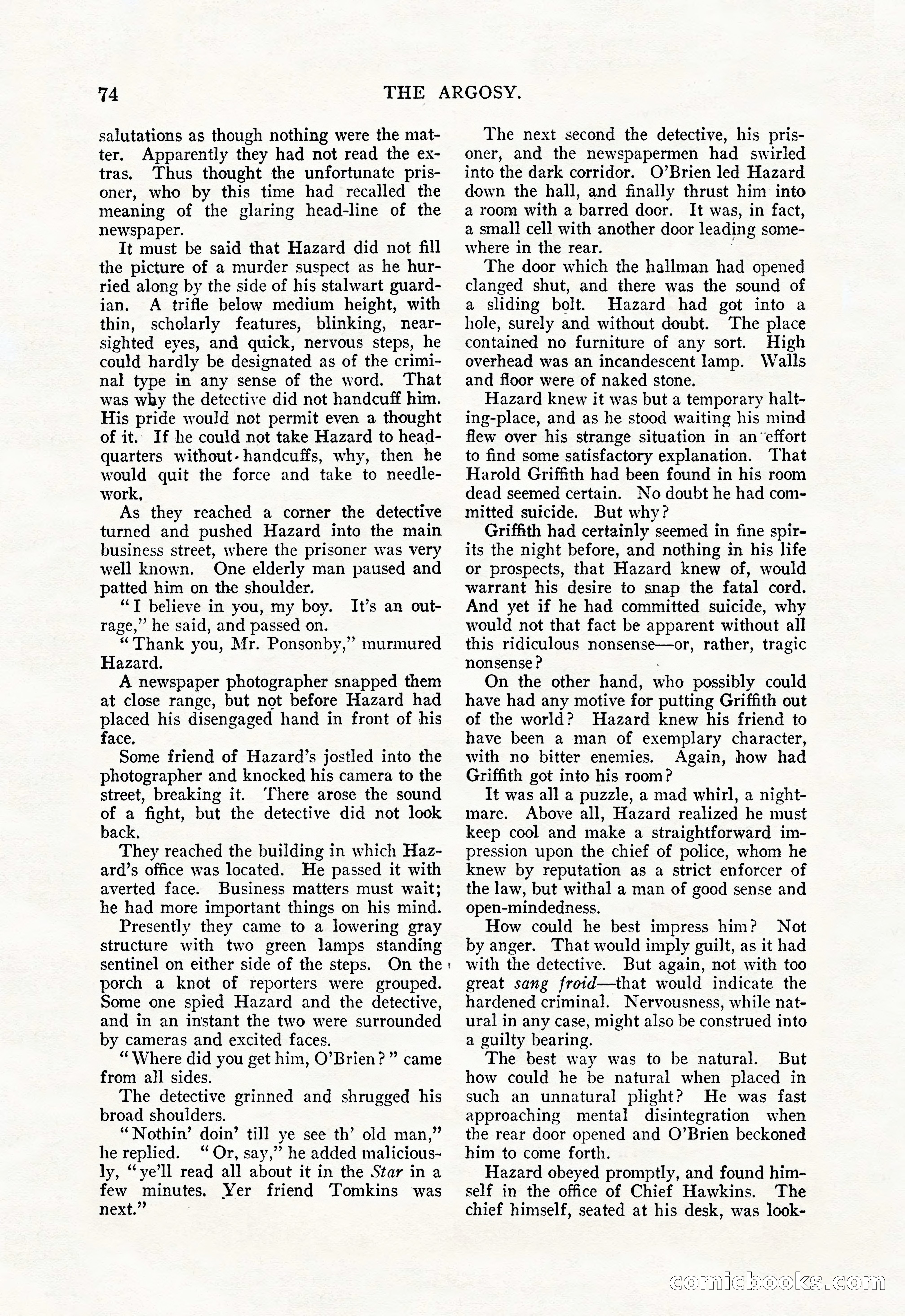
A restored page from Pulp Fiction, 1912. Page through the whole issue in the reader above.
📄 Transcribed text from this page (OCR, searchable)
Machine-transcribed from the original scan — historical spelling and the odd misread are preserved.
74 THE salutations as though nothing were the mat- ter. Apparently they had not read the ex- tras. Thus thought the unfortunate pris- oner, who by this time had recalled the meaning of the glaring head-line of the newspaper. It must be said that Hazard did not fill the picture of a murder suspect as he hur- ried along by the side of his stalwart guard- ian. A trifle below medium height, with thin, scholarly features, blinking, near- sighted eyes, and quick, nervous steps, he could hardly be designated as of the crimi- nal type in any sense of the word. That was why the detective did not handcuff him. His pride would not permit even a thought of it. If he could not take Hazard to head- quarters without- handcuffs, why, then he would quit the force and take to needle- work, As they reached a corner the detective turned and pushed Hazard into the main business street, where the prisoner was very well known. One elderly man paused and patted him on the shoulder. “T believe in you, my boy. It’s an out- rage,” he said, and passed on. “Thank you, Mr. Ponsonby,” murmured Hazard. A newspaper photographer snapped them at close range, but not before Hazard had placed his disengaged hand in front of his face. Some friend of Hazard’s jostled into the photographer and knocked his camera to the street, breaking it. ‘There arose the sound of a fight, but the detective did not look back, They reached the building in which Haz- ard’s office was located. He passed it with averted face. Business matters must wait; he had more important things on his mind. Presently they came to a lowering gray structure with two green lamps standing sentinel on either side of the steps. porch a knot of reporters were grouped. Some one spied Hazard and the detective, and in an instant the two were surrounded by cameras and excited faces. “Where did you get him, O’Brien?” came from all sides. The detective grinned and shrugged his broad shoulders. ‘Nothin’ doin’ till ye see th’ old man,” he replied. “Or, say,” he added malicious- ly, “ye’ll read all about it in the Star in a few minutes. Yer friend Tomkins ‘was next.” On the : ARGOSY. The next second the detective, his pris- oner, and the newspapermen had swirled into the dark corridor. O’Brien led Hazard down the hall, and finally thrust him into a room with a barred door. It was, in fact, a small cell with another door leading some- where in the rear. The door which the hallman had opened clanged shut, and there was the sound of a sliding bolt. Hazard had got into a hole, surely and without doubt. ‘The place contained no furniture of any sort. High overhead was an incandescent lamp. Walls and floor were of naked stone. Hazard knew it was but a temporary halt- ing-place, and as he stood waiting his mind flew over his strange situation in an effort to find some satisfactory explanation. That Harold Griffith had been found in his room dead seemed certain. No doubt he had com- mitted suicide. But why? Griffith had certainly seemed in fine spir- its the night before, and nothing in his life or prospects, that Hazard knew of, would warrant his desire to snap the fatal cord. And yet if he had committed suicide, why would not that fact be apparent without all this ridiculous nonsense—or, rather, tragic nonsense ? On the other hand, who possibly could have had any motive for putting Griffith out of the world? Hazard knew his friend to have been a man of exemplary character, with no bitter enemies. Again, how had Griffith got into his room? It was all a puzzle, a mad whirl, a night- mare. Above all, Hazard realized he must keep cool and make a straightforward im- pression upon the chief of police, whom he knew by reputation as a strict enforcer of the law, but withal a man of good sense and open-mindedness. How could he best impress him? Net by anger. That would imply guilt, as it had with the detective. But again, not with too great sang frotd—that would indicate the hardened criminal. Nervousness, while nat- ural in any case, might also be construed into a guilty bearing. The best way was to be natural. But how could he be natural when placed in such an unnatural plight? He was fast approaching mental disintegration when the rear door opened and O’Brien beckoned him to come forth. Hazard obeyed promptly, and found him- self in the office of Chief Hawkins. The chief himself, seated at his desk, was look- comicoool. CO