
Pulp Fiction, 1912 · page 89 of 238
The Argosy, April 1912 — page 89: what you’re looking at
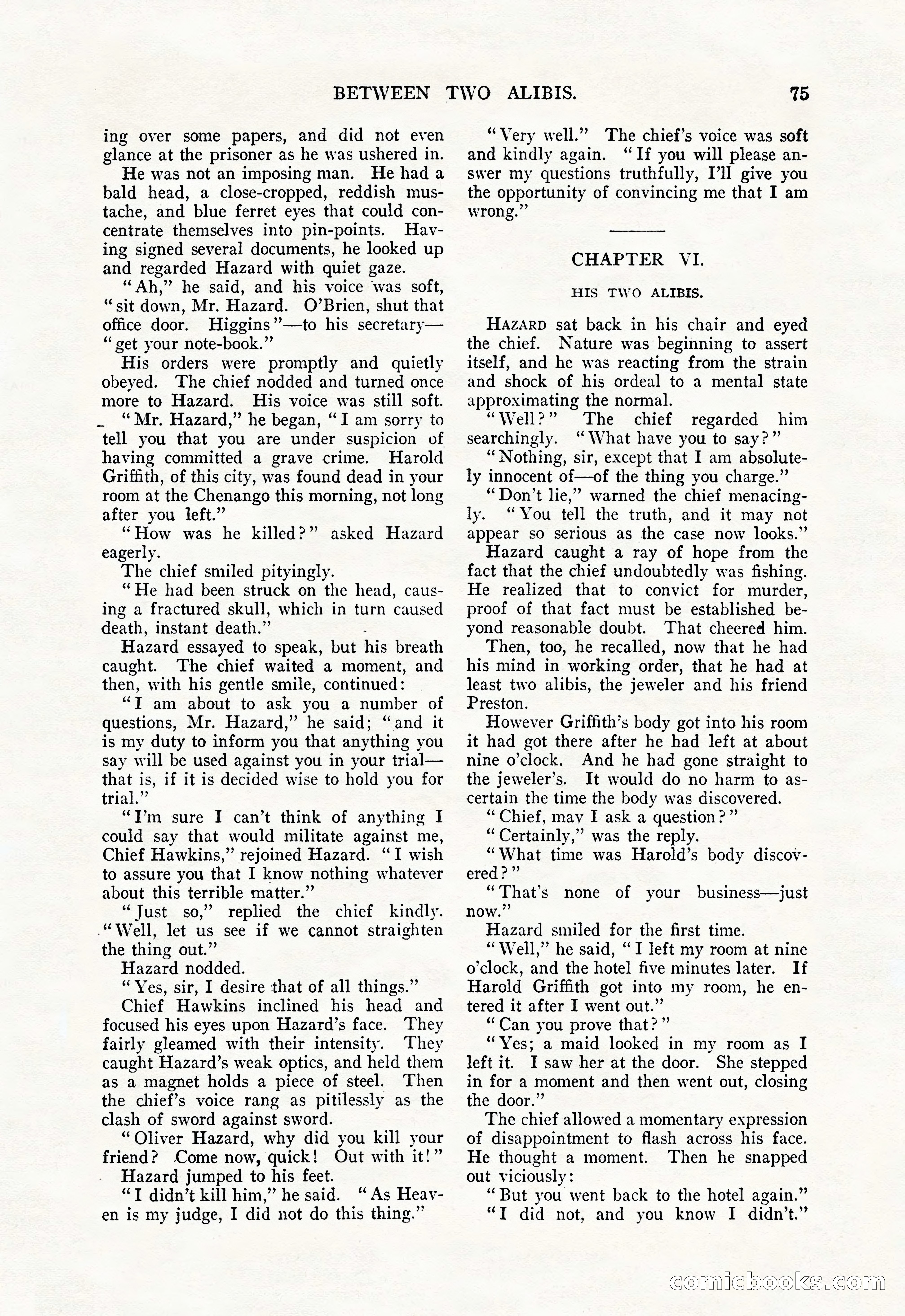
A restored page from Pulp Fiction, 1912. Page through the whole issue in the reader above.
📄 Transcribed text from this page (OCR, searchable)
Machine-transcribed from the original scan — historical spelling and the odd misread are preserved.
BETWEEN TWO ALIBIS. 15 ing over some papers, and did not even glance at the prisoner as he was ushered in. He was not an imposing man. He hada bald head, a close-cropped, reddish mus- tache, and blue ferret eyes that could con- centrate themselves into pin-points. Hav- ing signed several documents, he looked up and regarded Hazard with quiet gaze. “Ah,” he said, and his voice was soft, “sit down, Mr. Hazard. O’Brien, shut that office door. Higgins’—to his secretary— “get your note-book.” His orders were promptly and quietly obeyed. The chief nodded and turned once more to Hazard. His voice was still soft. “Mr. Hazard,” he began, “I am sorry to tell you that you are under suspicion of having committed a grave crime. Harold Griffith, of this city, was found dead in your room at the Chenango this morning, not long after you left.” “How was he killed?” asked Hazard eagerly. The chief smiled pityingly. “He had been struck on the head, caus- ing a fractured skull, which in turn caused death, instant death.” Hazard essayed to speak, but his breath caught. The chief waited a moment, and then, with his gentle smile, continued: “T am about to ask you a number of questions, Mr. Hazard,” he said; “and it is my duty to inform you that anything you say will be used against you in your trial— that is, if it is decided wise to hold you for trial.” “I’m sure I can’t think of anything I could say that would militate against me, Chief Hawkins,” rejoined Hazard. “I wish to assure you that I know nothing whatever about this terrible matter.”’ “Just so,” replied the chief kindly. .“Well, let us see if we cannot straighten the thing out.” Hazard nodded. “Yes, sir, I desire that of all things.” Chief Hawkins inclined his head and focused his eyes upon Hazard’s face. They fairly gleamed with their intensity. They caught Hazard’s weak optics, and held them as a magnet holds a piece of steel. Then the chief’s voice rang as pitilessly as the clash of sword against sword. “Oliver Hazard, why did you kill your friend? Come now, quick! Out with it!” Hazard jumped to his feet. “T didn’t kill him,” he said. ‘As Heav- en is my judge, I did not do this thing.” “Very well.” The chief’s voice was soft and kindly again. “If you will please an- swer my questions truthfully, Vl give you the opportunity of convincing me that I am wrong.” CHAPTER VI. HIS TWO ALIBIS. HAzarp sat back in his chair and eyed the chief. Nature was beginning to assert itself, and he was reacting from the strain and shock of his ordeal to a mental state approximating the normal. “Well?” The chief regarded him searchingly. ‘What have you to say?” “Nothing, sir, except that I am absolute- ly innocent of—of the thing you charge.” “Don’t lie,” warned the chief menacing- ly. “You tell the truth, and it may not appear so serious as the case now looks.” Hazard caught a ray of hope from the fact that the chief undoubtedly was fishing. He realized that to convict for murder, proof of that fact must be established be- yond reasonable doubt. That cheered him. Then, too, he recalled, now that he had his mind in working order, that he had at least two alibis, the jeweler and his friend Preston. However Griffith’s body got into his room it had got there after he had left at about nine o'clock. And he had gone straight to the jeweler’s. It would do no harm to as- certain the time the body was discovered. “Chief, may I ask a question?” “Certainly,”’ was the reply. “What time was Harold’s body discov- ered?” “That’s none of your business—just now.” Hazard smiled for the first time. “Well,” he said, “I left my room at nine o’clock, and the hotel five minutes later. If Harold Griffith got into my room, he en- tered it after I went out.” “Can you prove that?” “Yes; a maid looked in my room as I left it. I saw her at the door. She stepped in for a moment and then went out, closing the door.” The chief allowed a momentary expression of disappointment to flash across his face. He thought a moment. Then he snapped out viciously: “But you went back to the hotel again.” “TIT did not, and you know I didn’t.” comicaoolkks CO