
Pulp Fiction, 1912 · page 87 of 238
The Argosy, April 1912 — page 87: what you’re looking at
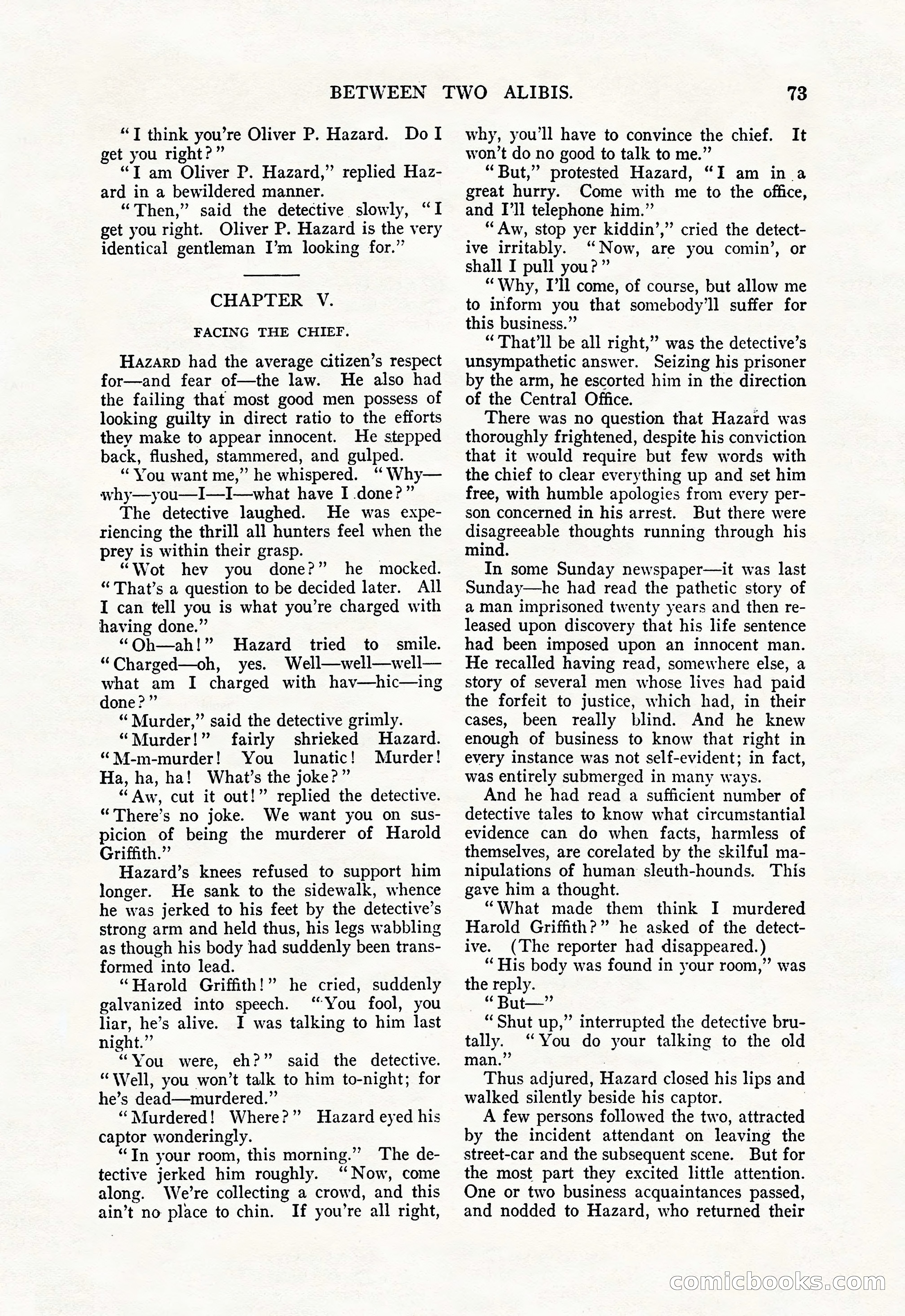
A restored page from Pulp Fiction, 1912. Page through the whole issue in the reader above.
📄 Transcribed text from this page (OCR, searchable)
Machine-transcribed from the original scan — historical spelling and the odd misread are preserved.
BETWEEN TWO ALIBIS. “T think you’re Oliver P. Hazard. Do I get you right?” “T am Oliver P. Hazard,” replied Haz- ard in a bewildered manner. “Then,” said the detective slowly, “I get youright. Oliver P. Hazard is the very identical gentleman I’m looking for.” CHAPTER V. FACING THE CHIEF. Hazarp had the average citizen’s respect for—and fear of—the law. He also had the failing that most good men possess of looking guilty in direct ratio to the efforts they make to appear innocent. He stepped back, flushed, stammered, and gulped. “You want me,” he whispered. “ Why— why—you—I—I—what have I done?” The detective laughed. He was expe- riencing the thrill all hunters feel when the prey is within their grasp. | “Wot hev you done?” he mocked. “That’s a question to be decided later. All I can tell you is what you’re charged with having done.”’ “Oh—ah!” Hazard tried to smile. “Charged—oh, yes. Well—well—well— what am I charged with hav—hic—ing done?” “ Murder,” said the detective grimly. “Murder!” fairly shrieked Hazard. “M-m-murder! You lunatic! Murder! Ha, ha, ha! What’s the joke?” “ Aw, cut it out!” replied the detective. “ There’s no joke. We want you on sus- picion of being the murderer of Harold Griffith.” Hazard’s knees refused to support him longer. He sank to the sidewalk, whence he was jerked to his feet by the detective’s strong arm and held thus, his legs wabbling as though his body had suddenly been trans- formed into lead. “Harold Griffith!” he cried, suddenly galvanized into speech. ‘You fool, you liar, he’s alive. I was talking to him last night.” “Vou were, eh?” said the detective. “Well, you won’t talk to him to-night; for he’s dead—murdered.” “Murdered! Where?” Hazard eyed his captor wonderingly. “Tn your room, this morning.” The de- tective jerked him roughly. “Now, come along. We’re collecting a crowd, and this ain’t no place to chin. If you’re all right, 73 why, you'll have to convince the chief. It won’t do no good to talk to me.”’ “But,” protested Hazard, “I am in a great hurry. Come with me to the office, and I’ll telephone him.” “Aw, stop yer kiddin’,” cried the detect- ive irritably. “Now, are you comin’, or shall I pull you?” “Why, I'll come, of course, but allow me to inform you that somebody’ll suffer for this business.” “That’ll be all right,” was the detective’s unsympathetic answer. Seizing his prisoner by the arm, he escorted him in the direction of the Central Office. There was no question that Hazard was thoroughly frightened, despite his conviction that it would require but few words with the chief to clear everything up and set him free, with humble apologies from every per- son concerned in his arrest. But there were disagreeable thoughts running through his mind. In some Sunday newspaper—it was last Sunday—he had read the pathetic story of a man imprisoned twenty years and then re- leased upon discovery that his life sentence had been imposed upon an innocent man. He recalled having read, somewhere else, a story of several men whose lives had paid the forfeit to justice, which had, in their cases, been really blind. And he knew enough of business to know that right in every instance was not self-evident; in fact, was entirely submerged in many ways. And he had read a sufficient number of detective tales to know what circumstantial evidence can do when facts, harmless of themselves, are corelated by the skilful ma- nipulations of human sleuth-hounds. This gave him a thought. “What made them think I murdered Harold Griffith?” he asked of the detect- ive. (The reporter had disappeared.) “His body was found in your room,” was the reply. 6s But “Shut up,” interrupted the detective bru- tally. “You do your talking to the old man.” , 3 Thus adjured, Hazard closed his lips and walked silently beside his captor. : A few persons followed the two, attracted by the incident attendant on leaving the street-car and the subsequent scene. But for the most part they excited little attention. One or two business acquaintances passed, and nodded to Hazard, who returned their cComicoool. CO